
Reviewed · WALKING TOURS
Rotterdam: 2-Hour Guided Walking Tour
Rotterdam tells its story through buildings. The city’s World War II bombing cleared much of the old center, and what followed was a bold experiment in modern design. In two hours, you’ll move from Central Station to the Cube Houses, Markthal, Coolsingel, and other landmarks while your guide explains why Rotterdam looks so different from Amsterdam.
I like the clear city overview and the chance to connect famous sights with everyday life at the Markthal. I also like the personal touch from guides such as Susan, Edwin, Michel, and John, who have explained local art, food, culture, and history in a conversational way. The main drawback is time: two hours gives you a useful introduction, but not a full tour of Rotterdam.
Key points to know before you book
- The route begins at Rotterdam Central Station, an easy place to start learning how the modern city fits together.
- The Cube Houses and Markthal are the major visual highlights, with stops that show Rotterdam’s playful approach to design.
- World War II shapes the entire tour, since the bombing helps explain the city’s wide mix of postwar architecture.
- You can ask questions as you walk, making the experience more flexible than a simple sightseeing circuit.
- Guides lead tours in English, Dutch, or German, and private groups are available.
- The $25 price is fair for a focused introduction, but you may want a longer tour if you prefer extended historical detail.
Why Rotterdam makes such a good walking-tour city
Rotterdam is not a city you understand from a quick postcard view. Its famous buildings can look like isolated design projects until you learn how war, trade, rebuilding, and modern planning shaped the center.
This walk gives you that framework. You begin at the new Central Station, then move through streets where old civic buildings sit near daring new structures. The route helps you read the city rather than simply photograph it.
I find that especially useful in Rotterdam because the city’s architecture is part of its history. The modern buildings are not just decoration. They reflect the decision to rebuild in a new style after the wartime destruction.
The tour is also built for questions. You can ask about a building, a street, local food, the harbor, or daily life, then get an answer while the group keeps moving. That personal exchange is one reason the guides have made such a strong impression. Susan has been praised for bringing the city’s buildings, culture, food, and past to life, while Edwin has handled detailed questions and pointed out things you could easily miss alone.
More Walking Tours in Rotterdam
- Rotterdam Walk: Hilights, Gems, Architecture & WWII | 2 or 3hrs
★ 5.0 · 149 reviews - Rotterdam: Highlights & Gems Walking Tour with Dutch Local
★ 5.0 · 133 reviews - Rotterdam 2-Hour Walking Tour | Discover The City With A Local
★ 4.5 · 111 reviews
Starting at Central Station and reading the new Rotterdam
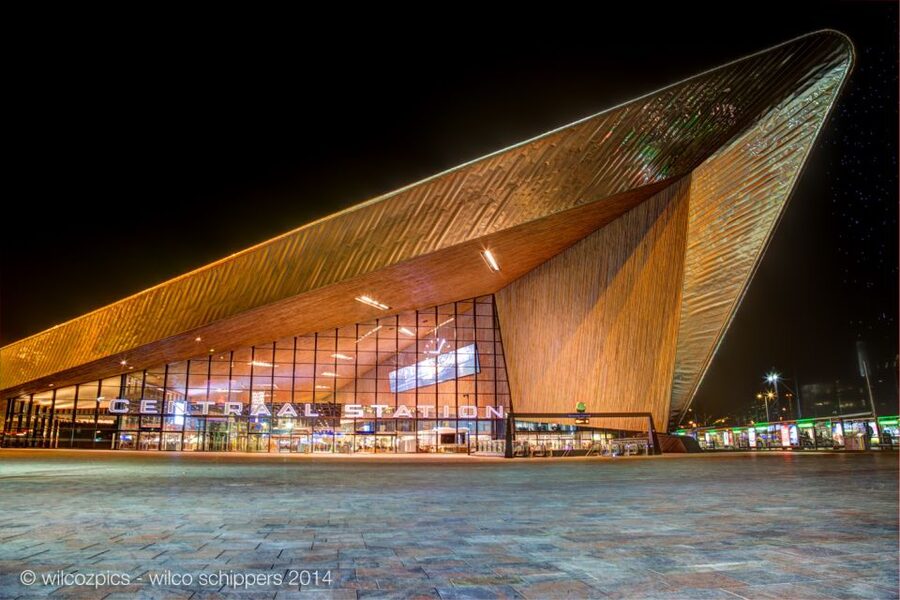
Rotterdam Central Station is a fitting starting point. It is one of the city’s most recognizable modern buildings, and its busy setting quickly shows you that this is a working Dutch city, not an open-air museum.
From here, your guide introduces the city’s layout and leads you toward important civic and historic sites. The opening section helps you understand the contrast that defines central Rotterdam: broad modern streets, practical city life, and older buildings that survived or were rebuilt after the war.
The guide also explains the harbor’s role in Rotterdam’s growth. The harbor is central to the city’s identity, even when you are walking inland among shops and offices. That context matters because Rotterdam’s wealth and outward-looking character are tied to trade, shipping, and industry.
You should expect a walking tour rather than a building-entry tour. The value comes from the explanations, street views, and connections between stops. Food and drinks are not included, so plan to buy anything you want during or after the walk.
Town Hall, St. Lawrence Church, and Rotterdam’s older face
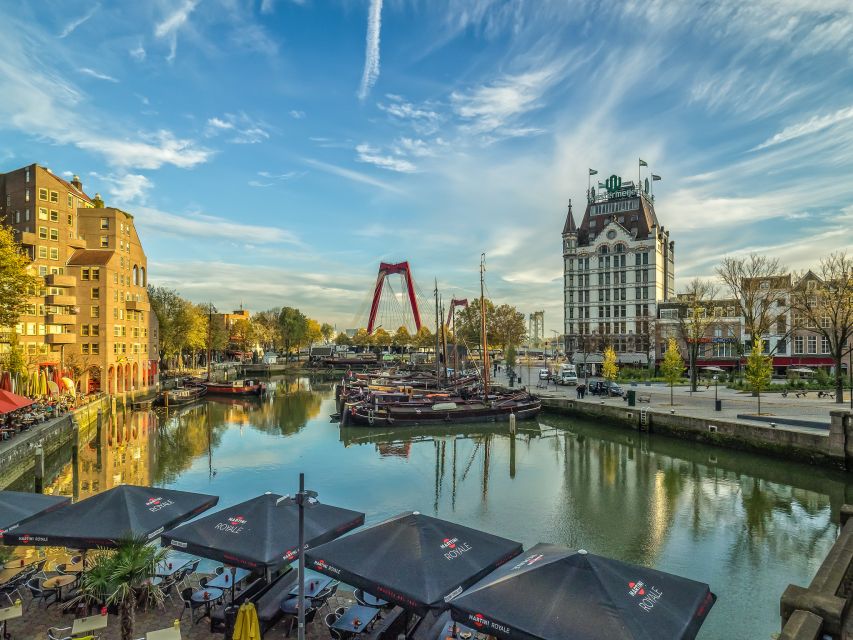
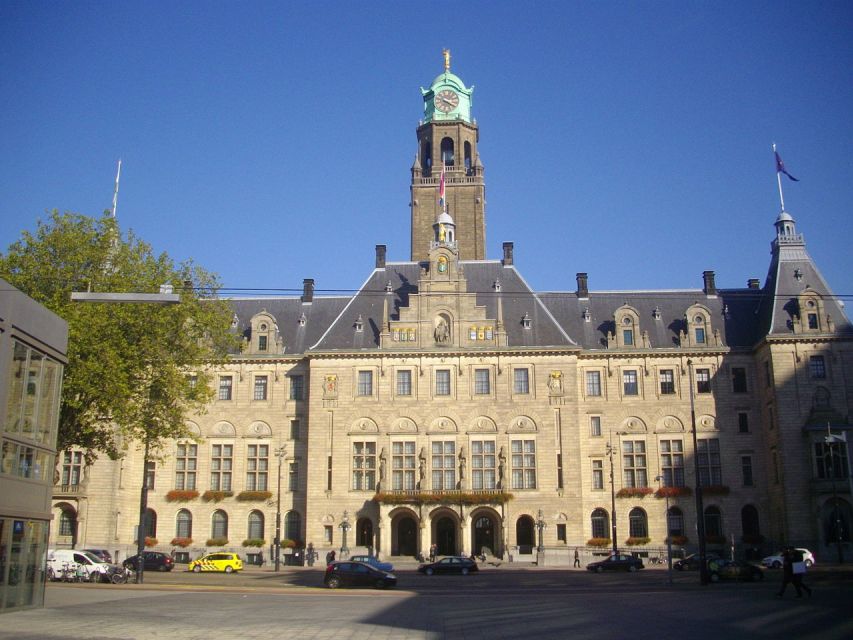
The route includes Rotterdam’s Town Hall and St. Lawrence Church, two stops that give you a sense of the city before its modern rebuilding.
The Town Hall brings the civic side of Rotterdam into view. Your guide discusses its role in the city and uses it to explain how Rotterdam functioned before the dramatic postwar changes.
St. Lawrence Church, also known as the Laurenskerk, offers an important contrast to the newer architecture around it. Its presence helps you see that Rotterdam did not lose every trace of its past. The church is one of the key historic reminders within a city often associated almost entirely with modern design.
You will also hear about Europe’s first high-rise building. This is a useful detail because Rotterdam’s interest in height and new construction did not begin only after World War II. The city already had a strong connection with ambitious architecture and commercial development.
These early stops prevent the tour from becoming a parade of unusual buildings. You get a basic timeline first, which makes the later structures easier to understand.
The wartime bombing and the reason Rotterdam looks new
The World War II bombing is the central historical explanation for Rotterdam’s appearance. Your guide describes what happened and how the destruction changed the city’s future.
That story gives meaning to the wide streets and modern blocks. Instead of asking why Rotterdam has so few old center streets compared with other Dutch cities, you learn why rebuilding took such a different path.
The tour does not treat the bombing as a detached history lesson. It connects the event to the buildings around you and to the choices made during reconstruction. Rotterdam could have tried to recreate the past, but much of the city chose a more forward-looking direction.
I consider this one of the most valuable parts of the walk. Without it, the Cube Houses and Markthal are simply striking objects. With it, they become evidence of a city that used rebuilding as a chance to try new ideas.
The exact amount of historical detail depends on your guide and the questions you ask. The two-hour format gives enough time for a solid explanation, but anyone wanting a longer account of the war, reconstruction, and harbor should consider a longer tour.
A few more days out around Rotterdam worth weighing up
- Rotterdam: Harbor Sightseeing Cruise
★ 4.3 · 7,599 reviews - Rotterdam: 1-Hour Sightseeing Splash Tour
★ 4.5 · 3,299 reviews - Rotterdam: Rotterdam Zoo Blijdorp Entry Ticket
★ 4.6 · 2,754 reviews - Rotterdam: Euromast Lookout Tower Ticket
★ 4.4 · 2,549 reviews
Timmerhuis and Rotterdam’s modern architectural language
The Timmerhuis is one of the notable modern buildings along the route. It was designed by OMA, the world-famous architecture firm, and it shows the city’s continued interest in unusual forms and new ways of using urban space.
Your guide uses buildings such as the Timmerhuis to explain how modern Rotterdam works. Rather than just pointing out its shape, the guide can place it within the larger story of offices, public space, commerce, and the city’s rebuilding tradition.
This is where a local guide adds real value. From ground level, you may notice a building’s shape but miss the reason it was designed that way. A guide can point out details, explain the architects, and show how the building relates to nearby streets.
The stop is also a good example of the tour’s balance. You see major architecture, but you do not spend the entire walk in a silent design lecture. The route keeps moving through shopping streets and ordinary city areas, so Rotterdam’s daily rhythm remains part of the experience.
Markthal: architecture with daily life inside
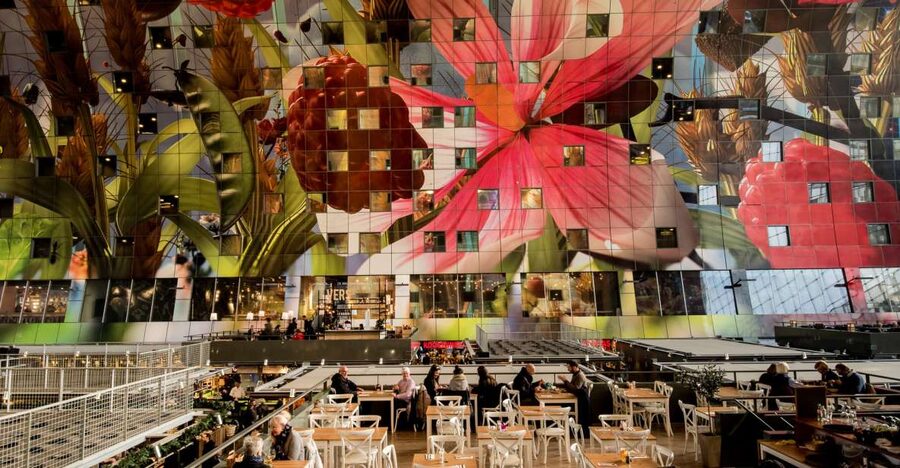
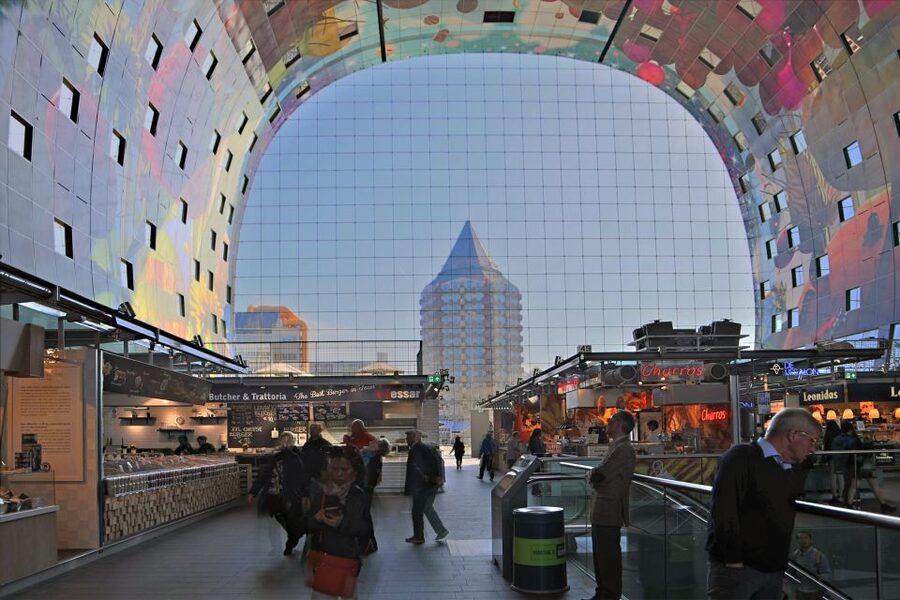
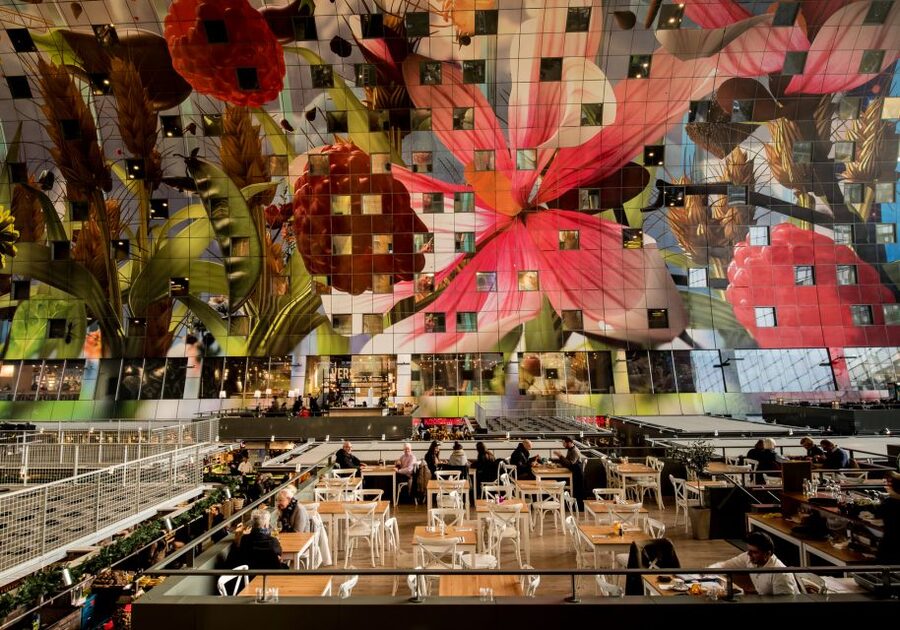
The Markthal is one of the tour’s central stops and one of Rotterdam’s most impressive indoor spaces. It is both a striking piece of architecture and a working covered market.
That combination is important. You are not only looking at a landmark from the outside. You can see people using the building for food shopping and eating, which gives the stop a stronger connection to local life.
Your guide explains the Markthal while you take in its large interior and distinctive design. The market is a useful place to pause because it brings together architecture, food, business, and ordinary routines in one setting.
Food and drinks are not part of the $25 tour price, so you can decide for yourself if you want to buy something here. Two hours is not designed as a food tour, and you should not expect a long tasting session. Still, the Markthal may be the most natural place on the route to continue exploring after the guided walk ends.
I like this stop because it keeps the tour from feeling too formal. Rotterdam’s architecture can sometimes seem intellectual or remote. Inside the Markthal, the building has a clear everyday purpose.
The Cube Houses and Rotterdam’s playful side
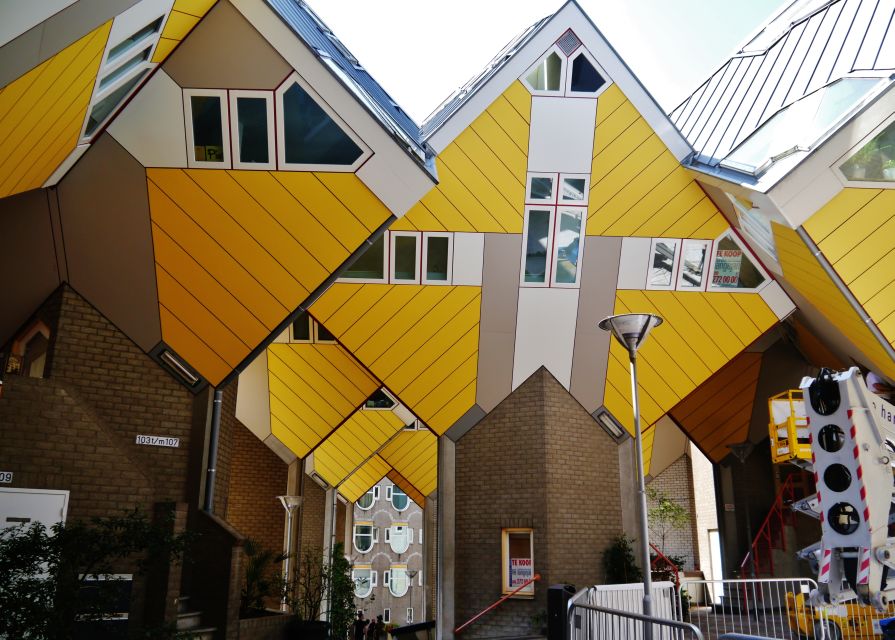
The Cube Houses are the tour’s most instantly recognizable design stop. Their tilted forms are a sharp break from conventional homes, and they capture Rotterdam’s willingness to test unusual ideas in public view.
Your guide explains the concept and points out details that are easy to miss when you are taking photographs. The houses are not simply strange shapes. They raise practical questions about how people live in unusual spaces and how architecture can change the feel of an entire neighborhood.
The stop is especially good for a short tour because it gives you a clear visual memory of Rotterdam. You will likely remember the angled homes long after you have forgotten the names of less distinctive office buildings.
There is a practical limitation. The tour takes you to see the Cube Houses, but the included experience is a guided walk, not a promise of interior visits. If you want to explore inside a particular building, check the booking details for your chosen option rather than assuming entry is included.
The Cube Houses also work well beside the Markthal. One is focused on unconventional residential design, while the other combines a large public structure with food and commerce. Together, they show two sides of Rotterdam’s modern character.
Coolsingel, shopping streets, and ordinary city life
The route continues through Coolsingel and attractive shopping streets. This part of the walk shows you Rotterdam as a place where people work, shop, commute, and meet, rather than as a collection of famous buildings.
That matters because a city tour can become too focused on monuments. Here, the streets between the landmarks help you understand the modern Rotterdam lifestyle. You see how the architecture fits into daily movement and commercial life.
Coolsingel also adds a broad urban scale to the tour. After the more concentrated stops at the church, market, and Cube Houses, the shopping streets give you a sense of how the city center operates.
You may find this section less dramatic than the Markthal or Cube Houses, especially if you are looking only for landmark photographs. I think it earns its place because it gives the tour a more honest sense of the city. Rotterdam is not just an architecture showcase. It is a busy urban center with a practical, modern personality.
Erasmus Bridge and the wider city picture
The tour includes the Erasmus Bridge among its modern Rotterdam sights. The bridge is closely tied to the city’s image and its connection between different parts of Rotterdam.
Depending on the precise route and timing of your option, the amount of time spent at each sight may vary. The supplied details describe the bridge as part of the sightseeing program, but they do not promise a long crossing or an extended visit on the bridge itself.
Even a brief look helps place the city in a wider setting. Rotterdam’s architecture is not limited to the historic core. The bridge points toward the harbor and the larger city beyond the central streets.
This is another moment when your guide’s explanation matters. A photograph gives you the shape of the bridge. A local guide can connect it with Rotterdam’s development, architecture, and relationship with the water.
What the guides add to the walk
The experience depends heavily on the person leading it. Guides have included Susan, Edwin, Michel, and John, and the strongest feedback centers on clear explanations, personal stories, and an easy willingness to answer questions.
Edwin has explained Rotterdam and the Netherlands, art, and history, while also drawing attention to small details along the route. Michel has used personal stories about his connection with Rotterdam to make the walk more engaging. John has been praised for shaping the route around the sights the group wanted to see.
That does not mean every guide delivers the tour in exactly the same way. It does mean you should take advantage of the conversational format. Ask about the harbor, the bombing, local food, architecture, or any building you notice. The tour becomes more useful when you treat it as a conversation rather than a fixed speech.
Tours are offered in English, Dutch, and German. A private group option is available, which may suit you if you want a more personal pace or have a particular interest in architecture and history. One private booking ended up with only two people, creating a very individual experience, though group size can vary by departure.
Is $25 a fair price for two hours?
At $25 per person, this tour offers solid value if you want a guided introduction to central Rotterdam. You are paying for two hours with a local guide, not for meals, transport, or attraction admission.
The price makes sense for a first afternoon in the city. You can see several major sights, learn the basic historical story, and finish with a better idea of where to return on your own.
The value is strongest if you ask questions and use the tour to plan the rest of your visit. The guide can help you decide which buildings, shopping streets, market areas, or harbor-related sights deserve more of your time.
The limitation is depth. A two-hour walk cannot cover every part of Rotterdam or give a long treatment of its war history, architecture, food, and harbor. One German-language assessment described the shorter route as a good fit for an overview while suggesting a longer tour for more information.
That is fair advice. Choose this tour for orientation and context. Choose a longer option if you already know Rotterdam’s main sights and want a more detailed study.
Practical details for a smooth walk
The meeting point may vary depending on the option you book, so check your confirmation carefully. The standard description begins at Rotterdam Central Station, but the stated meeting point is not guaranteed to be identical for every departure.
The tour lasts two hours, and starting times depend on availability. Wear comfortable shoes and allow enough time to arrive at the meeting point. The experience is a walking tour through streets, shopping areas, and public spaces, so you should be ready to keep moving.
You can cancel up to 24 hours before the activity for a full refund. A reserve-now, pay-later option is also available, which helps if you are still adjusting your Rotterdam plans.
Food and drinks are not included. That is easy to manage because the route includes the Markthal, and Rotterdam has plenty of places to eat after the walk, though the tour itself is focused on sightseeing and explanation.
Who should book this Rotterdam walking tour?
I would recommend it to first-time visitors who want a fast, sensible introduction to the city. It is also a good choice if you are arriving by train and want to begin sightseeing near Central Station.
Architecture fans should enjoy the route, especially the combination of the Timmerhuis, Markthal, Cube Houses, and Erasmus Bridge. History-minded visitors will value the explanation of the bombing and postwar rebuilding.
The tour also suits you if you prefer local conversation to a recorded audio guide. The guides have answered questions about culture, food, art, and daily life, giving the walk a personal edge.
Families and mixed-interest groups may like the variety. There are historic buildings, strange houses, a market, shopping streets, and large modern structures, so the experience does not depend on one narrow subject.
You may want something else if you dislike walking, need extensive time inside attractions, or want a long historical lecture. You should also choose a longer tour if two hours feels too short for the amount of detail you want.
Should you book it?
Book this tour if you want Rotterdam to make sense quickly. For $25, you get a useful route through the center, a local guide, strong architectural highlights, and the wartime context needed to understand the city’s unusual appearance.
I especially like it as an opening activity. Afterward, you can return to the Markthal, spend more time around the Cube Houses, explore shopping streets, or seek out other parts of the harbor with a clearer sense of place.
Skip it only if you already know central Rotterdam well or want a longer, more specialized experience. For most first visits, two hours is a practical introduction, and the chance to ask a guide direct questions adds value that a guidebook alone cannot provide.
FAQ
How long does the Rotterdam walking tour last?
The tour lasts two hours.
What sights are included on the route?
The route includes Rotterdam Central Station, the Town Hall, St. Lawrence Church, Europe’s first high-rise building, Timmerhuis, Markthal, the Cube Houses, Coolsingel, shopping streets, and the Erasmus Bridge.
What languages are available?
The live tour guide may lead the experience in English, Dutch, or German.
Is a private tour option available?
Yes. A private group option is available when you select the appropriate booking choice.
Does the price include food and drinks?
No. Food and drinks are not included in the tour price.
Where does the tour meet?
The standard route meets at Rotterdam Central Station, but the meeting point may vary depending on the option booked. Check your booking details before arrival.
Can I cancel for a full refund?
Yes. You can cancel up to 24 hours in advance for a full refund.
More 2-Hour Experiences in Rotterdam
- Rotterdam 2-Hour Grand Walking Tour
★ 4.9 · 41 reviews - Rotterdam Private 2-Hour Food Tour with Tastings
★ 4.3 · 12 reviews - Amsterdam: 2-Hour Canal Cruise incl. Drinks & Dutch Snacks
★ 5.0 · 594 reviews - Amsterdam 2-hour Private Canal Cruise with Live Guide and Drinks
★ 5.0 · 296 reviews
Just added around Rotterdam
- e-Scavenger hunt Rotterdam: Explore the city at your own pace★ 4.5 · 13 reviews
- Rotterdam: City Walk Audio Guide in 7 Languages on your Phone★ 3.5 · 6 reviews
- Rotterdam Must Do Tour: Highlights, History, WW2 and Architecture★ 5.0 · 20 reviews
- Breda Fun Puzzle Quest: True Lord Self-Guided Tour★ 4.0 · 9 reviews
- e-Scavenger hunt Breda: Explore the city at your own pace★ 4.5 · 27 reviews
- Delfshaven Self-Guided Tour: A Guide to Rotterdam’s Old Town★ 5.0 · 4 reviews
- Skip the Line: SS Rotterdam Steam Ship Entrance Ticket★ 4.5 · 18 reviews
- Discover Rotterdam: Classic Highlights Bike Tour with a Local★ 5.0 · 22 reviews
Walking Tours, compared.

Anne Frank’s Story – Guided Walking Tour through Amsterdam
Read our review →
Life of Anne Frank and World War II Walking Tour
Read our review →
Absolutely Amsterdam – the Essential Introductory Walking Tour
Read our review →
Anne Frank Walking Tour – Guided in EN/DE/IT/ES
Read our review →

Anne Frank Walking Tour Amsterdam Including Jewish Cultural Quarter
Read our review →Browse the lists this tour appears in