
Reviewed · HISTORICAL TOURS
Rotterdam Must Do Tour: Highlights, History, WW2 and Architecture
Rotterdam’s most interesting story is written in its buildings. This two-hour walk links the city’s wartime destruction with its daring rebuild, taking you from Rotterdam Centraal to the Luchtsingel, Markthal, Sint-Laurenskerk, and the Cube Houses. You get a quick but useful introduction to a city that looks unlike any other in the Netherlands.
I like the small maximum group of 15, which gives the local guide room to answer questions. I also like the clear theme: architecture here is not just decoration, it is part of Rotterdam’s story after the Second World War.
The main drawback is the pace. Two hours is enough for an excellent overview, but not for long visits inside each sight. One delayed cruise arrival forced one participant to move quickly and miss some detail, so arrive ready to walk and keep the schedule in mind.
Key points to know before you book
- WWII and rebuilding: See how the 1940 bombing shaped Rotterdam’s modern center.
- Bold architecture: Take in the Cube Houses, Markthal, Luchtsingel, and Rotterdam Centraal.
- Small-group format: The group is capped at 15 people.
- Central meeting point: Begin and end at Stationsplein outside Rotterdam Centraal.
- Local guide stories: Guides such as Edwin, Michel, Susan, John, and Stephan have led walks praised for clear history and personal stories.
- Good first look: The tour suits a first visit, but you will need extra time afterward to explore the Markthal and Old Harbour at leisure.
Why Rotterdam needs a history walk
At first glance, Rotterdam can feel like a city built by architects with very few rules. Sharp angles, bright colors, high bridges, broad streets, and unusual towers replace the old Dutch scene of narrow brick lanes and canal houses.
That look has a reason. Much of the center was destroyed during the Second World War, and Rotterdam rebuilt itself in a modern style. The result is a city where a shopping street, a wooden bridge, a church, and a market hall each tell part of the same story.
This tour helps you read that story. Rather than seeing the Cube Houses as an isolated photo stop, you can place them in a city shaped by loss, planning, and a willingness to try something new. The guide also covers the port and the way Rotterdam developed as a major working city.
The experience has a 4.8 out of 5 rating, with 95 percent of customers recommending it. That is a strong record, though the small number of ratings means you should still keep your expectations sensible. The tour depends heavily on the individual guide, and one three-star experience found the explanations too thin. Most of the praise centers on guides who make the history easy to follow and bring local pride to the walk.
A few more days out around Rotterdam worth weighing up
- Rotterdam: Harbor Sightseeing Cruise
★ 4.3 · 7,599 reviews - Rotterdam: 1-Hour Sightseeing Splash Tour
★ 4.5 · 3,299 reviews - Rotterdam: Rotterdam Zoo Blijdorp Entry Ticket
★ 4.6 · 2,754 reviews
Meeting the guide at Rotterdam Centraal
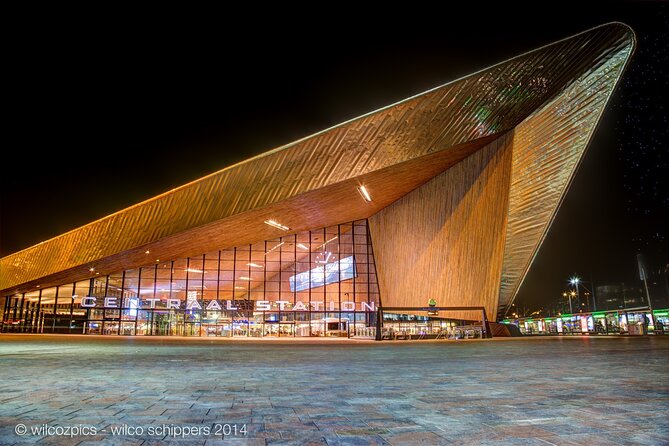
The walk begins at Stationsplein 10, outside Rotterdam Centraal Station. This is a practical meeting point if you arrive by train or public transport, and it gives the guide an immediate chance to explain Rotterdam’s modern architecture.
Rotterdam Centraal is more than a place to meet. Its bold design sets the tone for the rest of the tour. Your guide introduces the city through the station, then connects its shape and scale to Rotterdam’s postwar identity.
Give yourself enough time to find Stationsplein and locate the group. The meeting point was reportedly changed for one departure, so check your booking details close to the start time. The provider offers several departure times, which can help you fit the walk around a train journey, a day in port, or other plans.
The walk ends back at the meeting point. That makes it easy to continue by train, but it also means the route forms a fairly large loop through the center rather than finishing near a later attraction.
Groot Handelsgebouw and the first postwar chapter
From the station, the route includes Groot Handelsgebouw, completed in 1953. It was one of the first major buildings constructed after Rotterdam’s wartime bombing.
This stop gives the guide a useful way to explain the city’s recovery. Rotterdam did not simply restore every old street and facade. It used reconstruction as a chance to create offices, shops, pedestrian areas, and new public spaces.
You will not spend long inside or touring the building. Think of this as a short orientation stop, where the guide sets up the larger story. The value comes from the explanation, not from an extended architectural visit.
West-Kruiskade, Lijnbaan, and daily city life
The route then moves through the shopping district around Kruiskade and West-Kruiskade. These streets show you a more ordinary side of central Rotterdam, with shops and city traffic replacing the headline architecture.
Lijnbaan is the key historical point here. Opened in 1953, it became the main pedestrian shopping street in the new district after the older shopping area was destroyed. Its creation reflects a postwar idea of urban life: keep cars away from shoppers and build a clean, modern center around walking.
I like this section because it connects architecture with daily use. You are not only looking at spectacular buildings. You are seeing how Rotterdam reorganized shopping and movement after the bombing.
The stop is brief, so do not expect time for shopping. If you want gifts or a longer look at the stores, return later. One guide, Susan, was especially helpful to a participant looking for places to buy gifts for grandchildren, but the main purpose of this walk is city context, not retail time.
More history walks around Rotterdam:
- Rotterdam: Harbor Cruise on a Historic Ship
★ 4.2 · 812 reviews - MUST DO: Rotterdam highlights & history with a local guide
★ 4.5 · 57 reviews - Amsterdam Food and Cultural Tour with Tastings
★ 5.0 · 2,442 reviews - Rotterdam: Kinderdijk UNESCO World Heritage Entry Ticket
★ 4.6 · 1,477 reviews
Luchtsingel, a wooden bridge with a social purpose
One of the tour’s more unusual sights is Luchtsingel, a 390-meter wooden pedestrian bridge. It links Rotterdam North with the city center and helped reconnect an area that had suffered from vacancy and neglect.
The bridge is a good example of Rotterdam’s habit of treating public design as a tool for change. It is not simply a route from one street to another. Its purpose was to bring people into an overlooked part of the city and give that area a new connection with the center.
You get a short visit here, not a long walk across every section of the bridge. Still, it adds variety to the route. After the large-scale concrete and steel of the station and postwar buildings, the wooden structure feels more human in scale.
This is also a useful stop for anyone interested in how cities repair neglected districts. The guide can explain the bridge’s role in reconnecting neighborhoods, though the amount of detail may vary by guide.
Nieuwe Delftse Poort and a lost city gate
The Nieuwe Delftse Poort recalls an older Rotterdam. The original city gate was built in 1764, but it no longer survives in its original form. A steel reconstruction designed by artist Cor Kraat was later placed close to the old site on Pompenburg.
The stop is short, yet it adds an important contrast. Rotterdam is famous for new architecture, but it also contains reminders of the city that existed before the wartime destruction and later rebuilding.
You should not expect a complete medieval gate complex. This is a modern reconstruction, and the guide’s explanation is what makes the stop meaningful. It is a quick visual lesson in how Rotterdam remembers its past without pretending the old city remains intact.
Sint-Laurenskerk, the medieval survivor
The Grote of Sint-Laurenskerk is the only surviving remnant of medieval Rotterdam. Today it is a Protestant church, and you can enter free of charge.
This is one of the most important stops on the route because it gives you a physical link to the city before the bombing. Surrounded by modern buildings, the church helps you understand just how much of Rotterdam disappeared.
The tour allows only about ten minutes here, so your visit inside will be brief. If the church is open and you want more than a quick look, plan to return after the walk. The guide’s outside explanation may be the main part of the scheduled stop.
For me, this is the place where Rotterdam’s story becomes most clear. The modern center is not old in the usual Dutch sense, but the church shows that the city’s past was not erased completely.
Markthal, where the tour reaches its visual high point
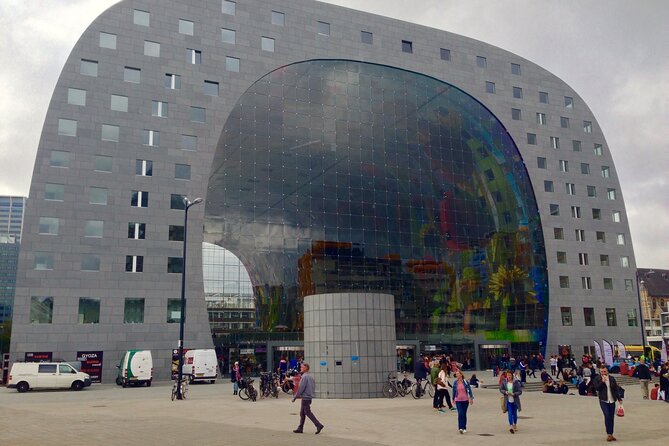
Markthal is likely to be one of the tour’s most memorable stops. Designed by MVRDV, it has a large gray stone arch shaped like a horseshoe. Inside, the ceiling carries an enormous artwork of fruit, vegetables, seeds, fish, flowers, and insects.
The tour gives you about 30 minutes here, the longest scheduled stop. That matters because Markthal is more than a quick exterior photograph. You can look at the interior artwork, browse the food stalls, and take in the scale of the building.
Food and drinks are not included, so any purchase is your own expense. This is not a problem if you see the tour as a walking introduction, but budget extra time and money if you want to eat inside.
One practical point: you may be tempted to explore Markthal before the guided walk, especially if you meet nearby at another time. The building can easily absorb your attention. The guide’s contribution is strongest when explaining how its shape and design fit Rotterdam’s modern identity. One less satisfied participant felt the artistic details around Markthal were not explained enough, so ask questions if the architecture interests you.
Oude Haven and the Cube Houses
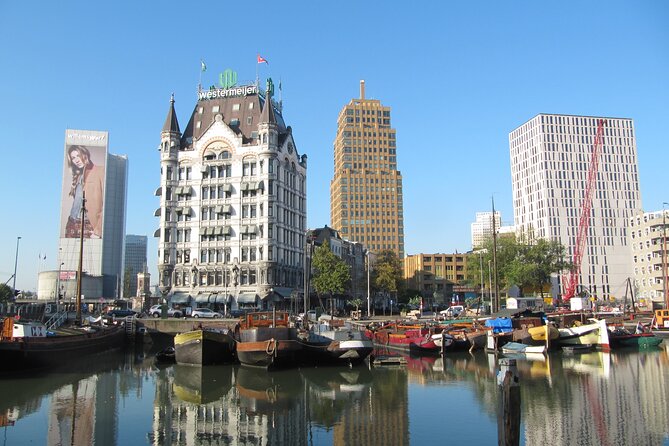
The final major section is Oude Haven, or Old Harbour, a historic area beside the Maas River in central Rotterdam. This is where you find the famous Cube Houses.
The harbor gives the tour a change of mood. After shopping streets and large postwar buildings, you reach an older waterside area with a more social feel. The Cube Houses then bring you back to Rotterdam’s experimental side.
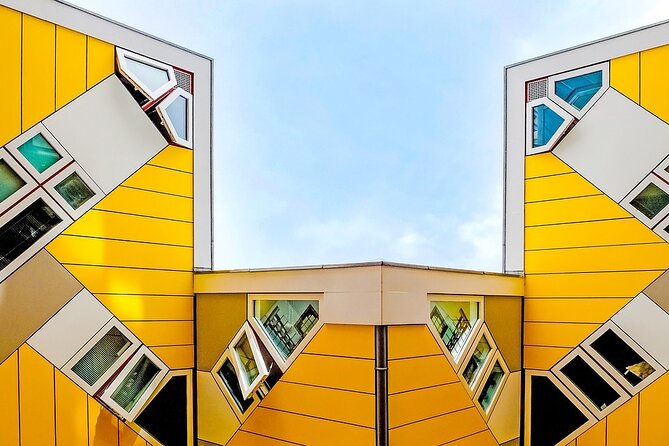
The homes are among the city’s best-known sights, but they can be hard to understand from a single photograph. Their tilted forms create a striking group of connected spaces, and the guide can explain how they fit into the area around the harbor.
You will have roughly 20 minutes here. That is enough to see the houses and hear the main story, but not enough for a long architectural study or a relaxed meal by the water. If you want to explore the Cube Houses from different angles, return later when you are not watching the clock.
Oude Haven is also a sensible place to continue your own Rotterdam visit after the tour, though this particular activity returns to the station. Check your route before setting off if you have a train or ship departure to catch.
What the guides add to the walk
The strongest part of this experience is the person leading it. Guides named Edwin, Michel, Susan, John, Tony, and Stephan have received high marks for clear explanations, humor, and enthusiasm for Rotterdam.
Edwin has been especially effective at explaining reconstruction after WWII, sculpture, and modern buildings. Michel has been praised for giving a clear introduction to the essential facts. Susan has been described as friendly and accommodating, including when a delayed ship created a tight schedule.
That last detail is useful if you are visiting Rotterdam from a cruise. One participant arrived late because of a delayed ship and had to leave early. Tony helped arrange transport to meet Susan, and Susan adjusted the walk to cover as much as possible. This was an unusual service effort, not something you should count on, but it shows the value of contacting the local provider quickly if a serious delay occurs.
The guide style is not identical every time. Most accounts describe an entertaining and informative walk, but one person wanted more detail at Markthal and the surrounding buildings. If architecture is your main reason for booking, tell the guide early. A good question can turn a passing stop into a more useful explanation.
Is $29.41 a fair price?
At $29.41 per person, this is a reasonable price for a two-hour guided introduction, especially with a small group capped at 15. You are paying for a local guide who links several parts of Rotterdam into one story, not for entry tickets or food.
The tour includes a mobile ticket and is offered in English. Admission is free at the listed stops, and food and drinks are extra. That keeps the base price clear, but you should not mistake the ticket price for the full cost of your time around Markthal or Oude Haven.
The value is best for a first visit. In two hours, you cover far more ground than you would by simply walking from the station to the Cube Houses without context. If you already know central Rotterdam well, you may prefer a longer specialist architecture walk or a self-guided visit at your own pace.
Who will enjoy this Rotterdam walk?
I would choose this tour if you want a fast introduction to Rotterdam’s architecture and WWII story. It is also a good fit if you are arriving by train, have only part of a day, or want a guide to give shape to your first few hours in the city.
It suits most people who can participate in a two-hour city walk. Service animals are allowed, and the route is near public transportation. The group is small, but the supplied details do not specify the exact walking distance or surface conditions, so ask the provider if you have mobility concerns.
This is less suitable if you want long indoor visits, a food-focused outing, or detailed time at every landmark. The route covers many stops, and the schedule gives only a short period at several of them.
The free cancellation policy allows you to cancel up to 24 hours before the local start time for a full refund. If the minimum number of participants is not reached and the provider cancels, you are offered another date or experience, or a full refund.
Should you book it?
Book it if you want Rotterdam to make sense quickly. The combination of war history, postwar planning, and striking architecture gives the walk a clear purpose, and the central route includes the city’s most recognizable sights.
I would especially recommend it to first-time visitors, rail arrivals, and cruise passengers with a flexible two-hour window. Just protect your schedule from delays, arrive at Stationsplein early, and save extra time afterward for the Markthal, Sint-Laurenskerk, and Cube Houses.
Skip it if you prefer to linger at each attraction or if you already have a strong plan for exploring central Rotterdam. For everyone else, $29.41 buys a useful orientation and a better understanding of why this unusual city looks the way it does.
FAQ
How long is the Rotterdam Must Do Tour?
The walking tour lasts approximately two hours.
Where does the tour begin?
The tour begins at Stationsplein 10, 3013 AJ Rotterdam, outside Rotterdam Centraal Station.
Where does the tour end?
The activity ends back at the meeting point at Rotterdam Centraal.
What language is the tour offered in?
The tour is offered in English.
How large is the group?
The maximum group size is 15 participants.
Are food and drinks included?
No. Food and drinks are not included in the tour price.
Can I cancel for a full refund?
Yes. You can cancel at least 24 hours before the local start time for a full refund. Changes or cancellations made less than 24 hours before the start are not accepted for a refund.
Just added around Rotterdam
- e-Scavenger hunt Rotterdam: Explore the city at your own pace★ 4.5 · 13 reviews
- Rotterdam: City Walk Audio Guide in 7 Languages on your Phone★ 3.5 · 6 reviews
- Breda Fun Puzzle Quest: True Lord Self-Guided Tour★ 4.0 · 9 reviews
- e-Scavenger hunt Breda: Explore the city at your own pace★ 4.5 · 27 reviews
- Delfshaven Self-Guided Tour: A Guide to Rotterdam’s Old Town★ 5.0 · 4 reviews
- Skip the Line: SS Rotterdam Steam Ship Entrance Ticket★ 4.5 · 18 reviews
- Discover Rotterdam: Classic Highlights Bike Tour with a Local★ 5.0 · 22 reviews
- 8 hour Walking and Boat Tour to Rotterdam and Kinderdijk★ 5.0 · 5 reviews
Historical Tours, compared.
Amsterdam Food and Cultural Tour with Tastings
Read our review →
Kinderdijk UNESCO World Heritage Entry Ticket
Read our review →
Hop-on Hop-off Old-Fashioned Heritage Tram Tour
Read our review →


Amsterdam High-End Dutch Food & History Tour – Up to 8 guests
Read our review →
Cruise through the Historic City Center with Guide
Read our review →
Browse the lists this tour appears in