
Reviewed · WALKING TOURS
Rotterdam 2-Hour Grand Walking Tour
Rotterdam is a city best understood on foot, where wartime loss, bold rebuilding, and future-focused design all sit within a few blocks. This tour links the practical Central Station with the Markthal, Cube Houses, and the River Maas, giving you a clear first look at the city rather than a quick checklist of sights. I especially like the visit inside the Markthal and the final views toward the modern South Bank. The main consideration is pace: you cover 3 to 4 km in two hours, and the walk runs in rain and snow.
Guide Tania has earned especially warm praise for being punctual, kind, and easy to follow while pointing out places you might otherwise miss. I like that the route covers both major landmarks and less obvious architectural details, including the Groothandelsgebouw and Timmerhuis. At $53 per person, the value depends on your interest in architecture and city history, since this is a guided orientation walk rather than a tour with museum admissions or food tastings.
Key points to know before you book
- Rotterdam’s postwar story shapes the route: The walk explains how the city rebuilt and why its modern center looks so different from many Dutch cities.
- The Markthal is a real stop, not just a passing photo: You go inside the city’s dramatic indoor marketplace.
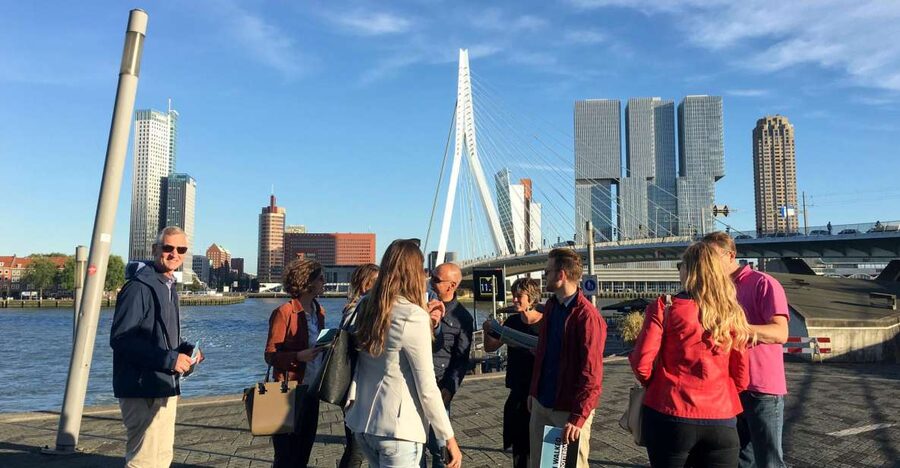
- The route ends beside the Maas: Boompjeskade brings broad views of the river and the developing South Bank.
- You cover several major buildings in two hours: Expect Central Station, the Groothandelsgebouw, Lijnbaan, City Hall, Timmerhuis, Cube Houses, and the Markthal.
- Guide Tania receives high praise: Her clear explanations and personal attention are a strong part of the experience.
- Plan for outdoor conditions: Comfortable shoes and weather-ready clothing matter because the walk covers several kilometers in all seasons.
Why Rotterdam makes sense on foot
Rotterdam can feel confusing at first. It is not a city where one old square neatly explains everything. Its center combines modern transport buildings, shopping streets, office blocks, rebuilt civic buildings, experimental homes, and a wide riverfront. The result is fascinating, but you need a bit of context to make sense of it.
That is where a walking tour earns its keep. Instead of seeing a collection of unusual buildings, you get a timeline. The guide explains the city’s past, its postwar reconstruction, its current character, and its plans for the future. I find that especially useful in Rotterdam because the architecture is not just decoration. It tells you how the city responded to destruction and how it chose to rebuild.
The two-hour length is also practical. You get enough time to understand the center without giving up an entire morning or afternoon. At the same time, it is not a slow, stop-and-stare architectural seminar. You keep moving, so comfortable shoes are important.
More Walking Tours in Rotterdam
- Rotterdam Walk: Hilights, Gems, Architecture & WWII | 2 or 3hrs
★ 5.0 · 149 reviews - Rotterdam: Highlights & Gems Walking Tour with Dutch Local
★ 5.0 · 133 reviews - Rotterdam 2-Hour Walking Tour | Discover The City With A Local
★ 4.5 · 111 reviews
Starting beneath Rotterdam Central Station
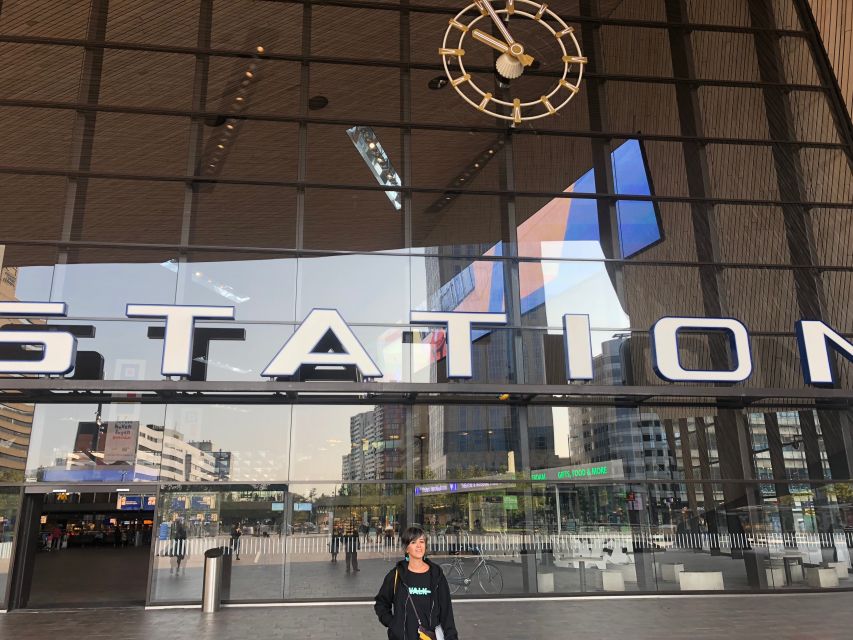
The tour begins outside Rotterdam Central Station, by the main entrance and the recently built station gate. This is a sensible meeting point. It is easy to identify, and the station introduces you to Rotterdam’s modern style before the walking route even begins.
From here, your guide sets out the city’s basic story. The focus is the chronology of reconstruction, so you can expect explanations of how Rotterdam moved from wartime damage to a city known for contemporary design and port connections. This opening context helps you read the buildings that follow.
The station area can be busy, and a large transport hub is not the quietest place to meet. Arrive with enough time to find the main entrance and locate your guide outside. The tour is conducted in English, and private groups are available if you prefer a more personal format.
Groothandelsgebouw and the practical postwar city
One of the first important buildings on the route is the Groothandelsgebouw. Its place in the tour matters because it represents the practical side of Rotterdam’s rebuilding. This is not simply a walk from one photogenic building to another. You are shown how commerce, work, shopping, housing, and transport helped shape the new center.
That broader view makes the tour more useful than a standard introduction focused only on famous sights. Rotterdam’s identity is tied to its port and its working economy, and the route keeps that connection in view.
If your interest is limited to old Dutch streets and traditional facades, this section may feel less immediately charming. Rotterdam offers a different kind of visual appeal. Here, scale, function, concrete, glass, and planning are part of the story.
Lijnbaan and the city’s shopping center
The walk continues through the Lijnbaan shopping area. This gives you a look at another part of the postwar plan: a central pedestrian shopping district designed for everyday city life.
I like this stop because it shows how reconstruction affected ordinary routines, not just civic monuments. You see a place built for people to move through, shop, and meet. Your guide can connect the shopping area to the wider pattern of rebuilding, making the city feel less like a set of isolated projects.
The Lijnbaan is also a useful contrast with the more dramatic Markthal and Cube Houses later in the walk. It may not be the most striking photo stop, but it helps you understand the city center as a functioning place rather than an open-air architecture exhibition.
A few more days out around Rotterdam worth weighing up
- Rotterdam: Harbor Sightseeing Cruise
★ 4.3 · 7,599 reviews - Rotterdam: 1-Hour Sightseeing Splash Tour
★ 4.5 · 3,299 reviews - Rotterdam: Rotterdam Zoo Blijdorp Entry Ticket
★ 4.6 · 2,754 reviews - Rotterdam: Euromast Lookout Tower Ticket
★ 4.4 · 2,549 reviews
City Hall and Timmerhuis: old and new together
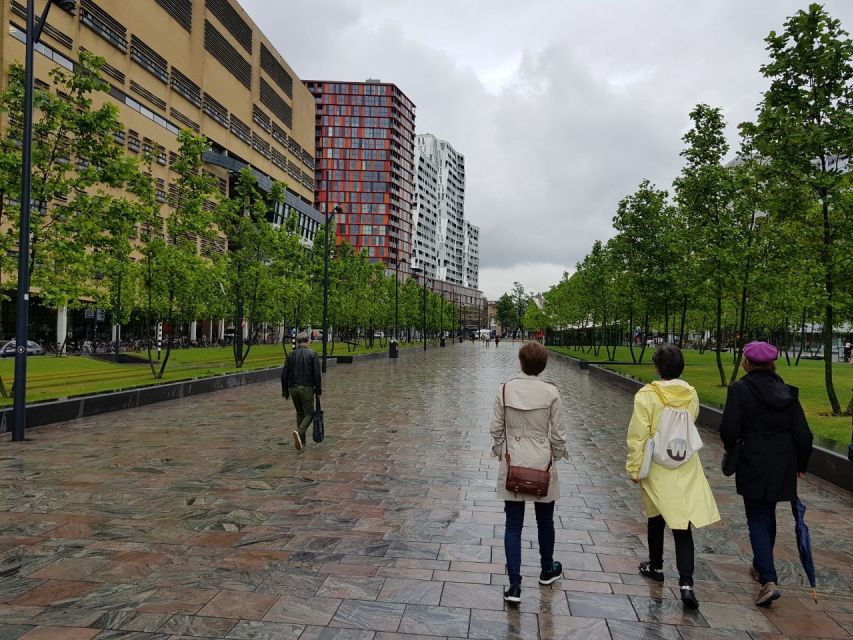
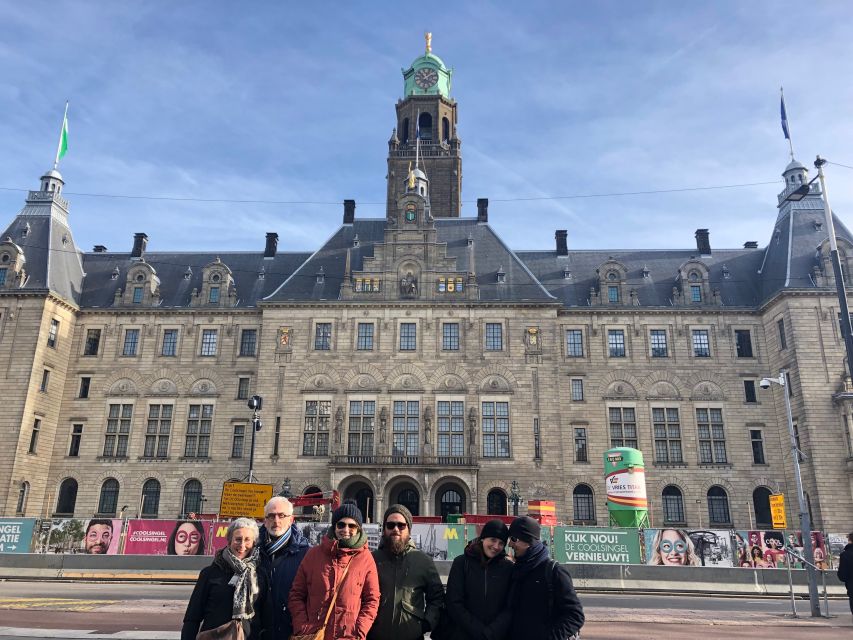
The route includes Rotterdam’s neo-classical City Hall, an important change of mood after the modern buildings and shopping district. Its inclusion shows that Rotterdam did not rebuild every part of the city in one single style.
The City Hall offers a link to the prewar city and to older ideas of civic architecture. You can compare its formal design with the more experimental buildings nearby. That contrast is one of the strongest reasons to take the tour with a guide. Without explanation, the shift from neo-classical government building to contemporary office design may seem random.
Next comes the Timmerhuis, a contemporary building that reflects Rotterdam’s ongoing interest in new forms. It helps bring the story into the present. The tour is not only about what happened after the war. It also addresses the city’s current direction and its bold plans for the future.
The route does not turn every building into a long lecture. That keeps the walk moving, but it also means the amount of detail depends on your guide and the group’s questions. If you want a highly technical architecture tour, a specialist private booking may suit you better.
Inside the Markthal
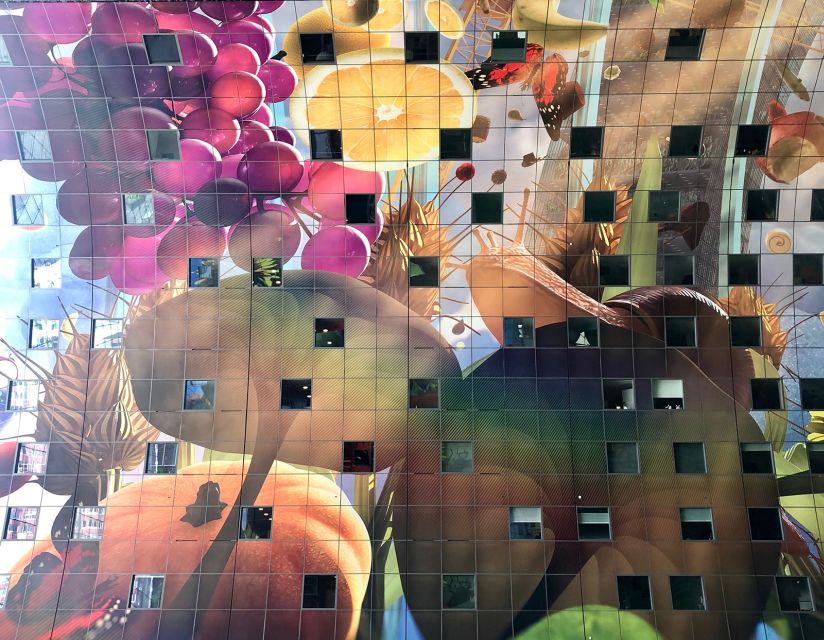
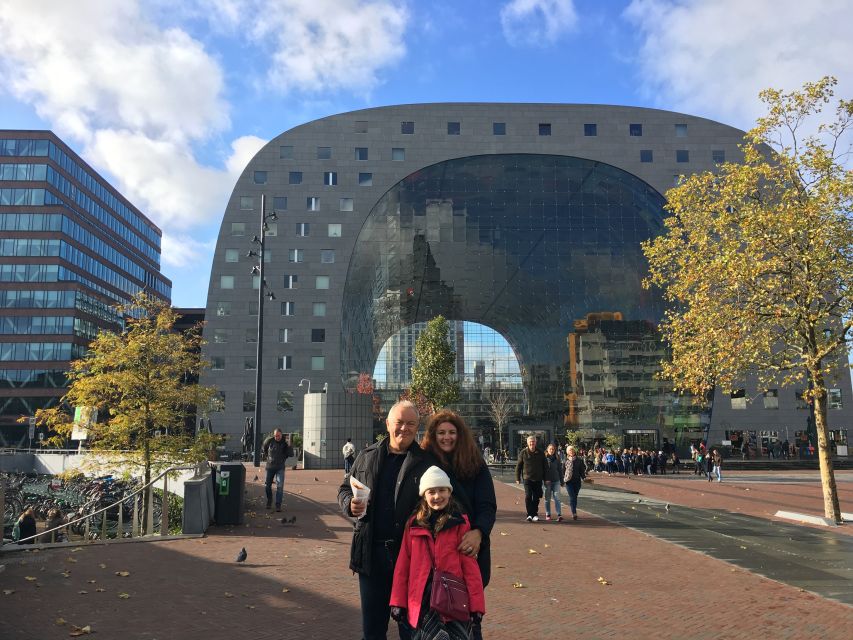
The Markthal is one of the clear high points of the walk. You enter the city’s indoor marketplace, a large and visually dramatic space that has become one of Rotterdam’s defining modern attractions.
This stop gives the tour a welcome change of pace. You are no longer looking only at facades from the pavement. Inside, the market setting shows how Rotterdam mixes design with daily use. The building is both a landmark and a place where people come to shop and eat.
You should allow yourself a moment to look upward and take in the interior, while still staying with the group. The visit is part of a walking route, not a separate food tour, so do not expect a tasting program or extended free time. Still, it is more satisfying than simply stopping outside for a photograph.
For many visitors, the Markthal is the most instantly memorable building on the route. I appreciate that it appears in the middle of a wider city story. You see it not as a standalone attraction, but as one chapter in Rotterdam’s habit of pairing practical urban use with adventurous design.
Cube Houses and Rotterdam’s experimental side
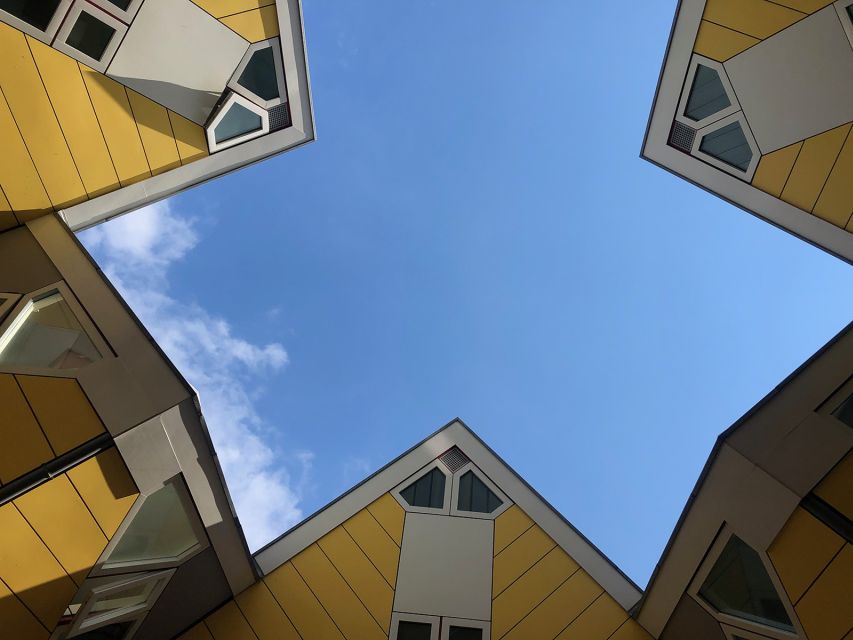
After the Markthal, the tour introduces the iconic Cube Houses. These homes are among the city’s most recognizable buildings, and their unusual angles make them an easy favorite for photographs.
Their value on this tour is not just visual. They reinforce the idea that Rotterdam used reconstruction as a chance to try new approaches to city living. The buildings ask you to think about how a home can be arranged, how streets can be shaped, and how architecture can challenge your expectations.
You should keep your expectations realistic. The route introduces the Cube Houses, but the supplied details do not promise entry into one of the homes or a separate interior visit. The main benefit is the guide’s explanation and the chance to see the complex as part of the surrounding city.
This is also a good point to ask questions. If you are curious about Rotterdam’s unusual buildings, the guide can help connect the Cube Houses with the wider design story covered throughout the walk.
Along the Maas to Boompjeskade
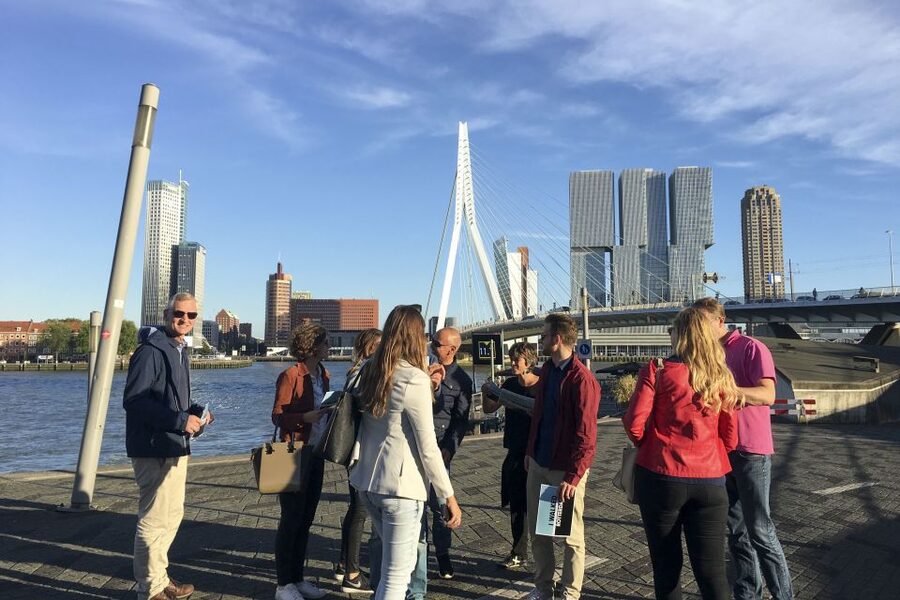
The final part leads toward the River Maas and ends at Boompjeskade. Here, the experience opens up. After the close streets and dense collection of buildings in the center, the river gives you room to look across toward the South Bank.
The views of the Head of South, a newer development on the south bank, show Rotterdam’s future-facing character. The riverfront is not treated as a decorative finish. It helps explain how the city continues to grow and change around its port and waterways.
Ending by the Maas is useful for planning the rest of your day. You finish at a clear riverside location rather than being returned to the station. Check your onward plans before booking, especially if you need to get back to Central Station immediately after the two-hour walk.
The final stretch is likely to be one of the most rewarding parts for anyone who enjoys city views and modern development. It also makes clear that Rotterdam is still a work in progress. The story does not stop with postwar reconstruction.
What $53 buys you
The price is $53 per person. For that fee, you are paying for a two-hour guided introduction, not entrance tickets, transport, meals, or a full-day sightseeing package.
I consider the price reasonable if you want help making sense of Rotterdam’s architecture and city planning. A guide can point out details you would probably walk past and explain why the city looks the way it does. The strongest value comes at the start of your visit, when a good overview can help you explore independently afterward.
The price may feel high if you are happy to follow a map and photograph the Markthal, Cube Houses, and riverfront on your own. You also need to factor in the tour’s fairly brisk distance. The experience is most worthwhile for people who want interpretation, not just access to places.
Kids aged 0 to 12 can join free, though parents should consider the 3 to 4 km distance, the two-hour duration, and the content. For a family with young children, the architecture may be interesting, but the steady walk could test patience.
Weather, access, and group choices
This tour operates in rain and snow, so Rotterdam weather is part of the planning. Wear comfortable shoes and seasonal clothing. A waterproof layer is a smart choice, since much of the experience takes place outdoors.
The tour is wheelchair accessible, which makes the route available to more people. Still, the distance and weather deserve attention when deciding if the format suits you. If you have specific mobility needs, contact the provider before booking so you can confirm the current route details.
The regular tour is in English. If you need another language, you are asked to contact the provider. A private group is also available, which may be worthwhile if you want to set the pace, ask many questions, or keep the experience focused on your group.
Recent bookings have repeatedly highlighted Tania’s preparation, kindness, and ability to show places that are easy to miss. That personal guidance matters here. Rotterdam rewards a guide who can explain connections between buildings rather than simply naming them.
Who should book this Rotterdam walk?
I would choose this tour for a first visit to Rotterdam, especially if you enjoy architecture, urban design, or postwar European history. It gives you a useful framework in two hours and covers many of the city center’s signature sights.
It also suits travelers arriving by train, since the meeting point is outside Central Station. You can make it an opening activity, then continue on your own from Boompjeskade once you know how the center fits together.
You may want something else if you prefer a slow food tour, extensive time inside attractions, or a long historical walk focused on older buildings. This route is about movement, reconstruction, modern design, and the city’s changing future. Its strength is breadth and explanation, not long visits at individual sites.
Free cancellation up to 24 hours before the start and the reserve now, pay later option make planning less rigid. Check available start times before booking, since the duration is fixed at two hours.
Should you book it?
Book the Rotterdam 2-Hour Grand Walking Tour if you want a clear introduction to a complicated, modern city. The Markthal, Cube Houses, Central Station, City Hall, Timmerhuis, and Maas views give you plenty to see, while the postwar timeline gives those sights meaning.
At $53, it is a considered purchase rather than a bargain walk. I would book it early in your Rotterdam stay, wear good shoes, and treat it as a foundation for later exploring. If your main goal is old-world Dutch charm or unstructured wandering, save the money and walk independently. If you want Tania’s kind of guided context and a well-planned route through Rotterdam’s boldest architecture, this is a strong choice.
FAQ
Where does the walking tour begin?
The tour begins outside Rotterdam Central Station, by the main entrance.
Where does the tour end?
The walk ends beside the River Maas at Boompjeskade.
How long is the tour?
The tour lasts two hours.
How far do you walk?
The route covers approximately 3 to 4 km.
What language is the tour conducted in?
The tour is conducted in English. You can contact the provider about another language.
Is the walking tour wheelchair accessible?
Yes, the activity is wheelchair accessible.
Can children join the tour?
Yes. Children aged 0 to 12 can join for free. Parents should consider the distance, content, and two-hour duration.
What happens if the weather is poor?
The tour operates in rain and snow, so wear comfortable shoes and clothing suited to the season.
More 2-Hour Experiences in Rotterdam
- Rotterdam: 2-Hour Guided Walking Tour
★ 4.6 · 58 reviews - Rotterdam Private 2-Hour Food Tour with Tastings
★ 4.3 · 12 reviews - Amsterdam: 2-Hour Canal Cruise incl. Drinks & Dutch Snacks
★ 5.0 · 594 reviews - Amsterdam 2-hour Private Canal Cruise with Live Guide and Drinks
★ 5.0 · 296 reviews
Just added around Rotterdam
- e-Scavenger hunt Rotterdam: Explore the city at your own pace★ 4.5 · 13 reviews
- Rotterdam: City Walk Audio Guide in 7 Languages on your Phone★ 3.5 · 6 reviews
- Rotterdam Must Do Tour: Highlights, History, WW2 and Architecture★ 5.0 · 20 reviews
- e-Scavenger hunt Breda: Explore the city at your own pace★ 4.5 · 27 reviews
- Breda Fun Puzzle Quest: True Lord Self-Guided Tour★ 4.0 · 9 reviews
- Delfshaven Self-Guided Tour: A Guide to Rotterdam’s Old Town★ 5.0 · 4 reviews
- Skip the Line: SS Rotterdam Steam Ship Entrance Ticket★ 4.5 · 18 reviews
- Discover Rotterdam: Classic Highlights Bike Tour with a Local★ 5.0 · 22 reviews
Walking Tours, compared.

Anne Frank’s Story – Guided Walking Tour through Amsterdam
Read our review →
Life of Anne Frank and World War II Walking Tour
Read our review →
Absolutely Amsterdam – the Essential Introductory Walking Tour
Read our review →
Anne Frank Walking Tour – Guided in EN/DE/IT/ES
Read our review →

Anne Frank Walking Tour Amsterdam Including Jewish Cultural Quarter
Read our review →Browse the lists this tour appears in