
Reviewed · WALKING TOURS
Rotterdam Travel to the Future Walking Tour
Rotterdam is at its best when you stop treating it as a collection of odd-looking buildings and start seeing it as a city testing new ideas. This private walk leads you from a yellow wooden street and rooftop farm to street art, Markthal, the Cube Houses, and Erasmus Bridge, with stories about how the city rebuilt itself.
I like the tour’s focus on public projects people actually use, not just famous photo stops. I also like the guide-led approach to street art and less obvious corners, where Rotterdam’s social changes become easier to understand. The main drawback is the $274.03 per person price, especially for a solo guest or small party, since food, coffee, and entrance costs are extra.
Key points at a glance
- Rooftop farming and De Luchtsingel: See how unused urban space became a farm, footbridge, and meeting place.
- Private three-hour format: Your group has the guide to itself, with no strangers setting the pace.
- Street art with context: Paintings and sculptures become part of Rotterdam’s story rather than quick photo stops.
- Markthal and the Cube Houses: Compare two bold MVRDV projects and consider how people live in unusual buildings.
- Free-entry itinerary: The listed stops do not require admission tickets, though snacks and drinks are on you.
- Erasmus Bridge finish: End beside Rotterdam’s most recognizable bridge with wide views across the city.
Rotterdam as a city-sized experiment
This is not a standard old-town stroll. Rotterdam was heavily damaged in the Second World War, and much of its center was rebuilt with a willingness to try new forms, new public spaces, and new ways to use limited land.
That gives the tour a clear theme. You are not simply looking at modern buildings. You are asking why a city would put a farm on a roof, connect neighborhoods with a bright wooden footbridge, combine apartments with a market hall, or turn public walls into a record of local life.
The route also puts old Rotterdam beside new Rotterdam. Laurenskerk and the old city hall area recall the city before the war, while Markthal, the Cube Houses, and Erasmus Bridge point toward the future. That contrast is the real lesson.
The tour lasts about three hours. Since it is private, you can ask questions and spend more time on the subjects that interest you. Families have found the storytelling easy enough for young children, while repeat visitors have discovered parts of the city they had never noticed on earlier trips.
More Walking Tours in Rotterdam
- Rotterdam Walk: Hilights, Gems, Architecture & WWII | 2 or 3hrs
★ 5.0 · 149 reviews - Rotterdam: Highlights & Gems Walking Tour with Dutch Local
★ 5.0 · 133 reviews - Rotterdam 2-Hour Walking Tour | Discover The City With A Local
★ 4.5 · 111 reviews
Starting near Ode aan Marten Toonder
The meeting point is Ode aan Marten Toonder on Verlengde Nieuwstraat, close to Rotterdam’s central area and public transportation. The location matters because the tour begins in a part of the city where the old street pattern and newer projects meet.
The supplied information does not promise a visit inside a museum or paid attraction at this point. Think of it as a street-level start, where your guide sets up the city’s story before leading you toward its public projects and art.
Your guide is listed as a certified guide. Past feedback uses several spellings for the guide’s name, including Danya, Danil, Danny, and Danja. If having a particular guide matters to you, confirm the name when booking.
Yellow streets, rooftop farms, and practical urban design
The first major part of the walk looks at Rotterdam’s innovative public spaces. This can include a bright yellow wooden road or footbridge, a rooftop eco-farm, and a garden designed by Piet Oudolf.
These are not random decorations. They show how Rotterdam uses design to make neglected or difficult spaces useful. The yellow wooden route is linked with De Luchtsingel, a roughly 390-meter footbridge that connects central Rotterdam with the northern side of the city.
The bridge was created by the Rotterdam firm ZUS and supported by the municipality. Its funding also came largely through a public crowdfunding campaign. That detail gives the project a human side: it was not only a top-down city plan. Local people helped pay for a connection they wanted.
De Luchtsingel crosses an area that once felt cut off and underused. Today, the route links creative studios, shops, cafes, and places to eat under the old Hofbogen railway viaduct. You get a practical example of how a walkway can do more than move people from one street to another.
The rooftop farm, known as DakAkker, adds another layer. It covers about 1,000 square meters and grows vegetables, fruit, and edible flowers, with bees kept on the roof. The site also has a bistro and hosts public events such as harvest festivals, lunches, and seminars.
Do not assume the food or bistro visit is included. Coffee, tea, and snacks are specifically excluded, and the tour does not promise a meal. Still, the rooftop farm helps explain why Rotterdam is often used as a testing ground for city projects. It turns a roof into productive space and gives residents a reason to visit a place that would otherwise be ignored.
The walk may also touch on social initiatives and Dutch technology. The exact projects can vary, so I would treat this part as an opportunity to ask questions rather than expect a fixed indoor presentation.
Street art that asks you to look twice
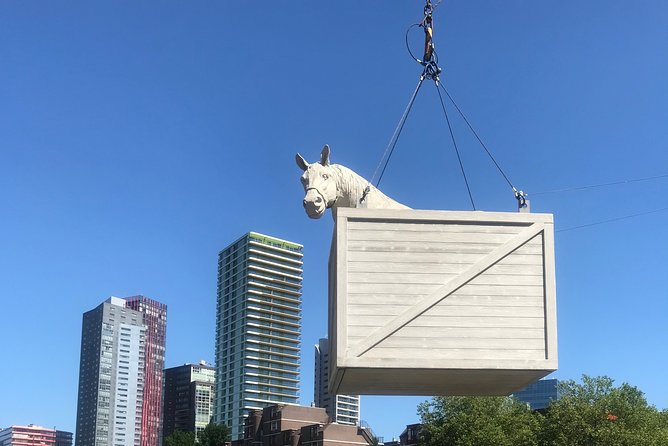
Rotterdam’s public art section is short on paper, about 15 minutes, but it may become one of the most memorable parts of the walk. The city has street sculptures, murals, graffiti, and painted walls scattered through ordinary routes.
A guide adds value here because the art is easy to pass without noticing. You may see a wall as a wall, then learn why a particular image was placed there, what it says about the neighborhood, or how it connects with Rotterdam’s past.
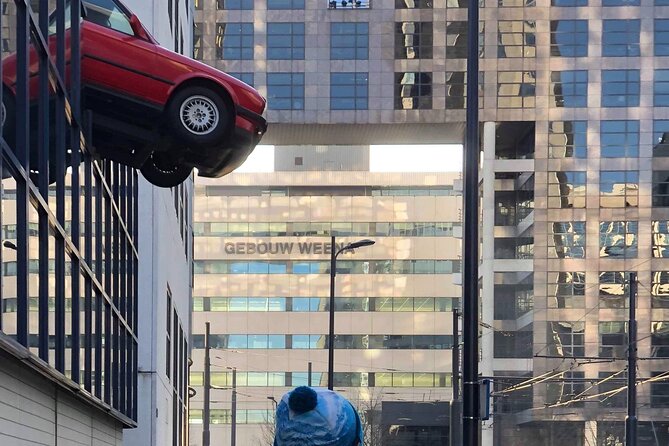
The strongest stories are often found away from the postcard sights. One described section includes a bright yellow route, a red car appearing to break through a wall, and murals with social messages. These details turn a quick walk into a reading exercise. You begin asking who made the work, what it is saying, and why it belongs in that location.
This is also where the tour’s local focus earns its keep. The city’s public art is not presented as a separate gallery. It is mixed into daily life, beside homes, offices, paths, and public spaces.
The limitation is time. Fifteen minutes is enough for an introduction, not a full street-art tour. If murals are your main interest, tell the guide early and ask what can be covered within the three-hour route.
A few more days out around Rotterdam worth weighing up
- Rotterdam: Harbor Sightseeing Cruise
★ 4.3 · 7,599 reviews - Rotterdam: 1-Hour Sightseeing Splash Tour
★ 4.5 · 3,299 reviews - Rotterdam: Rotterdam Zoo Blijdorp Entry Ticket
★ 4.6 · 2,754 reviews - Rotterdam: Euromast Lookout Tower Ticket
★ 4.4 · 2,549 reviews
Laurenskerk and the surviving old city
Rotterdam’s modern image can make its older buildings feel like surprises. The Grote of Sint-Laurenskerk, usually called Laurenskerk, is one of the key reminders that the city existed long before its postwar experiments.
The tour also includes the old city hall building and stories about important figures in Rotterdam’s past. This section is brief, around 15 minutes, so it is designed as context rather than a full historical lecture.
That balance works well. You need some older Rotterdam before the futuristic buildings make sense. The old church and civic buildings show what was lost, what survived, and how sharply the rebuilt center differs from the city that came before.
The itinerary does not include an admission ticket, and entrance costs are not included in the price. If you want to enter Laurenskerk, ask the guide about the current arrangement and any ticket cost before the tour begins.
Markthal, where housing meets a market
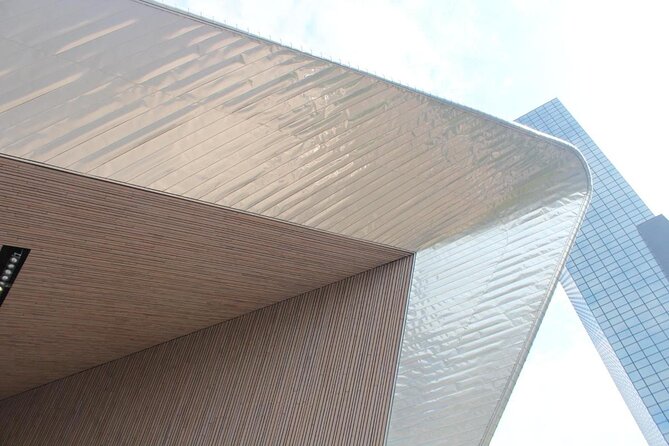
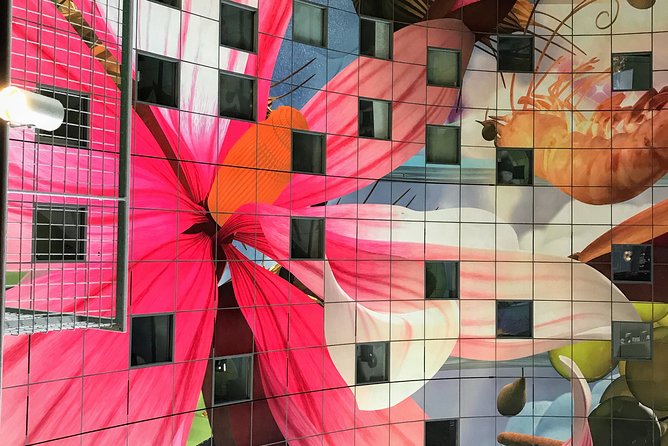
Markthal is one of Rotterdam’s most useful stops because you can study a major building and also pause for food. Designed by MVRDV, it combines apartments with a large indoor market hall under one dramatic roof.
The guide explains the building as an example of mixed use. People live above a public food market, so the project is not just a sculptural object. It puts housing, commerce, and shared space together in one block.
Inside, you can browse stalls and choose something to eat if you wish. The food possibilities listed for the stop include herring, truffle sausages, Dutch wine, farmer cheese, and ethical food. These purchases are optional and not included.
I like this part of the tour because it gives the architecture a job to do. You can look up at the building, then see how people use it at ground level. You can also make the stop practical by buying a snack instead of adding a separate market visit to your day.
Keep your expectations sensible. The tour allows about 30 minutes here, so you will have time to walk through the market and perhaps sample something, but not necessarily sit down for a long meal. If you want to taste several specialties, budget extra time and money after the tour.
Cube Houses and the question of livability
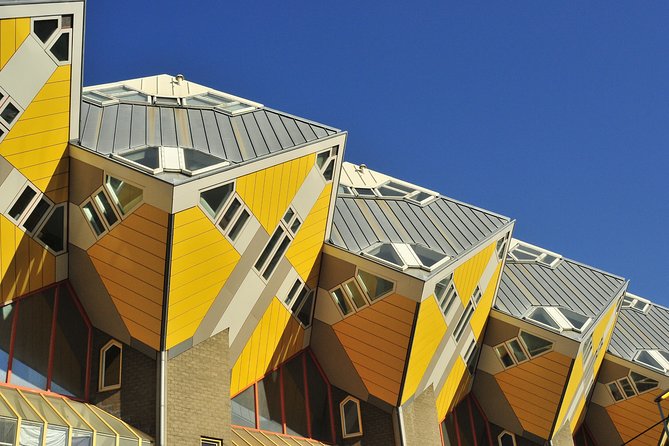
The Cube Houses are among Rotterdam’s most famous sights, and the tour uses them to discuss 20th-century architectural movements, social housing, and the unusual buildings nearby.
Piet Blom’s tilted homes are easy to photograph, but the better question is how they work as homes. The angled walls and unusual floor plans challenge the ordinary idea of an apartment. Your guide can put the design into the wider story of experimental housing and Rotterdam’s interest in doing things differently.
The stop also includes views of other recognizable structures, including The Pencil and The Apple buildings. Together, these projects make a useful group lesson. Rotterdam’s modern architecture is not one single style. It is a conversation between bold shapes, housing needs, public space, and the desire to give the city a new identity.
The itinerary does not list an entrance ticket for the Cube Houses. It also does not promise entry into a show home or any other paid interior. You should expect an exterior visit unless the guide confirms otherwise.
Families may like this section because the buildings are visually strange and easy to discuss with children. Older children and teenagers can consider a more serious question: would they actually want to live in one?
Erasmus Bridge and the final city view
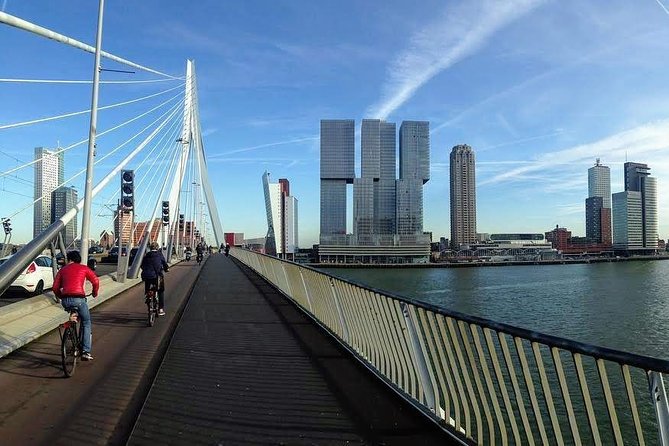
The tour ends at Erasmus Bridge, at Erasmusbrug. This is a strong finishing point because the bridge opens the view across the water and toward the opposite side of Rotterdam.
The stop also includes OMA by Rem Koolhaas, giving you another chance to compare major architectural ideas. The bridge and surrounding buildings show Rotterdam at its most open and forward-looking, with broad views rather than narrow historic streets.
The final stop lasts about 15 minutes. That is enough for photographs and a short explanation, but not a long waterfront visit. Plan a little extra time afterward if you want to linger by the river or continue exploring on your own.
Ending here also makes practical sense. You are not returned to the starting point, so keep the final location in mind when planning your next activity. The tour’s stated end is Erasmusbrug, while the meeting point is near Verlengde Nieuwstraat.
What the private format is worth
The price is $274.03 per person. That is a serious amount for a three-hour walk, particularly if you are booking alone or as a couple.
The value improves for a larger group because the activity is private and group discounts are available. Your party gets the guide to itself, and the pace can be shaped around your interests. You are paying for interpretation and personal attention rather than entrance tickets, transport, or included meals.
There are no listed admission fees built into the route. Coffee, tea, snacks, and entrance tickets are extra. That makes the price harder to justify if you mainly want a quick orientation and are happy to read about the buildings yourself.
I would consider it most worthwhile for a family, a group of friends, or an architecture-minded visitor who wants a custom conversation about Rotterdam. It is also useful for someone returning to the city. A local guide can direct you beyond the standard attractions and explain places you have walked past many times.
The walk is offered in English. Most people can participate, and the route is near public transportation. No special access details are provided, so ask the provider if you have specific mobility needs.
What the guide adds to the walk
The strongest praise centers on the guide’s storytelling. The history is described as informative but light, with enough energy to keep a seven-year-old interested. That is a useful sign for families who do not want a heavy lecture.
The guide also appears to connect Rotterdam’s wartime past with its present-day identity. Stories about the Second World War and the character of Rotterdam’s people give the futuristic buildings some emotional weight. You get more than dates and building names.
The less obvious neighborhoods seem especially important. The guide can lead you through areas that once had a more troubled reputation and show how public art, footbridges, creative businesses, and rooftop projects changed the way people use them.
Names are presented inconsistently in the supplied details, so do not assume every booking will involve the same person. The safest practical step is to confirm your guide’s name and meeting details before the day.
Walking pace, food, and planning tips
Three hours goes quickly because the route covers many subjects. Wear comfortable shoes and leave room for pauses, especially if you want to ask questions or stop for food at Markthal.
Bring a payment method for anything you want to eat or drink. The tour includes a certified guide, but not coffee, tea, snacks, or entrance tickets.
The meeting point is Ode aan Marten Toönder, Verlengde Nieuwstraat, 3011 GA Rotterdam. The tour ends at Erasmusbrug, 3011 BN Rotterdam. Both points are in Rotterdam and close to public transportation, but they are not the same place.
Confirmation is sent at booking. Free cancellation is available up to 24 hours before the start time for a full refund. Changes or cancellations made less than 24 hours before the start time are not accepted for a refund.
Who should book this Rotterdam walk
You should consider this tour if you like architecture, public art, city planning, social projects, or modern history. It suits people who want to understand why Rotterdam looks the way it does, not just photograph the Cube Houses and move on.
It also works well for families. The route has colorful structures, strange buildings, food, murals, and stories that can hold the attention of different ages.
Repeat visitors may get even more from it than first-time visitors. The guide’s route can reveal side streets and public projects that are easy to miss when you follow the usual center-city circuit.
You may want to skip it if your main goal is a long museum visit, a full meal, or a cheap general orientation. You should also compare the cost carefully if your group is very small. Since the listed price is per person and the experience lasts only three hours, the personal attention needs to matter to you.
Should you book it?
Book this walk if you want Rotterdam explained as a living city laboratory, with rooftop farming, public art, unusual housing, and major architecture tied together by one guide. The private format and strong storytelling make it a good fit for families and groups who value questions and flexibility.
Skip it if you only need a short list of landmarks or prefer exploring independently. For everyone else, the best reason to book is simple: you will leave looking at ordinary streets, roofs, bridges, and walls with sharper eyes.
FAQ
Where does the Rotterdam Travel to the Future Walking Tour start?
It starts at Ode aan Marten Toönder, Verlengde Nieuwstraat, 3011 GA Rotterdam, Netherlands.
Where does the tour end?
The tour ends at Erasmusbrug, 3011 BN Rotterdam, Netherlands.
How long does the walking tour last?
The experience lasts approximately three hours.
Is the tour private?
Yes. Only your group participates in the private tour or activity.
What language is the tour offered in?
The tour is offered in English.
Is a guide included?
Yes. A certified guide is included.
Are food and drinks included?
No. Coffee, tea, and snacks are not included. Food and drinks at Markthal must be purchased separately.
Can I cancel for a full refund?
Yes. You can cancel at least 24 hours before the experience start time for a full refund. Cancellations made less than 24 hours before the start time are not refunded.
Just added around Rotterdam
- e-Scavenger hunt Rotterdam: Explore the city at your own pace★ 4.5 · 13 reviews
- Rotterdam: City Walk Audio Guide in 7 Languages on your Phone★ 3.5 · 6 reviews
- Rotterdam Must Do Tour: Highlights, History, WW2 and Architecture★ 5.0 · 20 reviews
- Breda Fun Puzzle Quest: True Lord Self-Guided Tour★ 4.0 · 9 reviews
- e-Scavenger hunt Breda: Explore the city at your own pace★ 4.5 · 27 reviews
- Discover Rotterdam: Classic Highlights Bike Tour with a Local★ 5.0 · 22 reviews
- Delfshaven Self-Guided Tour: A Guide to Rotterdam’s Old Town★ 5.0 · 4 reviews
- Skip the Line: SS Rotterdam Steam Ship Entrance Ticket★ 4.5 · 18 reviews
Walking Tours, compared.

Anne Frank’s Story – Guided Walking Tour through Amsterdam
Read our review →
Life of Anne Frank and World War II Walking Tour
Read our review →
Absolutely Amsterdam – the Essential Introductory Walking Tour
Read our review →
Anne Frank Walking Tour – Guided in EN/DE/IT/ES
Read our review →

Anne Frank Walking Tour Amsterdam Including Jewish Cultural Quarter
Read our review →Browse the lists this tour appears in