
Reviewed · WALKING TOURS
Private Walking Tour of Delft: Dive into the Dutch Golden Age
Delft’s story comes alive in small, closely packed places: the church tower that began leaning during construction, the former monastery where William of Orange was assassinated, and the canal view Johannes Vermeer turned into one of the Netherlands’ best-known paintings. This private two-hour walk links those places without wasting time.
I like the personal format, since your guide can adjust the pace for a child, a senior, or a group full of questions. I also like the range of subjects, from Vermeer and the Dutch royal family to beer brewing, military trade, and the water boards that helped keep Delft dry. The main consideration is that two hours passes quickly, and the tour focuses on explanation and exterior sightseeing rather than extended visits inside every building.
Key points to know before booking
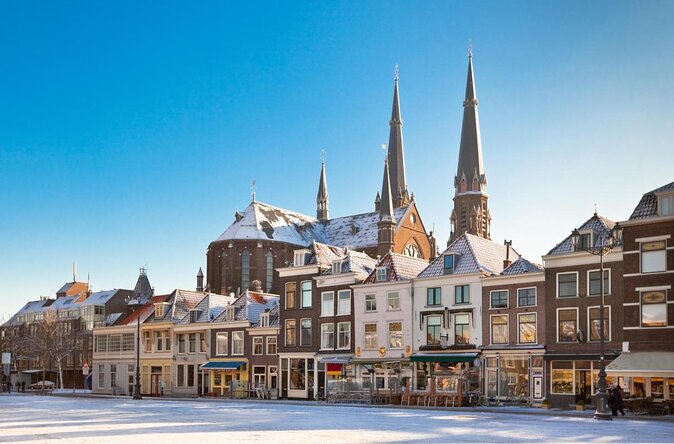
- Vermeer’s Delft comes into view: See the Old Church, Vermeer’s grave, and the exact location connected with View of Delft.
- Eight historic stops fit into two hours: The route covers Market Square, Prinsenhof, canals, civic buildings, the former armory, and more.
- Your group gets a private guide: Only your party participates, with guides including Robin and Matyas named in the tour information.
- The route begins and ends in the center: Meet beside the Hugo Grotius statue on Markt, with optional pickup anywhere in Delft’s city center.
- The price works best for a group: The cost is $203.22 for up to 15 people, not per person.
- The tour is highly flexible: Previous groups praised the guides for answering questions, adapting the pace, and offering food and shopping tips.
Why Delft is better understood on foot
Delft is compact, but its history is not simple. The same streets connect the Dutch royal family, the Dutch Republic’s military and commercial growth, Johannes Vermeer, Jewish life, and the constant Dutch struggle with water.
A walking tour helps you see those links. You move from the grand Market Square into quieter canal streets, then south toward the old armory and East India Company buildings before returning north through another historic canal district. The route is not just a parade of old façades. It shows how Delft worked as a city.
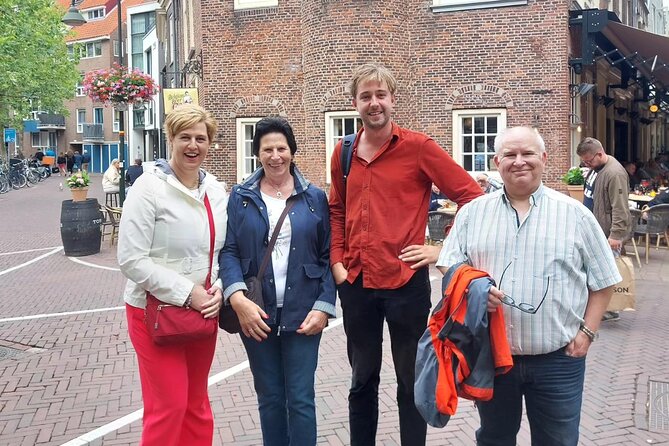
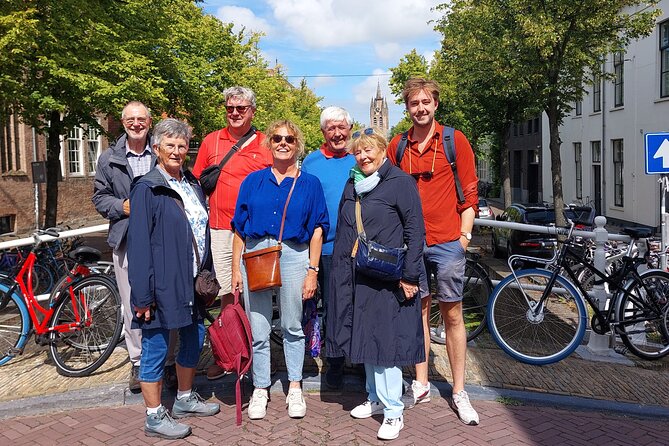
The private setting matters here. If you want to stop for a question, linger over a detail, or slow down for a younger member of your group, your guide can respond. A group of three, including a senior and a small child, was able to change the plan slightly without trouble. That kind of flexibility is hard to count on in a large scheduled walk.
Robin is specifically praised for humor, an easygoing manner, and a strong grasp of both Delft’s past and present. Matyas is also named as a guide who brings charm, stories, and historical context to a first visit. Guide availability may vary, but these names give you a useful sense of the style to expect: friendly, conversational, and focused on more than dates.
More Private Tours in Delft
- Get the best out of Delft by creating memories during our private walking tour!
★ 5.0 · 15 reviews - Private Tour of Delft & Rotterdam with Cube House and Transfer
★ 5.0 · 12 reviews - Private Tour of Delft + Visit to Delft Blue Museum & Factory
★ 4.5 · 8 reviews
Market Square and the New Church
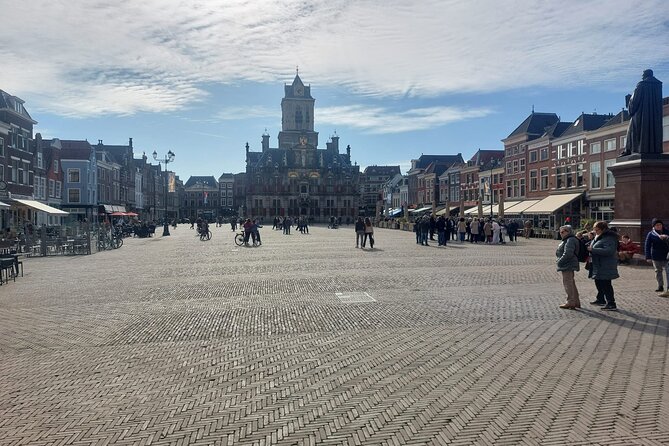
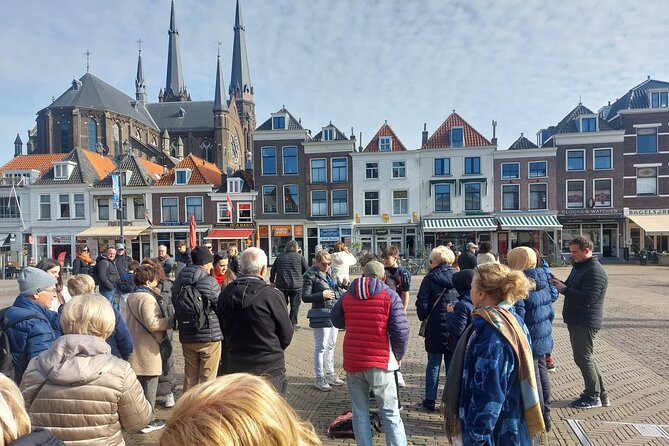
Your guide meets you beside the statue of Hugo Grotius on Markt, Delft’s historic Market Square. This is one of the oldest market squares in the Netherlands, and it gives you an immediate sense of the city’s scale. The square is also practical: it is easy to find, central, and serves as both the starting and ending point.
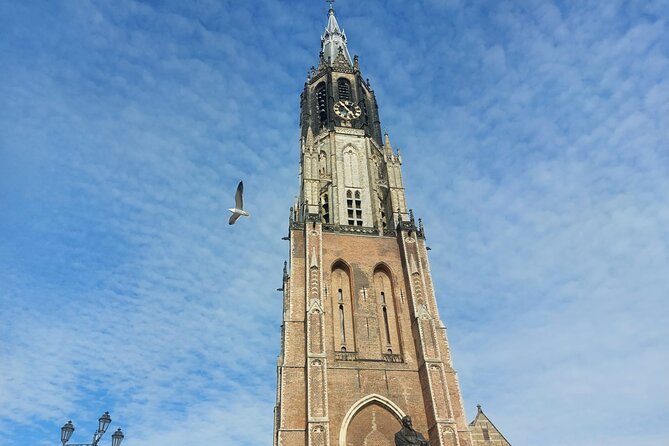
The New Church dominates the square. It is the burial place of members of the Dutch royal family, as well as Hugo Grotius, the Delft-born jurist and political thinker. Its tower is the second tallest church tower in the country, so your guide has plenty of material for explaining why this church matters beyond its size.
The stop lasts about 15 minutes. You should expect historical explanation and orientation rather than a long interior visit. Since the entire tour is only two hours, this opening stop sets the story before you move into the surrounding streets.
This is also a good moment to tell your guide what interests you most. If you care about the House of Orange, Vermeer, architecture, or daily life in old Delft, the private format gives you room to steer the conversation.
Town Hall and the power of Delft’s civic center
The Town Hall is across the square, with an elegant Renaissance façade that hides a rougher past. Your guide passes it while leaving Markt on the way to the Old Church.
Behind that graceful front were the practical workings of city rule, justice, and punishment. The building also served as a prison, and its story includes fires and the difficult business of governing a growing Dutch town.
This short stop works well because it adds balance. The New Church represents royal and national memory, while the Town Hall shows local power. You are not only looking at pretty buildings. You are seeing where Delft handled law, administration, and public order.
The tour does not promise admission into the Town Hall, so treat it as a guided exterior stop. That is typical for a fast city walk, and it keeps the route moving toward the canals and churches that follow.
The Old Church, Vermeer, and a leaning tower
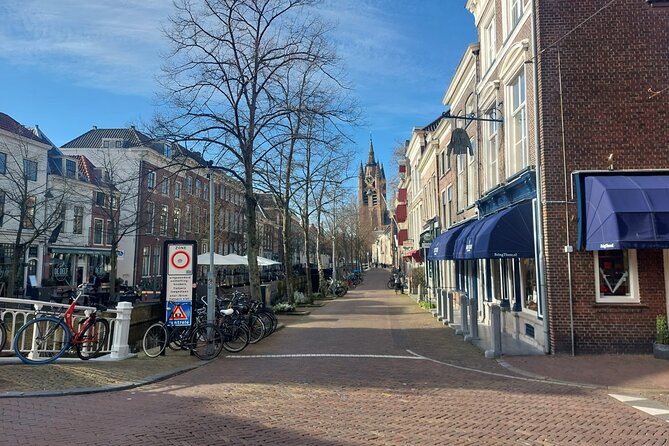
The walk from Markt passes several telling remnants of old Delft. You see the former Butter House, the old Weigh House, and the historic home of Antonie van Leeuwenhoek, the scientist associated with early microscope work. The route then enters what was once the city’s beer-brewing quarter.
The Old Church is the visual surprise. Its tower leans noticeably, and your guide explains why it began to tilt almost as soon as construction started. The story connects Delft’s buildings to its soft, water-shaped ground, giving you a useful bit of context for why construction in the Netherlands has never been a simple matter.
Inside the church is the grave of Johannes Vermeer. That detail gives the stop real emotional weight. Vermeer is closely tied to Delft, yet his surviving body of work is small, and the city’s connection to him can be easy to miss if you only chase famous paintings in museums.
Allow about 15 minutes here. You may want more time if you are especially interested in Vermeer or church interiors, but the schedule is designed to give you a strong introduction rather than a full museum visit. The leaning tower alone makes this one of the route’s most memorable stops.
More Private Tours in The Hague
- The Hague: Old City Private Walking Tour
★ 4.4 · 81 reviews - The Hague: Private Boattour up to 10 persons
★ 4.9 · 37 reviews - The Hague Private Walking Tour with a Local
★ 4.0 · 29 reviews - Royal The Hague Private Guided Walking Tour
★ 4.5 · 21 reviews
Prinsenhof and the birth of the House of Orange connection
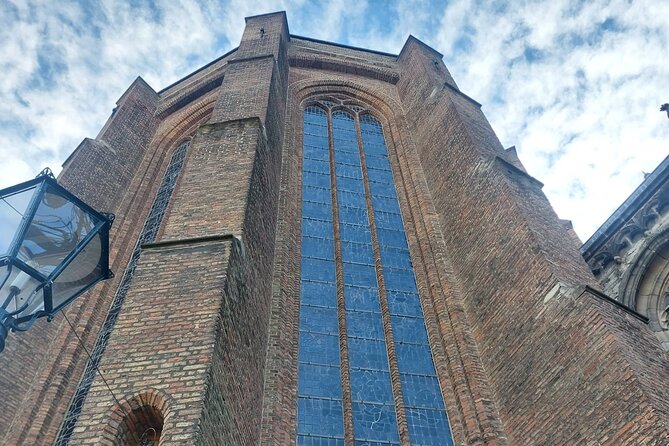
Across from the Old Church, the Prinsenhof occupies a former monastery. It later became the residence of William of Orange, often called the Father of the Fatherland.
The key event took place here in 1584, when William of Orange was assassinated. Your guide explains how that killing affected the future of the Netherlands and why Delft became so closely linked with the House of Orange.
This is one of the tour’s strongest history stops because the setting and the event are tightly connected. You are not hearing about a distant palace or battlefield. You are standing beside the place where a major political turning point occurred.
The 15-minute timing is enough for the essential story, but not enough for a full museum visit. If Prinsenhof is your main reason for coming to Delft, you may want to return separately. As part of this walk, though, it gives the city’s Golden Age story a clear human and political center.
Oude Delft canal and the Dutch battle with water
The route then follows the Oude Delft canal, where your guide points out the oldest surviving house in the city. Since 1645, the richly decorated building known as the Gemeenlandshuis van Delfland has housed the local Water Board.
This may sound less dramatic than royal burials or assassinations, but it is one of the most useful parts of the tour. A water board helped manage the conditions that allowed Delft and other Dutch towns to survive and prosper. Water management was not background administration. It could determine whether homes, farms, roads, and businesses remained safe.
You also get a better view of Delft’s canal structure here. The water is part of the city’s design, transport system, and risk. Your guide uses one building to explain a basic Dutch truth: keeping water under control required local cooperation, money, and constant work.
The canal walk also gives the tour some breathing room after the heavier stories at the Old Church and Prinsenhof. You can look at the old houses while the guide connects architecture to practical city life.
The Armamentarium, East India Company, and Vermeer’s viewpoint
Continuing south along Oude Delft, you pass impressive historic residences before reaching two reminders of Delft’s military and commercial power. One is the former state weapons armory, called the Armamentarium. The other is the main building of Delft’s chamber of the Dutch East India Company.
These sites widen the tour beyond churches and famous individuals. Delft played a part in the Dutch Republic’s military, maritime, and commercial expansion. The buildings help your guide explain how a city that can feel calm and intimate today took part in national and international affairs.
Nearby, you see the exact location where Johannes Vermeer stood when he painted View of Delft. This is a particularly satisfying moment for anyone interested in art. You are not simply told that Vermeer lived in Delft. You are shown a physical point where the city became an image.
The stop is still part of a fast walk, so you should not expect a long art lecture or a gallery session. What you get is a useful connection between the actual city and the painting. If you know View of Delft, the location gives the work a stronger sense of place. If you do not, it gives you a clear reason to look it up later.
The former synagogue and Delft’s Jewish community
Walking north along Delft’s second-oldest canal, once the city’s grain market, the tour passes the former synagogue of Delft. The building reflects the long presence of a Jewish community in the city.
This is a quieter stop, but it adds an important layer to the route. Delft was not only a city of princes, painters, officials, and merchants. Its streets also held communities with their own places of worship and traditions.
The canal itself helps explain how the city developed. A former grain market points to food supply and trade, while the synagogue points to the people who lived and worked within that urban system. Together, the two details make the route feel more grounded in daily life.
As with several stops, the value is in the guide’s explanation and the setting. The walk gives you context without pretending that every building can be explored at length in a two-hour schedule.
Beestenmarkt, the practical finish to the walk
The tour ends at Beestenmarkt, a former animal market just behind Markt. Today it is a picturesque social square lined with cafés and restaurants.
I like this ending because it is useful, not merely symbolic. After two hours of walking, you are already in a good place to pause, have a beer, grab a snack, or sit down for dinner. Your guide can offer local suggestions for the rest of your time in Delft.
The ending also makes navigation easy. You return close to where you began, so you do not have to figure out a complicated final transfer. If you were picked up in the city center, ask your guide for the clearest way to continue from Beestenmarkt.
Price, timing, and what you actually receive
The price is $203.22 per group of up to 15 people. That makes the value much better for a family or group of friends than for one or two people paying together. Split among 10 people, it works out to about $20 per person. For two people, the cost is much less attractive, though the privacy and flexibility may still justify it.
The tour lasts approximately two hours. Eight stops are listed at roughly 15 minutes each, with the remaining time used for walking and connecting stories. That tells you to expect a brisk overview, not long indoor visits.
The guide, fees, and taxes are included. The tour is offered in English, uses a mobile ticket, and can include pickup from any place in Delft’s city center if you request it. The official location information also identifies The Hague, so check the exact pickup arrangement when booking if you are staying outside Delft. The stated meeting point is the Hugo Grotius statue on Markt in Delft.
The tour is available as a private activity only, with your group participating on its own. Service animals are allowed, public transportation is nearby, and most people can take part. Still, you will be walking and standing for about two hours, so anyone who needs frequent rest should tell the guide at the start.
Free cancellation is available up to 24 hours before the local start time. Changes or cancellations inside that window are not accepted for a refund.
Who will get the most from this Delft walk
I would choose this tour for a first visit when you want a clear introduction without joining a large group. It is especially useful if you like history but prefer stories tied to real streets and buildings.
It also suits families and mixed-age groups. The guide can adjust the pace and answer questions instead of forcing everyone through a fixed script. One small child and one senior were accommodated by changing the plan slightly, which is a good sign for groups that do not move at exactly the same speed.
Art lovers will appreciate the Vermeer connections, while history-minded visitors will get more from the House of Orange, the Town Hall, the armory, and the East India Company material. Food-focused visitors should save the final minutes for local advice around Beestenmarkt.
I would think twice if you want extensive interior sightseeing, a museum tour, or a very slow photography walk. The route covers a lot, and its strength is the breadth of the introduction. You may need a separate visit to explore the New Church, Old Church, or Prinsenhof at length.
Should you book the Private Walking Tour of Delft?
Book it if you want efficient, private orientation with a guide who can explain why Delft matters, not just point at old buildings. The mix of Vermeer, William of Orange, Dutch water management, Jewish heritage, and Golden Age commerce gives you a fuller picture than a simple stroll around Market Square.
The strongest reasons to book are the private format, central route, flexible pace, and guides such as Robin and Matyas, whose style is described as friendly, funny, and adaptable. The perfect score from 33 reviews and 100 percent recommendation also support the tour’s reputation, though the short duration still limits how much you can see inside.
For a group of several people, the $203.22 price is sensible. For a couple, it is a premium introduction, but one that may save time and help you make better choices for the rest of your Delft visit.
FAQ
Where does the Delft walking tour begin?
It begins beside the Hugo Grotius statue on Markt, the historic Market Square in Delft.
Where does the tour end?
The walk ends back at the starting meeting point, close to the Market Square.
Is pickup available?
Yes. Pickup can be arranged from any place in Delft’s city center if you request it.
How long does the tour last?
The tour lasts approximately two hours.
Is this a private tour?
Yes. Only your group participates, and the price covers up to 15 people.
What language is the tour offered in?
The tour is offered in English.
Are entrance fees included?
The private guide, all fees, and taxes are included. The listed stops show free admission, but the tour schedule is designed around brief visits and guided explanations.
Can I cancel for a full refund?
Yes. You can cancel at least 24 hours before the experience start time for a full refund. Cancellations or changes made less than 24 hours before the start time are not accepted for a refund.
More Walking Tours in The Hague
- Food Walking Tour of The Hague – by Bites & Stories
★ 5.0 · 188 reviews - The Hague: City Walking Tour
★ 4.5 · 156 reviews - The Hague: Courtyard Walking Tour
★ 4.5 · 71 reviews - The Hague Walking Tour
★ 4.5 · 16 reviews
More Walking Tours in Delft
- Walking Tour of Delft – The City of Orange and Blue
★ 5.0 · 50 reviews - Delft 2-Hour Walking Tour | Discover The City With A Local
★ 4.5 · 8 reviews - Private Walking Tour: Delft’s Royal History and Pottery
★ 4.0 · 5 reviews - Delft: City Walk with Audio Guide in 7 Languages on your Phone
★ 5.0 · 4 reviews
Just added around The Hague
- Your Own Hague. Behind The Scenes of The Royal City★ 4.5 · 5 reviews
- e-Scavenger hunt The Hague: Explore the city at your own pace★ 3.5 · 10 reviews
- 3 Course Walking Dinner in Delft with Guided Tours in Between★ 5.0 · 3 reviews
- Delft: City Walk with Audio Guide in 7 Languages on your Phone★ 5.0 · 4 reviews
- Surfing at The Shore in The Hague★ 4.5 · 3 reviews
- The Hague Must-See attractions Private Walking Tour With A Guide★ 5.0 · 5 reviews
- The Hague: City Walk Audio Guide in 7 Languages on your Phone★ 3.5 · 5 reviews
- Surprise Walk of The Hague with a Local★ 4.5 · 3 reviews
Walking Tours, compared.

Anne Frank’s Story – Guided Walking Tour through Amsterdam
Read our review →
Life of Anne Frank and World War II Walking Tour
Read our review →
Absolutely Amsterdam – the Essential Introductory Walking Tour
Read our review →

Anne Frank Walking Tour – Guided in EN/DE/IT/ES
Read our review →


Anne Frank Walking Tour Amsterdam Including Jewish Cultural Quarter
Read our review →Browse the lists this tour appears in