
Reviewed · WALKING TOURS
Maastricht Private Walking Tour With A Professional Guide
Maastricht’s story runs from Roman settlement to the birth of the euro, and this private walking tour gives you one clear thread through it all. In about two hours, your local guide leads you from Markt through medieval lanes, old churches, wartime memories, and the political history tied to the Maastricht Treaty.
I like the customizable route, since you can ask for more architecture, religion, war history, or modern European politics. I also like the small private setting, which lets you ask questions and avoid the poor sight lines and fixed pace of a bus tour. The main concern is reliability: one booking went wrong when a guide mistakenly thought the tour had been canceled, so I would confirm the appointment shortly before arrival.
Key points to know
- Roman beginnings to the euro: The tour links Maastricht’s earliest settlement with the Maastricht Treaty and the creation of the European Union and euro.
- A private group of up to 15: You get your own guide rather than sharing the walk with strangers.
- A strong first look at the city: The route covers Markt, Vrijthof, major churches, Helpoort, and Sint Servaasbrug.
- Two hours on foot: This suits you best if you are comfortable walking through the historic center.
- Flexible conversation: You can ask your guide to adjust the focus during the tour.
- Entrance fees are extra: The experience is mainly an outdoor orientation walk, not a package of museum or church admissions.
Starting at Markt 52 in the heart of Maastricht
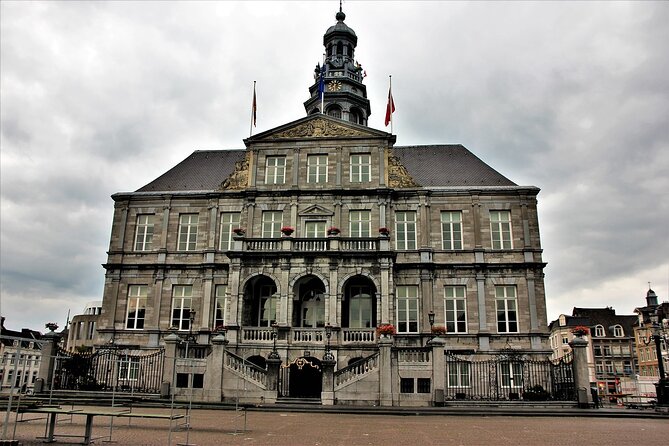
The tour begins at Markt 52, beside Maastricht’s central market square. This is a practical meeting point because the walk starts in the middle of the old city rather than at a distant transport stop or hotel pickup location.
Markt gives your guide an immediate place to explain how Maastricht developed. The square is also home to the City Hall, or Stadhuis, one of the key sights on the route. From here, you can expect the walk to move through the historic center on foot, with the guide using buildings and streets as the backdrop for the story.
You should arrive ready to walk for the full two hours. The route is designed for mobile visitors, and the short duration makes it a useful first activity after arriving in Maastricht. You get a broad orientation without giving up half a day.
The activity ends back at the meeting point. That makes planning easier if you want to continue exploring Markt, find lunch nearby, or use the square as your reference point for the rest of the day.
A few more days out around Maastricht worth weighing up
- Highlight Running Tour
★ 5.0 · 118 reviews - e-Scavenger hunt Maastricht: Explore the city at your own pace
★ 4.5 · 110 reviews - Maastricht: Museum of Illusions Entry Ticket
★ 4.2 · 82 reviews
City Hall and the old market quarter
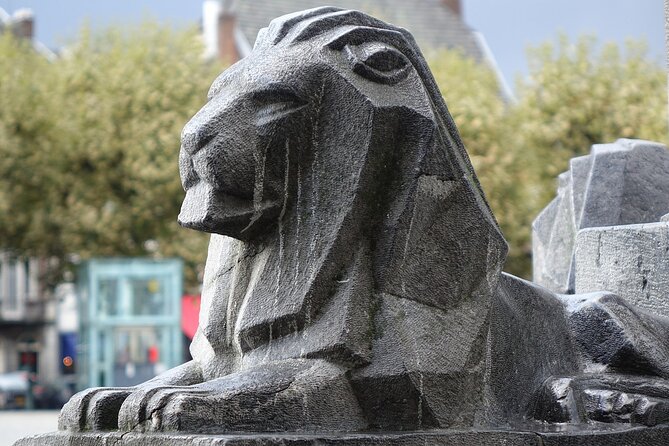
The City Hall provides one of the tour’s clearest introductions to Maastricht’s civic past. From this point, your guide can place the city’s political and commercial life in context before leading you farther into the old center.
You will also see the Street Market. Its presence helps connect the historic city with everyday Maastricht rather than presenting the old town as a collection of frozen monuments. I find this kind of stop useful because it gives the city a working center, not just a scenic one.
The walk from Markt also gives you an early chance to ask for a change of emphasis. If architecture interests you, ask for more detail about the buildings and street plan. If you are more interested in political history, ask your guide to keep the discussion moving toward Maastricht’s role in the Netherlands and Europe.
Dominican Church and Maastricht’s religious story
The Dominicans Church, or Dominikanerkerk, is another important stop. It brings the religious side of Maastricht into focus and helps explain why churches matter so much to the city’s identity.
The guide’s historical outline reaches back to the Middle Ages and the Carolingian Empire. You will also hear the legend of Saint Servatius, a central figure in Maastricht’s religious tradition. These stories give the city’s churches more meaning than a quick photograph can provide.
The tour also covers the religious wars of the 16th and 17th centuries. That period adds some needed complexity. Maastricht was not shaped by one uninterrupted religious tradition. Its churches, conflicts, and political changes reflect a city caught between larger powers and competing beliefs.
Entrance fees are not included. The information provided does not promise admission inside every church, museum, or historic building, so you should think of this as a guided city walk with exterior viewing unless your guide confirms that a particular interior visit can be arranged.
St. Servatius, St. John, and the Vrijthof
The route continues to St. Servatius Church, a major stop for understanding Maastricht’s religious and civic importance. The guide connects the church with the legend of Saint Servatius and the long development of the city around religious institutions.
You will also see St. John Church, or Sint-Janskerk, and the Museum Aan Het Vrijthof. The Vrijthof area brings several layers of Maastricht together in one setting. Churches, public spaces, and cultural institutions sit close enough to make the city’s past easy to read on foot.
Hendrik van Veldeke is included as another point of interest. The itinerary does not specify the full treatment of his connection to Maastricht, so you may want to ask your guide for more detail when you reach that part of the route.
This is where the private format has real value. In a large group, a guide has to keep moving and deliver the same speech to everyone. Here, you can stop for a question about a church, a local figure, or the difference between religious and civic power in the city.
More walking tours in Maastricht:
- Maastricht Privat Sightseeing City Walk
★ 5.0 · 76 reviews - 2H Walking Tour Maastricht
★ 4.8 · 57 reviews - Maastricht 2-Hour Walking Tour | Discover The City With A Local
★ 4.5 · 57 reviews - Best of Maastricht: Private Walking Tour with a Local
★ 5.0 · 10 reviews
Our Lady’s Church and the old defensive edge
The Church of Our Lady, or Onze-Lieve-Vrouwekerk, adds another major religious landmark to the walk. Together with St. Servatius and St. John, it gives you a useful way to compare Maastricht’s prominent churches rather than seeing just one isolated building.
The tour then reaches Helpoort, a surviving piece of the city’s defensive past. The name points to its role as a gate in the old fortifications, and the stop changes the mood from religious history to urban defense and movement through the city.
Pieke oet de Stokstraot is also included. This local point of interest gives the route a more personal and street-level feel. Not every stop is a grand church or official building, and that variety helps keep the walk from becoming a parade of major monuments.
You may find that the most useful part of this section is the connection between the sights. Churches, gates, narrow streets, and public spaces show how Maastricht grew as a real city, with practical needs as well as ceremonial ones.
Sint Servaasbrug and the city’s changing economy
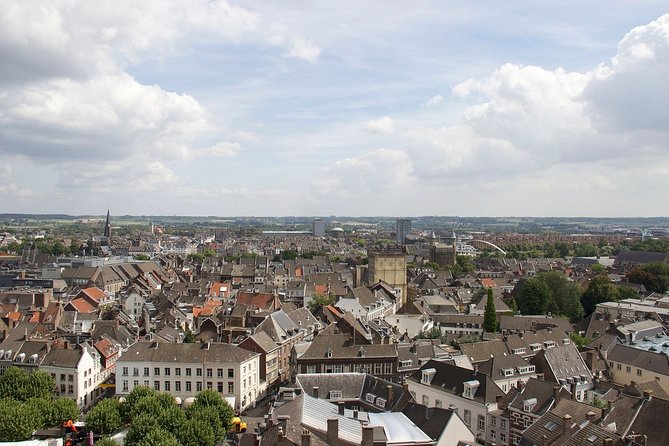
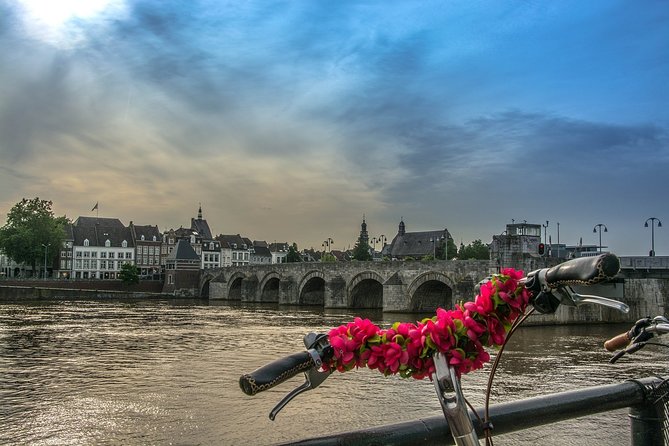
Sint Servaasbrug, or Saint Servatius Bridge, is one of the route’s most recognizable sights. A bridge is a simple way to explain Maastricht’s importance because it connects the city across the Meuse and helps you picture how people, goods, and armies moved through the region.
The historical account then turns toward the economic turnaround during the Industrial Revolution. This is an important shift. Maastricht was not only a medieval city preserved for modern visitors. It also had to adapt to new industries, new forms of work, and new economic pressures.
The tour also covers the Napoleonic era and the formation of the Kingdom of the Netherlands. Maastricht’s integration into the new kingdom was difficult, and that tension gives the city a different political character from a simple Dutch postcard town.
I would pay close attention here if you are interested in borders and national identity. Maastricht’s location helps explain why its history often involves larger powers, changing governments, and questions about where the city belongs.
War, refuge, occupation, and recovery
The tour includes Maastricht during World War I, when the city served as a haven for refugees. That detail adds a human side to the wartime story and shows how Maastricht was affected even when the main fighting was elsewhere.
World War II brings the German occupation into the account. The walk then moves into the post-war period, allowing you to see the city’s history as a sequence of disruption and recovery rather than a collection of disconnected dates.
The supplied details do not identify specific wartime buildings or memorials along the route, so you should not expect a dedicated museum visit or a long stop at one particular site. Instead, this part appears to be woven into the walk as your guide explains how Maastricht experienced these events.
That approach can work well in a two-hour introduction. You get the essential outline, then you can decide if you want to return later for a museum or a longer historical visit.
From the Maastricht Treaty to the euro
The final major historical theme is Maastricht’s place in modern Europe. The Maastricht Treaty helped establish the European Union and the euro, giving the city a role far beyond its medieval walls.
This is one of the tour’s most distinctive features. Many city walks focus only on old buildings, but this one connects medieval Maastricht with a major political agreement of the modern era. If European institutions, borders, or currency interest you, ask your guide to spend extra time on this part.
The tour does not promise admission to a treaty-related building or a formal political exhibit. Its value is the explanation of why the city’s name appears in discussions of the European Union. You leave with a better sense of how a historic Dutch city became associated with modern European cooperation.
For first-time visitors, this broad time span is useful. You do not need to know Maastricht before you arrive. The guide provides a basic framework, and you can use that framework to choose what to see afterward.
What the private format is worth at $275.65
The price is $275.65 per group, with up to 15 people included. That figure looks high for a two-hour walk if you are traveling alone or as a couple. It becomes more reasonable when shared by a family or larger private group.
At the maximum group size, the cost works out to about $18.38 per person. A group of five would pay about $55 per person, while two people would carry the full group price between them. The value therefore depends heavily on how many people are in your party.
The strongest benefit is control. You can ask questions without waiting for a large group to catch up, and the guide can adjust the discussion on the spot. You also avoid the limited views and fixed route of a bus tour, which matters in a historic center best experienced at street level.
The two-hour length keeps the cost from turning into a full-day commitment. Still, you should not book this expecting a series of included admissions or a long guided visit inside each landmark. Entrance fees are separate, so set aside additional money if you decide to visit museums or churches after the walk.
Who will get the most from this walk
I would recommend this experience most strongly to first-time visitors who want a clear introduction to Maastricht before exploring alone. The route covers enough major sights to help you understand the city’s layout, while the historical timeline gives meaning to what you see.
It also suits families or friend groups who want a private guide and can divide the cost. The ability to ask questions and change the emphasis is especially useful when a group has mixed interests.
You should choose it if you enjoy walking and prefer history explained beside the actual buildings. You may want a different activity if you have limited mobility, dislike walking, or mainly want interior visits and museum time.
The tour is private, and most people can participate. Service animals are allowed, and the meeting point is near public transportation. The available details do not specify the exact walking distance or whether every surface is suitable for mobility equipment, so ask the provider if that matters for your group.
Reliability, timing, and the small amount of risk
The posted experience has a 4.2 rating from six ratings, with strong praise for the overall route, easy walking pace, broad historical coverage, and patient guidance. One serious service failure is also recorded: a guide was absent after confusing this booking with another cancellation.
The provider accepted responsibility and explained that the guide was a licensed professional with more than 20 years of guiding experience. That background is reassuring, but it does not erase the practical lesson. I would keep your confirmation handy and contact Global Guide Services before the tour if you have any doubt about the start time.
One German-language comment specifically praised the guide’s patience after the group arrived late and said the guide still explained Maastricht from several angles. That suggests some flexibility, but you should not treat lateness as part of the service. Arrive at Markt 52 on time, especially because the activity is short.
Free cancellation is available until 24 hours before the local start time. If you cancel less than 24 hours ahead, you will not receive a refund, and changes inside that window are not accepted.
Should you book the Maastricht private walking tour?
Book it if you want a two-hour orientation with a wide historical range, especially if you are traveling with a group that can share the $275.65 cost. The combination of Roman origins, medieval churches, wartime history, and the Maastricht Treaty gives you more context than a quick sightseeing loop.
I would be less enthusiastic for a solo visitor or couple on a tight budget. The per-person cost rises quickly with a small party, and entrance fees are not included. In that case, compare the price with a standard group walk or explore the center independently.
For most first-time visitors in a family or private group, this is a useful opening look at Maastricht. Confirm the appointment, arrive ready to walk, and use the private format to shape the conversation around the parts of the city that interest you most.
FAQ
Where does the Maastricht private walking tour begin?
The tour begins at Markt 52, 6211 CK Maastricht, Netherlands.
Where does the tour end?
The activity ends back at the meeting point.
How long does the tour last?
The walking tour lasts approximately two hours.
How many people can join one private booking?
Up to 15 people can participate in one group.
Are entrance fees included?
No. Entrance fees are not included in the tour price.
Is the tour private?
Yes. Only your group participates in the activity, with a local guide assigned to your group.
Is the tour suitable for people who use public transportation?
Yes. The meeting point is near public transportation.
What is the cancellation policy?
You can cancel at least 24 hours before the local start time for a full refund. Cancellations or changes made less than 24 hours before the start are not accepted for a refund.
Just added around Maastricht
- e-Scavenger hunt Valkenburg: Explore the city at your own pace★ 4.5 · 20 reviews
- Maastricht Highlights, Architecture & Heritage Tour★ 5.0 · 7 reviews
- Maastricht Medieval Mystery: Interactive City Game & Tour★ 4.0 · 25 reviews
- Maastricht Heritage and Nature Tour★ 5.0 · 6 reviews
- Highlight Running Tour★ 5.0 · 118 reviews
- Discover Maastricht with a Smile! Culture, History and People★ 5.0 · 16 reviews
- Maastricht Self Guided Sherlock Holmes Murder Mystery Game★ 3.5 · 6 reviews
- Maastricht Evening Sightseeing Tour★ 4.5 · 7 reviews
Walking Tours, compared.

Anne Frank’s Story – Guided Walking Tour through Amsterdam
Read our review →
Life of Anne Frank and World War II Walking Tour
Read our review →
Absolutely Amsterdam – the Essential Introductory Walking Tour
Read our review →

Anne Frank Walking Tour – Guided in EN/DE/IT/ES
Read our review →


Anne Frank Walking Tour Amsterdam Including Jewish Cultural Quarter
Read our review →Browse the lists this tour appears in