
Reviewed · WALKING TOURS
Rotterdam Walk: Hilights, Gems, Architecture & WWII | 2 or 3hrs
Rotterdam’s story makes the most sense when you walk through its sharp contrasts: old harbor boats beside daring modern buildings, and wartime loss beside a city rebuilt with nerve. This tour ties those pieces together, from Museumpark to the Markthal, rather than treating each sight as a separate photo stop.
I like the WWII focus, especially the way the guide uses photographs to show what Rotterdam looked like before and after the 1940 bombardment. I also like the route’s range: river views, historic ships, public art, early skyscraper design, Cube Houses, and the colorful Markthal all fit into one morning or afternoon.
The main consideration is pace. You cover a lot in two to three hours, and most stops are short. That makes this a strong introduction, but not a substitute for entering museums or taking your time inside the Cube House and Markthal.
Why this Rotterdam walk earns a place on your first day

- WWII explained through the city itself: The route connects the invasion, bombardment, destruction, and reconstruction to real places and images.
- A useful mix of old and new: You move from the Museum District and historic shipping quarter to Cube Houses and the modern Markthal.
- Local storytelling: Guides such as Yoreh and Elmer bring personal knowledge, humor, city tips, and visual aids to the walk.
- Small-group feel: The group is limited to 15 people, which should make questions and guide contact easier.
- Strong river views: From Nieuwe Werk, you can see Hotel New York, the Steamship Rotterdam, and Erasmus Bridge across the Maas.
- A practical ending: The tour finishes inside Markthal, with time afterward to eat, browse, and visit the Cube House demo home on your own.
Rotterdam’s past begins at Museumpark
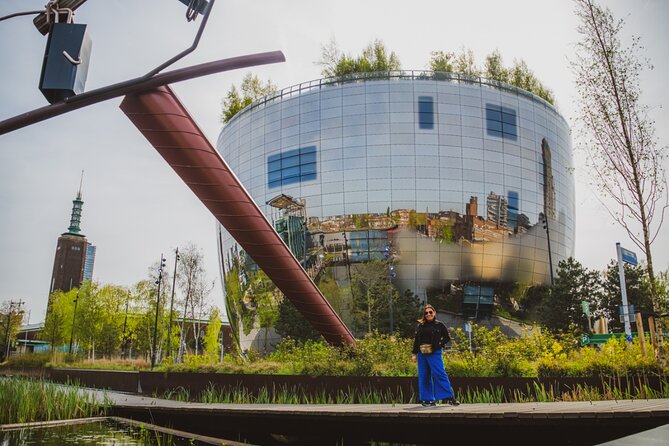
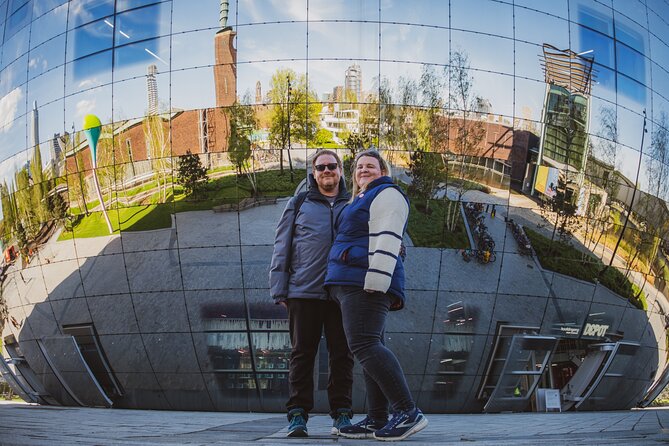
The walk starts at the Vaimoo shared-bike station beside Museumpark, near Depot Boijmans Van Beuningen. The mirrored depot is an eye-catching first stop, but the real purpose here is orientation.
Your guide introduces Rotterdam’s Museum District and the former Land of Hoboken. This gives you a sense of how the city organizes its art, parks, and public spaces before the route heads toward the river.
You do not pay an admission fee for this tour stop, and the visit lasts about 15 minutes. That is useful if you have limited time, though you should not expect a full museum visit. The depot is viewed as part of the city walk, not toured from inside.
I like this opening because it avoids dropping you straight into a list of famous buildings. You first get a broad sense of Rotterdam’s cultural center, then move into the city’s maritime and wartime story.
More Walking Tours in Rotterdam
- Rotterdam: Highlights & Gems Walking Tour with Dutch Local
★ 5.0 · 133 reviews - Rotterdam 2-Hour Walking Tour | Discover The City With A Local
★ 4.5 · 111 reviews - Walking Rotterdam Food Tour
★ 5.0 · 89 reviews
Nieuwe Werk opens the city toward the Maas
The route continues into Nieuwe Werk, also known as Het Scheepvaartkwartier, Rotterdam’s Shipping Quarter. This area offers a change of mood from the denser city streets. You get a wider view and a better sense of Rotterdam as a port city.
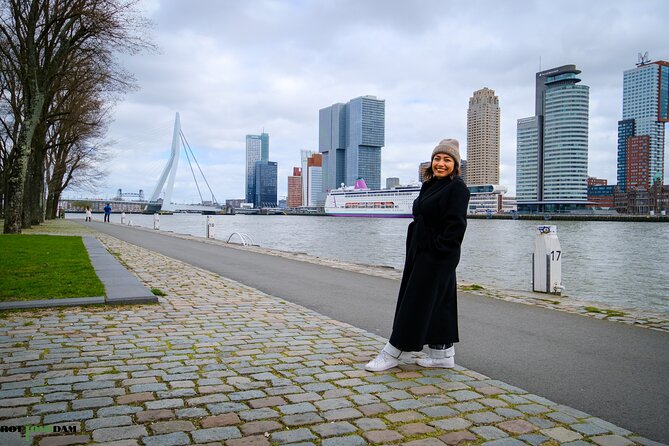
The riverfront is the reward. From here, you can see Hotel New York, the Steamship Rotterdam, and Erasmus Bridge. These sights help explain the city’s relationship with shipping, migration, trade, and the Maas.
The stop lasts around 30 minutes, making it one of the longer pauses. Bring a rain jacket if the forecast looks uncertain. The route depends on outdoor walking, and the riverfront can feel exposed in poor weather.
This is one of the tour’s best choices. You are not simply being led from one landmark to the next. You are given room to understand Rotterdam’s scale, its open waterfront, and its role as a working harbor city.
Erasmus Bridge puts the war story in place
Erasmus Bridge is Rotterdam’s modern symbol, a long white crossing over the Maas that links the northern and southern parts of the city. It is an obvious photo stop, but the guide uses it for something more important than architecture.
Here you hear about the Second World War, including the invasion and the bombardment of Rotterdam. The bridge and river provide a strong setting for explaining how the city’s center was destroyed and how its rebuilding shaped the Rotterdam you see today.
The stop lasts about 20 minutes. The tour does not include paid entry because the bridge is part of the public streetscape. You should expect stories and views rather than a climb or a special bridge experience.
The guide’s use of photographs is especially useful here. A verbal account of wartime destruction can feel distant. Seeing older images alongside the present-day streets helps you grasp the scale of the change.
This is where the walk’s central idea becomes clear: Rotterdam is not old in the way Amsterdam is old. Its identity comes from survival, rebuilding, and a willingness to try new forms.
The Maritime District turns boats into an open-air museum
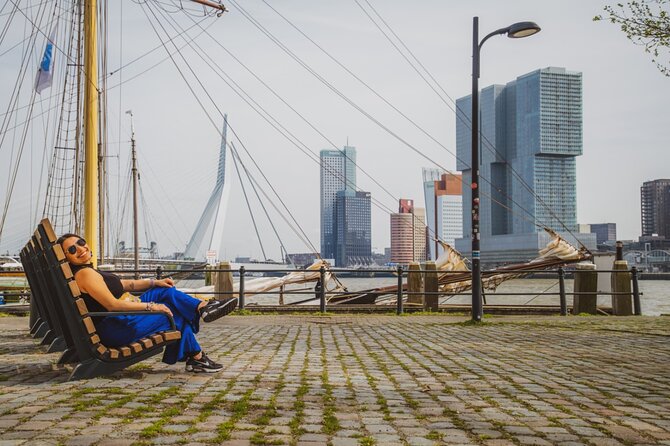
At the Maritime Museum area, the route passes historic boats, including vessels that are more than 100 years old. The stop takes roughly 10 minutes, so it is a quick look rather than a complete maritime visit.
Still, the setting adds texture to the walk. Rotterdam’s port past is not only displayed in museum cases. It is also visible in aging boats, harbor structures, and the water routes around the city.
You will want to pay attention to the guide’s explanation here, since the stop is brief. If ships are a major interest, save extra time for the Maritime Museum or return to this district later. The tour gives you context and a preview, not a full collection visit.
A few more days out around Rotterdam worth weighing up
- Rotterdam: Harbor Sightseeing Cruise
★ 4.3 · 7,599 reviews - Rotterdam: 1-Hour Sightseeing Splash Tour
★ 4.5 · 3,299 reviews - Rotterdam: Rotterdam Zoo Blijdorp Entry Ticket
★ 4.6 · 2,754 reviews - Rotterdam: Euromast Lookout Tower Ticket
★ 4.4 · 2,549 reviews
The Destroyed City gives Rotterdam a human voice
At Square 1940, you stop at Ossip Zadkine’s sculpture The Destroyed City. The work is one of Rotterdam’s key WWII memorials, and it gives physical form to the city’s grief.
This is a short stop of about 10 minutes, but it carries more emotional weight than some of the larger sights. The sculpture is not just another piece of public art. It connects the city’s broken center with the people who lived through the bombing and its aftermath.
The guide explains the meaning and history behind the statue. That context matters, because public art can be easy to pass without understanding. Here, the memorial becomes part of the route’s larger account of loss and renewal.
I appreciate that the tour does not treat WWII as a quick fact between architecture stops. The subject returns at several points, giving the history room to connect with the streets around you.
Witte Huis shows Rotterdam’s early modern ambition
The White House, or Witte Huis, is another useful contrast. Built as an office tower, it was once the tallest office building in Europe. The building points to Rotterdam’s early interest in height, commerce, engineering, and modern city design.
The stop lasts around 15 minutes. You learn why the building matters and how it fits into the city’s older harbor district. It also helps you see that Rotterdam’s modern character did not begin with the postwar reconstruction boom.
The Witte Huis is a reminder that Rotterdam has long been willing to build differently. Its importance is not based only on appearance. It represents the city’s confidence before WWII, making the later destruction and rebuilding story easier to follow.
Oude Haven brings back the pleasure of a small harbor
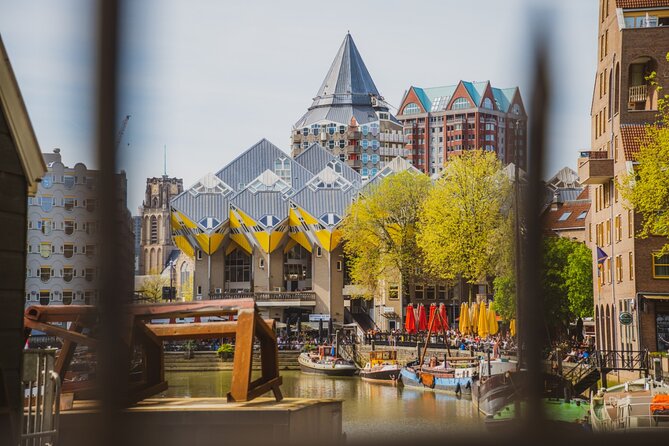
Oude Haven is one of the oldest harbors in the Netherlands, and the atmosphere changes again. After the broad views around Erasmus Bridge, this feels more intimate and relaxed.
The stop lasts about 15 minutes, with views toward the Cube Houses. You get a chance to see how Rotterdam places historic water, cafes, boats, and experimental architecture close together.
This is a good place to notice the tour’s balance. Rotterdam is often presented as a city of huge port facilities and dramatic new construction. Oude Haven shows a smaller, more comfortable side.
You should not expect a long break here, but the guide can point out details you may want to revisit. If you are planning an evening in the area, note the location for a later return.
Cube Houses explain architecture without jargon
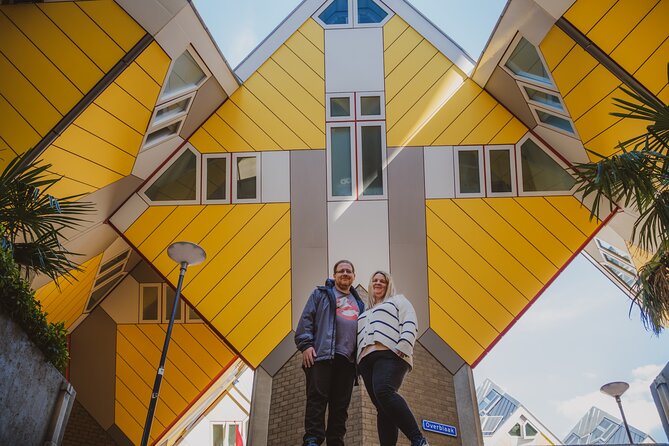
The Cube Houses, or Kubuswoningen, are among Rotterdam’s most recognizable buildings. The route takes you along Overblaak, through what feels like a concrete forest, while the guide explains the purpose, design, and unusual logic behind the houses.
The stop is about 10 minutes. That is enough for an explanation and a walk-through of the street, but it is short if you want interior photos or a careful look at how the homes work.
The tour ends later near the Cube Houses and Markthal, so you can visit the demo Cube House independently afterward. That is a valuable detail. You can first hear the explanation in context, then decide if you want to pay for and enter the sample home with more time.
I like having the Cube Houses near the end of the route. By then, you have heard about Rotterdam’s rebuilding and its taste for bold design. The houses no longer seem like a random oddity. They become part of the city’s larger experiment with space and urban living.
Markthal finishes the walk with color and food
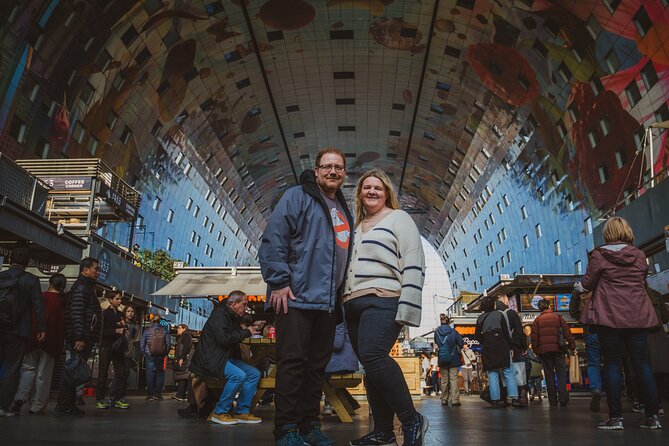
The final stop is Markthal, Rotterdam’s large indoor market and one of its most photographed modern buildings. The tour finishes inside, beneath the huge colorful artwork that has earned comparisons to the Sistine Chapel.
The stop lasts about 15 minutes, but you should plan extra time after the official walk. The market has food stalls and places to browse, making it an easy spot for lunch or a snack.
The guide explains the building and its ceiling artwork before leaving you to explore. That arrangement works well: you receive the architectural background, then have the freedom to look around at your own pace.
One practical tip is to avoid scheduling something immediately afterward. The Markthal is the natural place to linger, and the nearby Cube House demo home is also best visited when you are not watching the clock.
What the guide adds to the experience
The strongest part of this walk is the guide’s role. Yoreh is described as a Rotterdam local who brings energy, humor, and a strong grasp of the city’s past, present, and future. Elmer is also named as a host, praised for a good pace and for answering questions clearly.
The presentation includes visual aids, especially old photographs that show the city before and after WWII. That approach suits Rotterdam, where so much of what you see today is the result of rebuilding.
You can also expect practical advice about museums, buildings, gardens, food, and things to do after the walk. This is one reason to take the tour early in your stay. It can help you choose which places deserve a second visit.
The pace appears steady rather than rushed, but the route still covers nine stops. If you have mobility concerns, note that this is an outdoor walking tour lasting two to three hours. Service animals are allowed, most people can participate, and the group limit is 15.
Is $49.60 a fair price?
At $49.60 per person, the tour is priced above a free city walk but below many longer guided excursions. Its value depends on what you want from Rotterdam.
You are paying for a local English-speaking guide, a carefully connected route, historical explanation, visual material, and help planning the rest of your visit. You are not paying for museum admissions, a meal, private transport, or entry into the Cube House demo home.
I consider the price fair if you want a strong first look at the city and would otherwise spend time finding the major sites yourself. The route covers a lot of ground, and the WWII context gives it more substance than a simple photo walk.
It is less useful if you prefer long museum visits or independent wandering. Several stops last only 10 to 15 minutes, so you may still want a separate afternoon for the Maritime Museum, Markthal, or Cube Houses.
Group discounts may be available. The tour is also booked well ahead by many people, with an average booking lead time of about 49 days, so you should not assume a last-minute place during a busy visit.
Who should book this walk?
I would choose this tour for a first visit to Rotterdam, especially if you like architecture, urban history, ports, public art, or WWII sites. It also suits cruise passengers who want a meaningful city introduction before embarkation, since the route gives you a clear sense of what to revisit.
It is a good match for curious adults, older children who can manage several hours of walking, and anyone who prefers stories tied to visible places. The English presentation and small maximum group make it easier to follow and ask questions.
You may want another plan if you need a fully indoor activity, dislike walking in changeable weather, or want to spend most of your time inside museums. The experience requires good weather, and poor conditions can lead to a new date or a full refund.
Free cancellation is available up to 24 hours before the start time. If the minimum group size is not met, the provider offers another date or experience, or a full refund.
My call: book it early, then keep exploring
I recommend booking this Rotterdam walking tour early in your visit, ideally with free time afterward. The route gives you the city’s key design ideas, its harbor character, and its wartime story in one connected walk.
The best reasons to choose it are the visual WWII material, the local perspective from guides such as Yoreh, the river views, and the practical ending at Markthal. The main limit is the short time at each stop.
Book it if you want Rotterdam to make sense quickly. Skip it only if you already know the city well or would rather explore fewer places at a slower pace.
FAQ
How long does the Rotterdam walking tour last?
The tour lasts approximately two to three hours.
What language is the tour offered in?
The tour is offered in English.
Where does the tour start?
The meeting point is the Vaimoo shared-bike station at Melkkoppad, Museumpark 20, 3015 CX Rotterdam.
Where does the tour finish?
The tour ends inside Markthal at Verlengde Nieuwstraat, 3011 GX Rotterdam.
Are admission tickets included?
The listed stops have no admission charge as part of the walk. Entry to the Cube House demo home is not included and can be done independently after the tour.
How large is the group?
The tour has a maximum of 15 people.
Can I cancel the booking?
You can cancel up to 24 hours before the experience for a full refund. Changes or cancellations made less than 24 hours before the start time are not accepted for a refund.
Just added around Rotterdam
- e-Scavenger hunt Rotterdam: Explore the city at your own pace★ 4.5 · 13 reviews
- Rotterdam: City Walk Audio Guide in 7 Languages on your Phone★ 3.5 · 6 reviews
- Rotterdam Must Do Tour: Highlights, History, WW2 and Architecture★ 5.0 · 20 reviews
- e-Scavenger hunt Breda: Explore the city at your own pace★ 4.5 · 27 reviews
- Breda Fun Puzzle Quest: True Lord Self-Guided Tour★ 4.0 · 9 reviews
- Delfshaven Self-Guided Tour: A Guide to Rotterdam’s Old Town★ 5.0 · 4 reviews
- Skip the Line: SS Rotterdam Steam Ship Entrance Ticket★ 4.5 · 18 reviews
- Discover Rotterdam: Classic Highlights Bike Tour with a Local★ 5.0 · 22 reviews
Walking Tours, compared.

Anne Frank’s Story – Guided Walking Tour through Amsterdam
Read our review →
Life of Anne Frank and World War II Walking Tour
Read our review →
Absolutely Amsterdam – the Essential Introductory Walking Tour
Read our review →
Anne Frank Walking Tour – Guided in EN/DE/IT/ES
Read our review →

Anne Frank Walking Tour Amsterdam Including Jewish Cultural Quarter
Read our review →Browse the lists this tour appears in