
Reviewed · KINDERDIJK WINDMILL TOURS
8 hour Walking and Boat Tour to Rotterdam and Kinderdijk
Rotterdam is at its best when you read it as a city rebuilt with nerve. This tour moves from the modern sweep of Rotterdam Centraal and the Markthal to old ports, wartime memorials, bridges, and the 19 windmills of Kinderdijk. It gives you a useful two-part picture of the Netherlands: one city shaped by trade and reinvention, and one countryside shaped by water control.
I like the small private format, capped at four people, because a walking tour works better when the guide can keep the pace personal. I also like the mix of included extras: Rotterdam-style patatje oorlog, coffee or tea, bus tickets to Kinderdijk, and entry to the Kijk-Kubus apartments. The main consideration is stamina. You will walk for much of the day, and Kinderdijk admission costs an extra €19 per person.
- A private group of up to four: The small size should make it easier to hear Alex, ask questions, and adjust the pace within the tour’s limits.
- Rotterdam’s architecture in one route: You see the station, Markthal, cube houses, old harbor, modern bridges, and maritime waterfront.
- A clear water-management story: Kinderdijk gives the city tour a strong second act, with 19 authentic windmills from the first half of the 18th century.
- Useful inclusions: Coffee or tea, patatje oorlog, bus transport, guide service, and Kijk-Kubus entry are included.
- A serious walking day: The route is not a good choice if mobility is a concern, and comfortable shoes matter.
- Check the boat wording: The title refers to a walking and boat tour, but the supplied details list bus transportation to Kinderdijk and back, not a boat trip.
Why Rotterdam and Kinderdijk Work Together
At first glance, Rotterdam and Kinderdijk seem like different outings. One is a hard-edged port city filled with experimental buildings. The other is a quiet polder area marked by windmills and drainage channels.
The connection is water. Rotterdam grew around rivers, docks, shipping, and engineering. Kinderdijk shows the older, slower work of keeping water out of low-lying land. I like this pairing because it helps you understand Dutch practicality without turning the day into a classroom lecture.
The tour lasts about 7 hours 40 minutes, though it is marketed as an eight-hour experience. That is a full day, but the schedule has enough variety to keep it from feeling like one long architecture march. You move between streets, public squares, the riverfront, food, transport, and open countryside.
Starting at Rotterdam Centraal
The meeting point is at Stationsplein 48, beside Rotterdam Centraal Station. Plan to arrive ready to walk. The station itself receives an average of 170,000 passengers each day and is one of Rotterdam’s major architectural sights.
The opening 20-minute stop is a sensible orientation. Centraal is not just a place to meet. Its dramatic form introduces the city’s modern character before you begin looking at older buildings and industrial structures.
This is also the easiest point for public transport access, since the tour begins at the main railway station. The activity ends back at the same meeting point, which makes it practical if you are using Rotterdam as a base or arriving by train.
More Boat Tours in Rotterdam
- Rotterdam: Harbor Sightseeing Cruise
★ 4.3 · 7,599 reviews - Rotterdam: Pancake Cruise
★ 4.4 · 1,986 reviews - Rotterdam: Harbor Cruise with Live Guide
★ 4.0 · 1,270 reviews
From a Water Board Office to Rotterdam’s Oldest Building
The next stop, now associated with Rotterdam Partners, occupies a 17th-century building that once served as the headquarters of Waterschap Schieland. That institution handled water policy and management in this part of South Holland.
This stop adds useful context. Dutch water control is not only about windmills. It also depends on organized public bodies, local decisions, and long-term maintenance. The building is also connected with Napoleon Bonaparte, who used it as temporary accommodation.
You then reach the Grote of Sint-Laurenskerk, a late Gothic church completed in 1525. It is Rotterdam’s oldest building and one of the few structures to survive the Nazi bombing of May 15, 1940.
The visit here is brief, about 10 minutes, with free admission listed. Do not expect a long church visit. Instead, treat it as a sharp contrast with the city’s newer buildings and as a reminder of how much of Rotterdam disappeared during the war.
Erasmus, Markthal, and the Cube Houses
A 15-minute stop at the Erasmus sculpture introduces Desiderius Erasmus Roterodamus, better known as Erasmus of Rotterdam. He was a 16th-century philosopher, theologian, scholar, and priest. Rotterdam has named many public institutions and structures after him, so recognizing the figure helps you read the city’s civic identity.
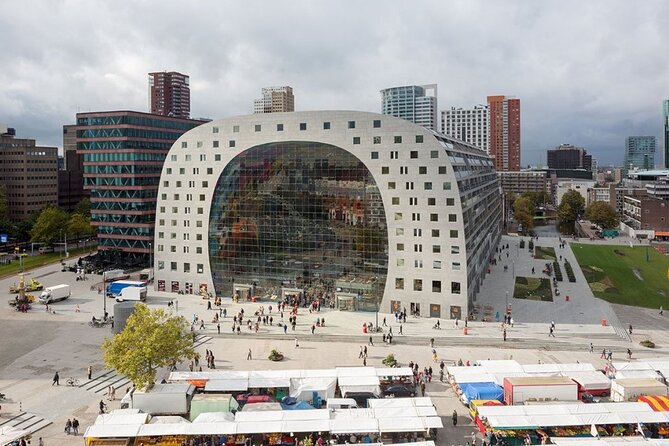
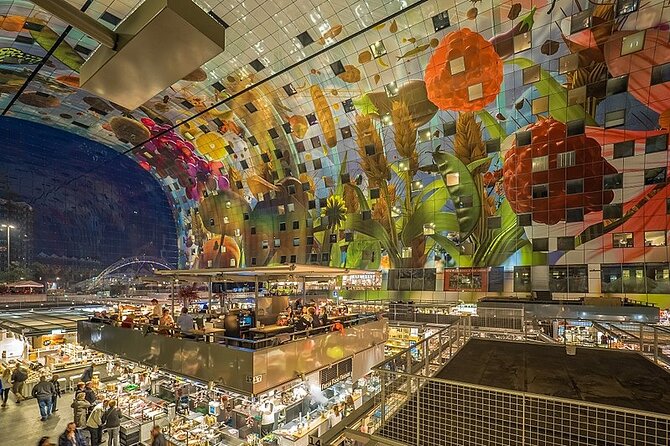
The Markthal gets about 20 minutes. This horseshoe-shaped building combines a covered market with housing and other facilities. Its huge interior artwork has earned it the nickname the Sistine Chapel of Rotterdam.
I like this stop for the simple reason that you can understand several sides of modern Rotterdam at once. It is a place for food, architecture, and daily life, not just a photo stop. The short visit means you may need to keep moving rather than browse every stall at leisure.
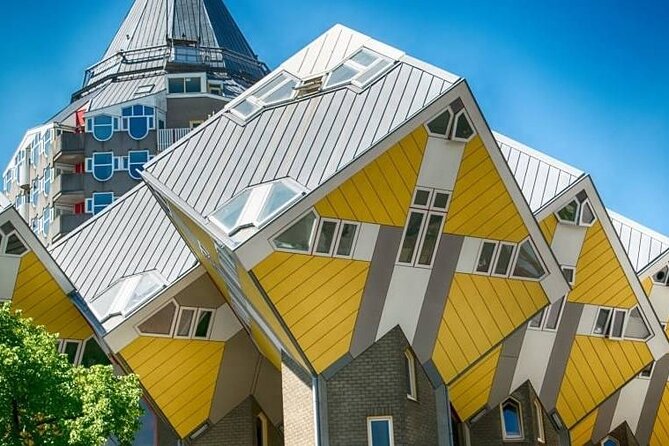
The Kijk-Kubus comes next, with entry included. These unusual cube-shaped homes sit on top of supporting columns and resemble a group of angled trees. Because of the design, only about three-quarters of the interior space is suitable for ordinary living.
This is one of the tour’s more useful inclusions. Looking at the outside tells you the buildings are odd. Entering one helps you understand the practical cost of that design. The visit takes about 20 minutes, so it is concise rather than a full architectural museum experience.
An Hour Around Oude Haven
Oude Haven is one of medieval Rotterdam’s oldest ports, though it is not the oldest. It was once the mouth of the River Rotte as it reached the Nieuwe Maas. Today, it is a social part of the city, with coffee bars, restaurants, taverns, and clubs.
The one-hour stop gives the walking portion some breathing room. This is where you can better sense Rotterdam as a working and social port rather than a collection of famous buildings.
The longer pause may also be the best moment to ask Alex questions about the city. His route covers a lot of ground, and the review information identifies him by name. He is described as well informed about Rotterdam, Kinderdijk, and the history of both places. His role matters here because the harbor’s importance is easier to grasp with a guide connecting the visible water, bridges, and buildings.
The included patatje oorlog is another practical touch. This famous Rotterdam snack is fries served with a combination of sauces. The name translates as war fries, but the important point for you is that the snack gives the day a local food break without requiring a separate restaurant stop.
More Walking Tours in Rotterdam
- Rotterdam Walk: Hilights, Gems, Architecture & WWII | 2 or 3hrs
★ 5.0 · 149 reviews - Rotterdam: Highlights & Gems Walking Tour with Dutch Local
★ 5.0 · 133 reviews - Rotterdam 2-Hour Walking Tour | Discover The City With A Local
★ 4.5 · 111 reviews - Walking Rotterdam Food Tour
★ 5.0 · 89 reviews
Witte Huis and Rotterdam’s Bridges
From Oude Haven, the tour continues to Witte Huis. Built in 1898, it was once Europe’s tallest building and is often described as the first skyscraper in Europe. Like many older Amsterdam buildings, it rests on 1,000 wooden pillars.
The stop lasts about 15 minutes. That is enough to take in the building and hear why its foundations matter, but not enough for an extended architectural study. It is a good example of Rotterdam’s earlier ambition before the city’s later experiments with concrete, steel, and glass.
Willemsbrug, known as the Red Bridge, gets another 15 minutes. Dedicated to Willem III, it is one of three Rotterdam bridges linking the central and northern parts of the city with southern districts.
Then comes De Hef, a large steel structure whose name means the Lift. It once operated as a rotating and lifting railway bridge across the Nieuwe Maas. It was used before a rail tunnel was dug beneath the river.
These stops are brief, but together they make the river crossing feel like a story of changing technology. You see an old rail solution, a major traffic bridge, and the city’s ongoing relationship with the Nieuwe Maas. If you prefer long interior visits, the pace may feel quick. If you enjoy seeing many distinct structures, it works well.
De Boeg and the Open-Air Maritime Museum
De Boeg is a war memorial on the right bank of the Nieuwe Maas. It honors the 3,500 people aboard Dutch merchant ships who died during World War II.
The 15-minute stop is quiet and purposeful. It keeps the port from being presented only as an economic success story. Rotterdam’s shipping links also carried danger, loss, and wartime responsibility.
The Maritime Museum Rotterdam follows at Leuvehaven. This is an open-air collection of steamships, cargo-handling machinery, ship engines, and other naval and shipping objects dating from the mid-19th century through the 1970s.
The tour allows about 20 minutes here, with free admission listed. That is enough to see the waterfront displays, but not enough to explore every object in detail. You should think of it as an outdoor introduction rather than a complete museum visit.
The Erasmus Bridge and the City View

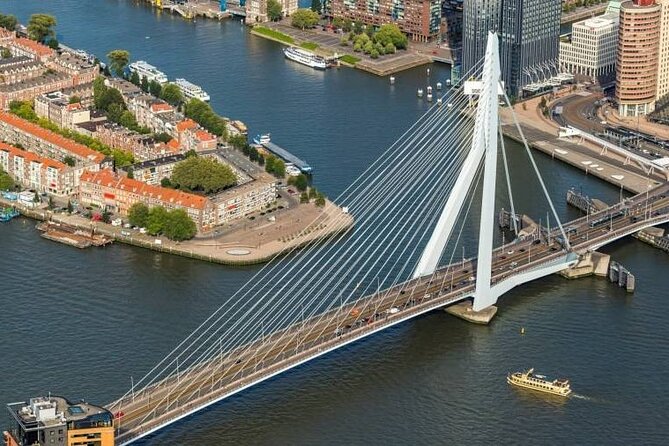
The Erasmus Bridge is the youngest bridge on the route and perhaps Rotterdam’s most recognizable modern symbol. Its nickname, the Swan, comes from its elegant shape, while another nickname compares it to a harp.
The bridge rises 139 meters and includes an 80-meter opening section, described as the largest and heaviest opening part of a bridge in Europe. The tour allows 30 minutes here, giving you more time than at several earlier structures.
This is likely one of the strongest photo stops. More important, it brings together many themes from the morning: river traffic, engineering, urban growth, and Rotterdam’s willingness to make bold public structures. The bridge is not merely a landmark to check off. It helps you see how the city’s center connects with districts south of the river.
Taking the Bus to Kinderdijk
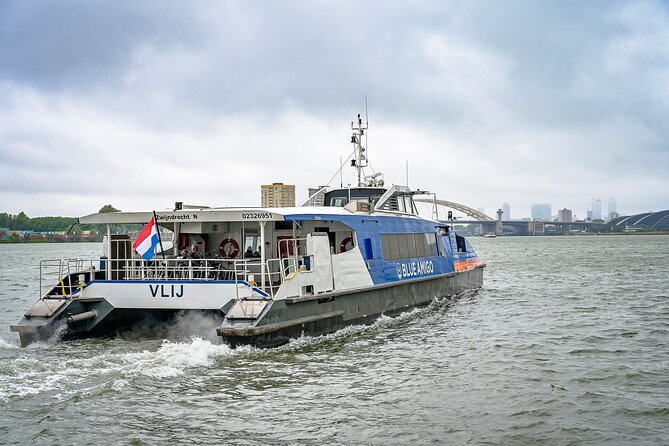
The supplied inclusions specify tickets for bus transportation from Rotterdam to Kinderdijk and back. That detail is important because the title mentions a boat tour, but no boat transport is listed in the included services. I would confirm the transport arrangement before booking if a boat ride is essential to you.
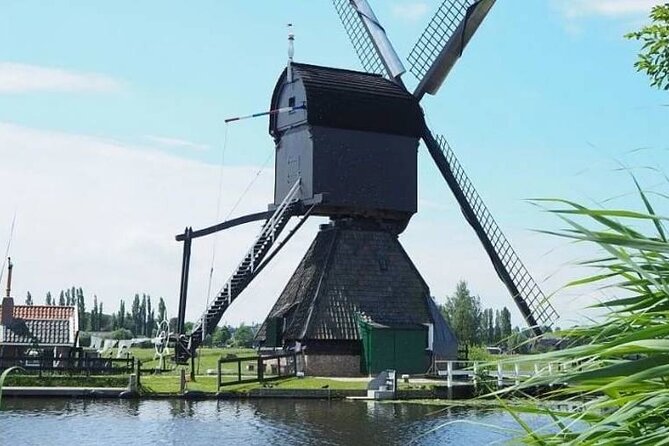
Kinderdijk is about 25 kilometers from Rotterdam. The change from city streets to polder country gives the day a welcome shift in pace. You are no longer looking upward at bridges and towers. You are looking across open land shaped by drainage and water control.
The tour allows three hours at Kinderdijk, by far the longest single stop. That amount of time matters. Nineteen windmills cannot be appreciated properly in a rushed photo stop, and the area’s value comes from seeing how the mills relate to the channels and low-lying land around them.
What Makes the 19 Windmills Special
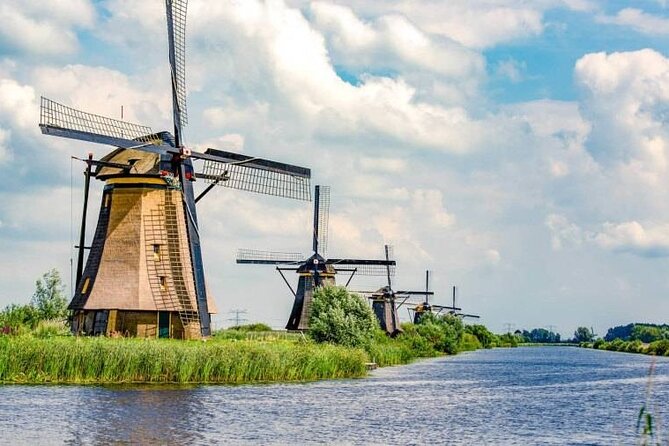
Kinderdijk’s 19 windmills date from the first half of the 18th century. They are described as unique and authentic, and the area is one of the clearest examples of organized Dutch water management across the centuries.
The windmills are not presented as isolated decorative objects. Their purpose was practical: helping move water out of polders. That is why the stop complements the earlier Waterschap building, the Rotterdam harbor, and the river bridges.
The €19 admission fee per person is not included. For a group of four, that adds €76 at the stated price, before any currency changes or booking conditions. Build it into your budget from the start.
Three hours is generous compared with the 10- to 30-minute city stops, but the setting is open and walking remains central. The pace may suit you if you want time to look carefully and connect the machinery with the surrounding water system. It may feel long if you only want a quick windmill photograph.
Is the $591.46 Group Price Good Value?
The listed price is $591.46 per group of up to four. Split four ways, that is about $147.87 each before the Kinderdijk entrance fee. Add €19 per person for admission, and the total cost rises further.
That is not a budget walking tour. The value comes from the private format, guide service, a full day of sightseeing, included bus tickets, the snack, coffee or tea, and Kijk-Kubus admission. You are also combining two destinations that would require separate planning.
For one or two people, the per-person cost is harder to justify. For four people who want a private guide and prefer not to organize the city route, transport, and Kinderdijk visit themselves, the calculation looks more reasonable.
I would compare this with the cost and effort of arranging several separate admissions and transfers. The tour is most useful when you value a clear route and personal explanation more than the lowest possible price.
Pace, Mobility, and What to Bring
This is a walking-heavy day. The provided practical information says most people can participate, but the direct experience feedback makes the limitation clear: it is not a good option if you have mobility concerns.
You should expect repeated walking between landmarks, standing during explanations, and more walking at Kinderdijk. The schedule does include food and drinks, but it is not built around long rest periods.
The group maximum of four is a real advantage for communication. Alex can speak to a small group rather than a crowd, and you should have more room to ask about the buildings, bridges, and water system.
The tour operates daily from 8:00 a.m. to 6:00 p.m. The listed operating period runs from April 11, 2023, through May 2, 2027. Confirmation is sent within 48 hours of booking, subject to availability. Free cancellation is available up to 24 hours before the start time. Late cancellations and changes are not accepted.
Who Should Book This Day
I would choose this tour if you want Rotterdam explained through architecture, shipping, war memory, and water engineering rather than only through its headline sights. It suits first-time visitors who want a structured day and small groups who can share the private price.
It also suits you if Kinderdijk is high on your list but you do not want to work out the bus connection yourself. The included transport removes one practical task, while the guide links the windmills to the city’s water story.
I would hesitate if you dislike walking, want a slow museum day, or expect a guaranteed boat journey. The supplied details support bus transport, not a boat ride, so confirm that point before paying.
FAQ
How long does the Rotterdam and Kinderdijk tour last?
The experience lasts approximately 7 hours 40 minutes and is marketed as an eight-hour tour.
Where does the tour start and finish?
It starts at Stationsplein 48, 3013 AJ Rotterdam, Netherlands, near Rotterdam Centraal Station, and ends back at the same meeting point.
How many people can join the tour?
The tour has a maximum of four travelers per group.
Is Kinderdijk admission included?
No. Admission to Kinderdijk costs €19 per person and is not included in the tour price.
Is transportation to Kinderdijk included?
Yes. Bus tickets from Rotterdam to Kinderdijk and back are included.
Is the Kijk-Kubus entrance included?
Yes. Entry fees for the Kijk-Kubus buildings are included.
Can I cancel for a full refund?
Yes, if you cancel at least 24 hours before the experience start time. Cancellations or changes made less than 24 hours before the start are not accepted and are not refunded.
More Kinderdijk Windmill Trips
- Rotterdam: Waterbus Ticket to Dordrecht and/or Kinderdijk
★ 4.6 · 542 reviews - All-Inclusive Private Windmill Tour to Kinderdijk from Rotterdam
★ 4.5 · 59 reviews - Kinderdijk Bike Tour
★ 5.0 · 35 reviews - Kinderdijk Area Cycling Tour
★ 5.0 · 17 reviews
Just added around Rotterdam
- e-Scavenger hunt Rotterdam: Explore the city at your own pace★ 4.5 · 13 reviews
- Rotterdam: City Walk Audio Guide in 7 Languages on your Phone★ 3.5 · 6 reviews
- Rotterdam Must Do Tour: Highlights, History, WW2 and Architecture★ 5.0 · 20 reviews
- Breda Fun Puzzle Quest: True Lord Self-Guided Tour★ 4.0 · 9 reviews
- e-Scavenger hunt Breda: Explore the city at your own pace★ 4.5 · 27 reviews
- Delfshaven Self-Guided Tour: A Guide to Rotterdam’s Old Town★ 5.0 · 4 reviews
- Skip the Line: SS Rotterdam Steam Ship Entrance Ticket★ 4.5 · 18 reviews
- Discover Rotterdam: Classic Highlights Bike Tour with a Local★ 5.0 · 22 reviews
Kinderdijk Windmill Tours, compared.
Kinderdijk UNESCO World Heritage Entry Ticket
Read our review →
All-Inclusive Private Windmill Tour to Kinderdijk from Rotterdam
Read our review →
Kinderdijk, The Hague, Mauritshuis Private Tour from Amsterdam
Read our review →
Kinderdijk Windmills and Delft Small-Group Tour from Amsterdam
Read our review →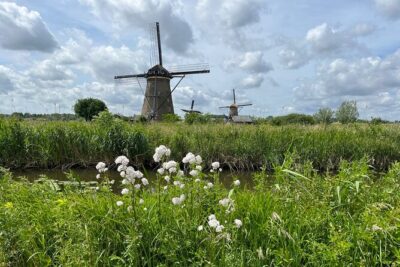
Kinderdijk Windmills, Delft City & Delft Blue Factory Visit
Read our review →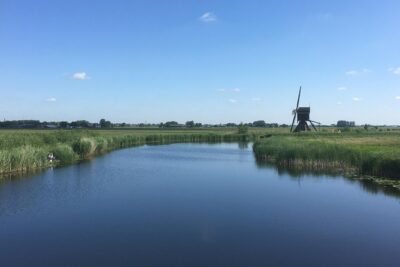
Browse the lists this tour appears in