
Reviewed · ANNE FRANK WALKING TOURS
Amsterdam: Life of Anne Frank and World War II Walking Tour
Anne Frank’s story becomes more meaningful when you place it in the Amsterdam streets where her family lived, worked, hid, and tried to survive. This two-hour walk links her diary to the wider story of the Jewish Quarter, German occupation, and Dutch Resistance.
I like the route’s strong sense of place, especially the Portuguese Synagogue, Auschwitz Monument, and Anne Frank House façade. I also like the choice between a shared group and private guide, with past guides such as Jonas, Manuel, Yoshi, Martina, and Florian praised for clear storytelling and care with difficult subjects.
The main limitation is simple: you do not enter the Anne Frank House. You see its exterior, so you must arrange that visit separately, and tickets often sell out months ahead.
Key points at a glance
- Anne Frank’s family story: Learn about her childhood, the Frank family’s move from Germany, life in hiding, and Otto Frank’s years after the war.
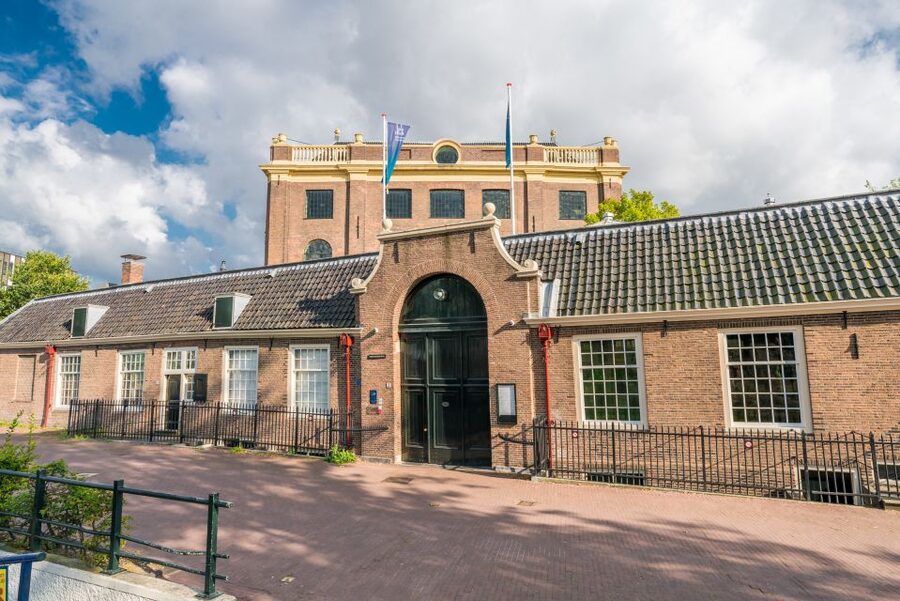
- Jewish Quarter landmarks: Begin near the 17th-century Portuguese Synagogue and walk past the Jewish Historical Museum.
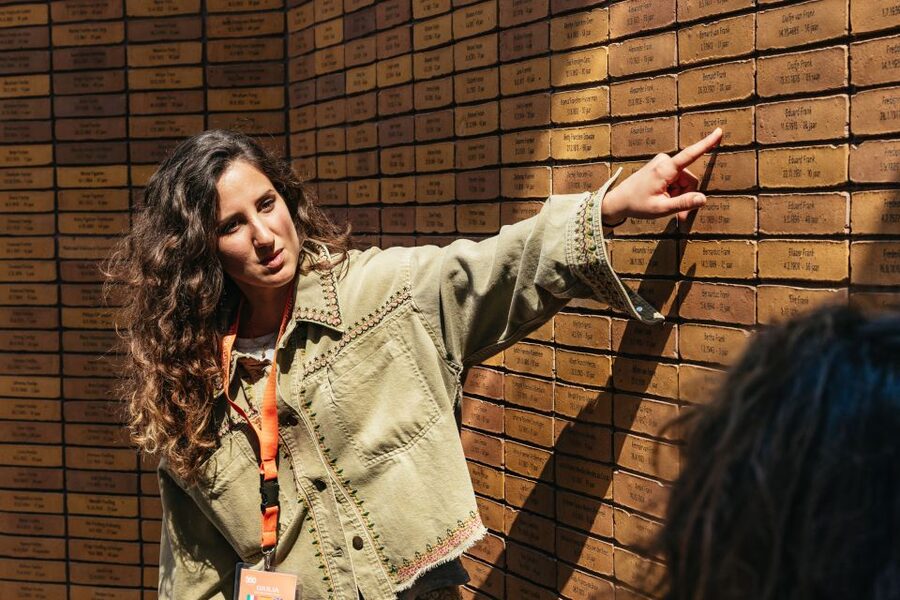
- Auschwitz Monument: Pause at a serious memorial site for reflection and context about the Jewish population lost during the war.
- Dutch Resistance stories: Hear how secret hiding places and resistance efforts fitted into Amsterdam’s wartime story.
- Flexible format: Choose a shared walking tour or book a private group, depending on availability and language needs.
- Good preparation matters: Wear comfortable shoes, bring water and a charged smartphone, and leave large bags behind.
Why this walking tour matters

This is not simply a tour about one famous diary. Anne Frank’s life makes more sense when you understand the community around her and the political events that changed Amsterdam.
Your guide connects several threads: the Frank family’s background in Germany, their move to the Netherlands, the conditions of Amsterdam in the 1930s and 1940s, the Nazi occupation, persecution of Jewish residents, resistance work, and Otto Frank’s life after the war. The result is a wider picture than you get from reading the diary alone.
I especially like this approach for a first visit to Amsterdam. The route helps you understand the city’s layout while giving you a clear historical frame. It also gives you places to pause, look around, and think instead of rushing from one famous address to another.
The subject is painful, and the best guides handle it with restraint. Guides such as Yoshi, Jonas, Julia, Florian, and Manuel have been described as passionate, careful, and good at answering questions. That matters here. A lively guide can hold your attention, but the tone must remain respectful.
More Walking Tours in Amsterdam
- Anne Frank’s Story – Guided Walking Tour through Amsterdam
★ 5.0 · 11,619 reviews - Absolutely Amsterdam – the Essential Introductory Walking Tour
★ 5.0 · 3,629 reviews - Amsterdam: Anne Frank Guided Small Group Walking Tour
★ 4.8 · 2,722 reviews
Starting beside the Portuguese Synagogue
The tour begins outside the Portuguese Synagogue, a 17th-century Sephardic synagogue that still functions as a place of worship. It is a useful starting point because it introduces Amsterdam’s Jewish community before the Second World War, rather than beginning only with tragedy.
Your guide explains how the original Jewish neighborhood developed over the centuries and how different Jewish communities shaped this part of the city. The Portuguese Synagogue also gives the tour an important time scale. The story is not only about the 1940s. It reaches back through generations of religious, cultural, and family life.
You should expect to remain outside during this walking route. The synagogue is a landmark and an entry point for the discussion, not a promised interior visit.
This opening section is particularly useful if Amsterdam is new to you. It gives you a sense of the Jewish Quarter before the group moves into the wartime period. I find that context helps prevent Anne Frank’s story from becoming detached from the people and neighborhood around it.
Anne Frank’s childhood and the family story
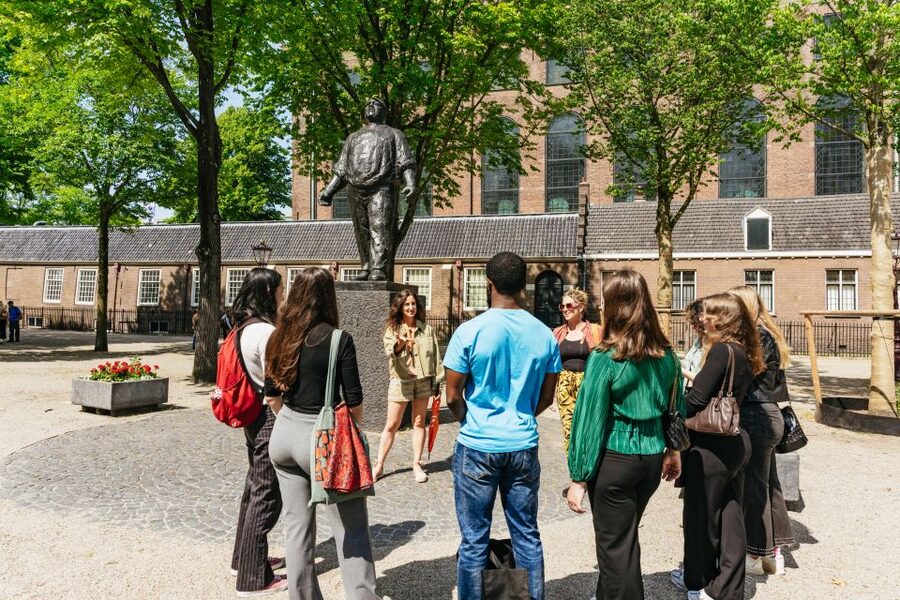
From the Jewish Quarter, the guide turns to Anne Frank’s personal story. You hear about her love of writing, her family dynamics, and the move from Germany to Amsterdam.
The focus is not only on Anne as a gifted writer. You also learn about the family relationships and the circumstances that shaped her short life. The tour addresses the family’s time in hiding and the later life of her father, Otto Frank, after the war.
That last part is important. Many visitors know Anne’s diary but know less about what happened to Otto Frank afterward, including his role in bringing the diary to the public. The walking tour places the diary within the family’s larger story.
A good guide will also explain how the diary became famous. You are not simply told that it is an important book. You get a sense of Anne’s ambition as a writer and why her words reached far beyond the small rooms where she wrote.
The reviews of individual guides point to a recurring strength here: clear storytelling that works for both adults and teenagers. Manuel, for example, was praised for making the material interactive for mixed-age groups. That makes this a sensible choice for families, provided younger children can manage two hours of serious historical discussion.
The Jewish Historical Museum and Amsterdam’s Jewish Quarter

The route passes the Jewish Historical Museum, one of the key landmarks in Amsterdam’s Jewish Cultural Quarter. The tour does not include museum admission, but the exterior becomes part of the walk and gives your guide another place to explain the community’s past.
This stop helps broaden the story beyond the Frank family. You learn about Jewish life in Amsterdam, the development of the neighborhood, and what changed under German occupation. The guide’s job is to connect the physical streets with the people who once lived in them.
You may notice that the tour is less about entering attractions and more about building a narrative as you walk. That is both its strength and its limit. You cover several meaningful locations in a short time, but you do not spend long inside a museum or historic building.
If you want a detailed museum visit, plan the Jewish Historical Museum separately. If you want a guided introduction that ties the quarter to Anne Frank and the war, the exterior commentary should give you a helpful foundation.
More Anne Frank and Jewish Quarter walks:
- Amsterdam: Anne Frank Walking Tour – Guided in EN/DE/IT/ES
★ 4.9 · 2,676 reviews - Anne Frank Walking Tour Amsterdam Including Jewish Cultural Quarter
★ 5.0 · 1,879 reviews - Anne Frank’s Last Walk & See Anne Frank House in Virtual Reality
★ 5.0 · 957 reviews - Anne Frank and Jewish Quarter Amsterdam Private Walking Tour
★ 5.0 · 684 reviews
The Auschwitz Monument and time for reflection

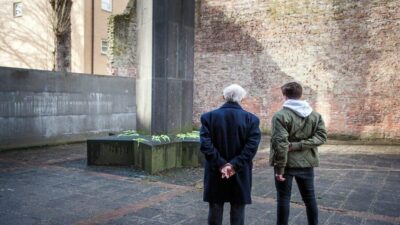
The Auschwitz Monument is one of the most serious stops on the route. Here, the subject moves from historical explanation to remembrance.
Your guide explains the scale of the loss and gives you time to take in the memorial. This is not a photo stop in the usual sightseeing sense. It is a place to slow down and think about the lives destroyed during the Holocaust and the effect on Amsterdam’s Jewish community.
One guide, Florian, was praised for allowing time to walk through the memorial area and making sure the group understood the number of lives lost. That detail captures what you should expect from a good version of this tour: information, but also space for silence and personal reflection.
The stop can be emotionally heavy. I would not book this as a light introduction to Amsterdam or squeeze it between two rushed attractions. Give yourself room afterward. The walking tour ends back at the meeting point, but the subject may stay with you for the rest of the day.
Dutch Resistance and wartime Amsterdam

The tour also covers the Dutch Resistance during the Second World War. This adds an important layer because wartime Amsterdam was not only a place of occupation and persecution. It was also a city where people made difficult choices, helped others, hid people, or resisted German rule.
Your guide points out areas connected with secret hiding places and explains how resistance fitted into the wider occupation of the Netherlands. The exact stories and emphasis can vary with the guide, but the goal is to show how ordinary streets became part of a dangerous wartime world.
This section helps you understand why Anne Frank’s hiding place was possible at all, and why it was so perilous. The tour does not promise access to hidden rooms or private interiors. Instead, it uses the city itself as the setting for the explanation.
I appreciate this part because it keeps the walk from becoming a single-family biography. Anne Frank remains central, but the guide also discusses the Jewish community, Dutch society, and the choices made under occupation.
Seeing the Anne Frank House from outside
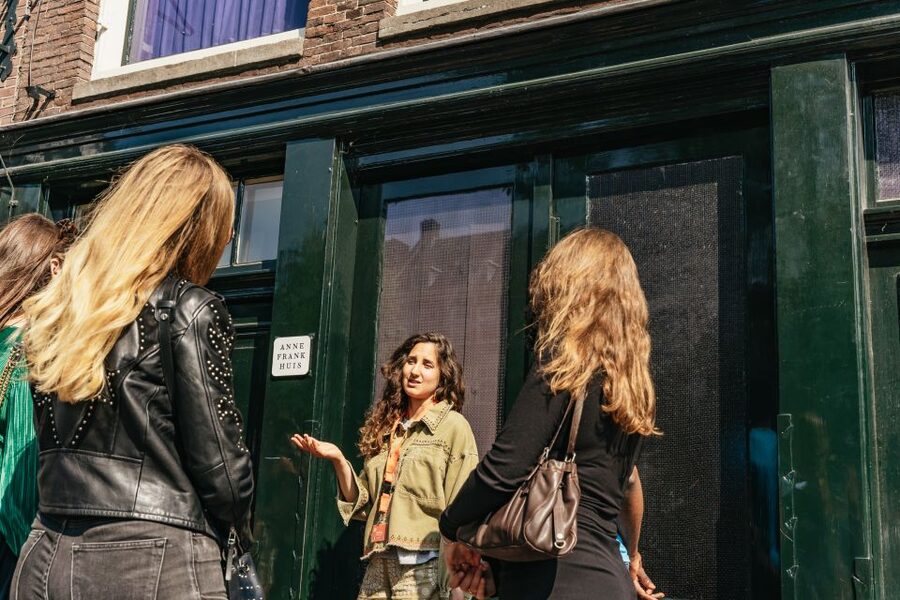
The final major point of interest is the outside façade of the Anne Frank House. You do not enter the building, and you do not receive an Anne Frank House ticket with this tour.
That distinction deserves emphasis. If your main aim is to see the Secret Annex interior, this walking tour is not a substitute. Book the house separately, ideally a few months ahead, because admission commonly sells out in advance.
Still, seeing the exterior can be worthwhile. After hearing the story of Anne’s family, hiding, writing, and postwar legacy, the building becomes more than an address. You arrive with context, which can make a later interior visit more meaningful.
Several guides have also been praised for making the tour worthwhile for people who could not secure Anne Frank House tickets. That is fair, as long as you understand what you are buying. This is a historical walking tour that includes the façade, not an entrance tour.
Shared group or private guide?
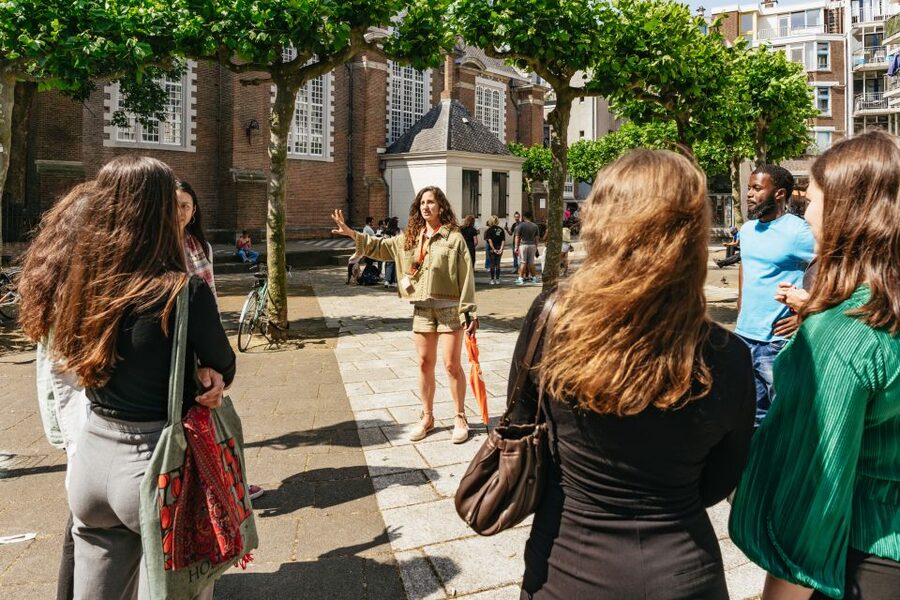
You can choose a small-group format or a private group, depending on the option and language available.
A shared tour usually makes sense for solo visitors, couples, and families who want a lower price and the energy of a group discussion. The listed price is $37 per person, which is reasonable for two hours with a live professional guide and several significant locations.
A private option costs more in many tour setups, though the supplied details do not give a separate private price. Its value depends on your priorities. A private guide can be a better fit if your group wants to ask many questions, needs a particular pace, or prefers a more personal conversation about the subject.
Language choice requires care. Live tours may be available in Dutch, German, Portuguese, Italian, English, Spanish, and French, but shared and private options do not always offer the same languages. Check the exact option before booking, especially if you are choosing a language other than English.
What the two-hour timing feels like

Two hours is enough for a focused introduction, but not enough for long visits inside several sites. The tour is a walking route with commentary, exterior stops, and memorial pauses.
You should wear comfortable shoes and bring water. Amsterdam’s streets are easy to walk in some areas, but you will be on your feet for the full activity. A charged smartphone is also requested, which may be useful for your booking details and meeting-point information.
Meeting points can vary by the option you select. Check your confirmation carefully rather than assuming every departure begins at the Portuguese Synagogue. The activity ends back at the meeting point.
Large bags and luggage are not allowed. This is worth planning around if you are arriving from the airport, checking out of a hotel, or moving between accommodations. Leave your suitcase elsewhere before joining the group.
The tour may run a little longer than the stated two hours. One guide, Yoshi, was reported to have taken about two and a half hours. That may be welcome if you enjoy extra stories, but leave a buffer before a timed attraction, train, or meal reservation.
Is $37 a good value?
At $37 per person, you are paying mainly for interpretation, not admission tickets. There is no entrance to the Anne Frank House, Jewish Historical Museum, or Portuguese Synagogue included.
I consider the price fair if you want a guide to connect the locations and explain the period in a thoughtful way. Walking the same streets on your own costs less, but you would need to research the Frank family, Jewish Amsterdam, the occupation, resistance work, and the memorials yourself.
The value also depends on your guide. The strongest sessions appear to rely on guides who tell stories clearly and adjust their pace to the group. Names associated with especially strong sessions include Jonas, Manuel, Yoshi, Martina, Florian, Julia, Arthur, Henk, Peter, Sasha, Kiran, Giovanni, and Janet.
Do not book this expecting a museum-heavy outing or a simple sightseeing loop. Book it for the human stories, historical connections, and chance to ask questions while moving through the city.
Who should book this tour?
I would recommend it to first-time Amsterdam visitors who want historical context early in their stay. It is also a good choice if you have read Anne Frank’s diary, plan to visit the Anne Frank House, or could not obtain a house ticket.
Families with teenagers may find it especially useful because guides have handled mixed ages well. The material is serious, so parents should decide if two hours about persecution, hiding, and mass murder is suitable for their children. Children up to age three can join free.
This tour also suits people who prefer a guide to a self-guided audio walk. You can ask questions, hear extra stories, and get a better sense of how the Jewish Quarter fits into Amsterdam’s wider city plan.
I would skip it if you only want to enter the Anne Frank House, dislike walking, or have no time for a solemn subject. In those cases, the tour’s price and two-hour commitment may not match what you want.
Should you book it?
Book this tour if you want Anne Frank’s story placed within the Jewish Quarter and the wider experience of wartime Amsterdam. The Portuguese Synagogue, Jewish Historical Museum, Auschwitz Monument, Dutch Resistance stories, and Anne Frank House façade create a well-linked route.
At $37, it is a sensible introduction, especially with free cancellation up to 24 hours before the start and the option to reserve now and pay later. Just confirm the meeting point and language, wear good shoes, and arrange Anne Frank House tickets separately well in advance.
FAQ
Does the tour include entrance to the Anne Frank House?
No. The tour includes an exterior view of the Anne Frank House façade, but admission and tickets to the house are not included.
How long does the walking tour last?
The stated duration is two hours. Some sessions may run longer, so allow extra time if you have another timed booking afterward.
What locations are included?
The route begins outside the Portuguese Synagogue and passes the Jewish Historical Museum, Auschwitz Monument, and Anne Frank House façade. It also includes discussion of the Jewish Quarter, Dutch Resistance, and wartime hiding places.
Is this a shared or private tour?
You can choose a small-group or private guided option, depending on availability.
Which languages are available?
Live tours may be offered in Dutch, German, Portuguese, Italian, English, Spanish, and French. The available languages can differ between shared and private options, so check the exact choice before booking.
What should I bring?
Bring comfortable shoes, water, and a charged smartphone.
Can I bring luggage?
No. Luggage and large bags are not allowed on the tour.
Can young children join?
Children up to three years old can participate for free.
Can I cancel for a full refund?
Yes. You can cancel up to 24 hours in advance for a full refund. You can also reserve now and pay later, according to the booking terms.
Just added around Amsterdam
- From Amsterdam: The Hague Private Trip and Mauritshuis Entry★ 4.3 · 4 reviews
- VIP Private Full Day Tour of the Netherlands★ 4.8 · 6 reviews
- Amsterdam Old-West Vegan Food Tour with Local Guide★ 4.7 · 3 reviews
- Vecht River: Full-day Cruise with Lunch★ 4.8 · 9 reviews
- Amsterdam: Van Gogh Museum Guided Tour★ 4.8 · 262 reviews
- Van Gogh Museum Private Guided Tour★ 4.2 · 10 reviews
- Van Gogh and Rijksmusuem Tour: Small Group Tour with Entry★ 4.7 · 3 reviews
- Amsterdam: Van Gogh Museum Ticket & Guided Tour★ 4.4 · 187 reviews
Anne Frank Walking Tours, compared.

Anne Frank’s Story – Guided Walking Tour through Amsterdam
Read our review →

Anne Frank Walking Tour – Guided in EN/DE/IT/ES
Read our review →
Anne Frank Walking Tour Amsterdam Including Jewish Cultural Quarter
Read our review →
Anne Frank’s Last Walk & See Anne Frank House in Virtual Reality
Read our review →
Anne Frank and Jewish Quarter Amsterdam Private Walking Tour
Read our review →
Browse the lists this tour appears in