
Reviewed · HISTORICAL TOURS
Historical Walking Tour, private with local Dutch guide
Amsterdam reveals itself best on foot, and this private walk begins at one of its oldest surviving landmarks, the Weeping Tower. From there, you follow the city’s growth from medieval dike town to trading power, passing old gates, canal houses, Dam Square, and the Jordaan before finishing near Westerkerk and the Anne Frank House. Guide Anna, who has lived in Amsterdam for 25 years, brings the past into ordinary streets and buildings.
I like the private format, since your group can ask questions, adjust the pace, and focus on interests such as Jewish history, architecture, art, or daily life. I also like the practical start to a visit: you learn how the old center fits together instead of wandering through it without a map. The main consideration is physical. You will walk and stand for about two hours, and mobility aids are not available.
Key points at a glance
- A medieval starting point: Meet at the Weeping Tower, one of Amsterdam’s few remaining traces of the Middle Ages.
- A private guide named Anna: Her 25 years living in Amsterdam help connect major sights with local stories and present-day life.
- A clear historical route: Move from the old sea dike and city gate to the Dutch East India Company, Dam Square, and the Golden Age canals.
- Time in the Jordaan: Thirty minutes are set aside for Amsterdam’s café-lined, boutique-filled neighborhood rather than just a quick photo stop.
- A useful first-day walk: The route ends near Westerkerk and the Anne Frank House, making it handy early in your stay.
- A personal pace: Only your group participates, with room for questions, pauses, and interests that may not fit a large group tour.
Why this walk works as an Amsterdam introduction
Amsterdam can feel confusing at first. The old center is compact, but its streets bend around canals, bikes appear from every direction, and several districts seem to blend into one another. This walk gives you a basic map in your head while explaining why the city looks the way it does.
The route has a sensible story. You begin at the edge of the old settlement, see how water shaped the town, learn about trade and city power, then move through the grander canal districts and into the Jordaan. By the time you reach Westerkerk, you have seen several different versions of Amsterdam rather than a string of unrelated sights.
Anna’s role matters here. The strongest part of the experience is not simply naming buildings. It is her ability to connect architecture, trade, religion, war, art, and ordinary city life. She also has a dry sense of humor and speaks clear English, two qualities that help when the subject turns serious or complicated.
The private setup gives you more control than a standard city walk. You can ask why a house is narrow, how the canals were planned, or how Amsterdam’s trading past still shapes the city. You may also ask for recommendations after the walk. Anna has given suggestions for places to explore later, and one group made stops for snacks along the way.
More History Tours in Amsterdam
- Amsterdam Food and Cultural Tour with Tastings
★ 5.0 · 2,442 reviews - Amsterdam: Haunted History and Ghost Walking Tour
★ 4.5 · 488 reviews - Amsterdam High-End Dutch Food & History Tour – Up to 8 guests
★ 5.0 · 482 reviews
Starting at the Weeping Tower and the old sea wall
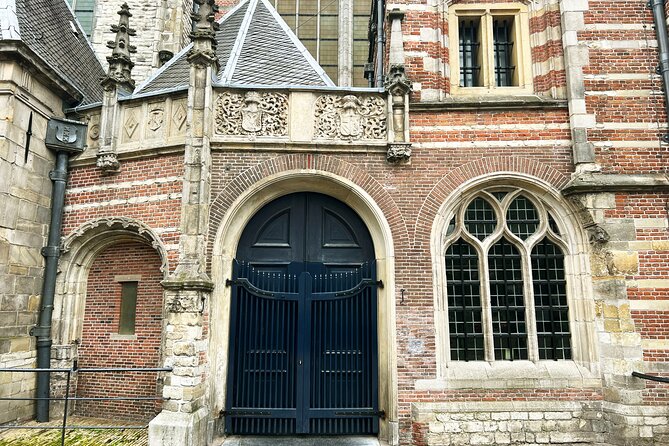
The meeting point is Café the Schreiertower at Prins Hendrikkade 95, close to Amsterdam Centraal Station. The tower is also called the Weeping Tower, and it is a fitting place to begin because it is one of the city’s few remaining medieval watchtowers.
Your first few minutes are used for an introduction to Amsterdam’s origins. This is more useful than it sounds. Instead of starting with the postcard canals, you begin with a town built around water, defense, shipping, and the need to keep the sea outside the streets.
From here, the group walks to Zeedijk, one of Amsterdam’s oldest streets. Its name points to its original job: it functioned as a sea dike, with locks that helped protect the settlement from flooding. The stop is brief, but the idea is important. Amsterdam’s celebrated canals are not just pretty waterways. They are part of a long effort to control water and make urban life possible.
You should expect a few short explanations rather than long periods at each early stop. The five-minute pauses at the Weeping Tower, Zeedijk, the Waag, and several later buildings keep the walk moving. Anna’s storytelling fills in the gaps as you walk between them.
The Waag and the city’s fortified edge
The Waag was once a medieval city gate linked to a defensive wall and moat system. It later took on other urban roles, but the key point on this tour is its place in Amsterdam’s early defenses and city boundaries.
This stop helps you see that the old center was not planned as a neat tourist district. It grew in layers. A gate could mark the edge of town, control movement, and later become part of commercial city life. Looking at the Waag with that change in mind makes the center feel less like a museum and more like a living place that kept adapting.
The early portion of the route is especially good for first-time visitors who want the basics without a lecture. Anna explains geography and architecture in plain language, and the walk links those details to the people who shaped the city, including shipbuilders, guild members, traders, artists, and civic leaders.
The East India Company and Amsterdam’s trading power
At the Oostindisch Huis, the story shifts from medieval defense to global trade. This former office and warehouse belonged to the Dutch East India Company, founded in 1602.
The stop covers the spice trade and the company’s role in the development of the modern corporation and stock market. That makes this more than a building photo opportunity. You get a compact explanation of how Amsterdam’s commercial power was organized, funded, and expanded.
This section may be one of the most useful for visitors who want context behind the grand canal houses. The wealth that paid for those homes did not appear by accident. It came from trade networks, company structures, shipping, and the people who controlled them. Anna’s strength is putting those broad subjects into a street-level setting.
The five-minute stop is short, so do not expect a full course in Dutch economic history. You will get an accessible outline, with time to ask for more detail if this subject interests you.
More Private Tours in Amsterdam
- Rijksmuseum Amsterdam Small-Group Tour with Private Upgrade
★ 4.5 · 1,547 reviews - Van Gogh Museum Tour Reserved Entry Semi Private
★ 5.0 · 1,437 reviews - Private Amsterdam Red Light District and Coffee Shop Tour
★ 5.0 · 763 reviews - Anne Frank and Jewish Quarter Amsterdam Private Walking Tour
★ 5.0 · 684 reviews
A tiny house and the symbols of old Amsterdam
The route includes Het Kleinste Huis van Amsterdam, known as Amsterdam’s smallest house. It stood beside a gate decorated with the city crest and other symbolic designs.
This is a small stop in every sense, but it adds a welcome change of scale. Amsterdam is often associated with imposing merchant houses and elegant canals. A tiny dwelling reminds you that space in the old city was limited and that buildings reflected status, function, and urban pressure in different ways.
The stop is also a good example of the tour’s style. You are not only shown a famous address. You are encouraged to notice the relationship between the house, the old gate, and the symbols around it. That kind of close looking can make the rest of your time in Amsterdam more rewarding.
Dam Square, the city’s public heart
At Dam Square, Anna spends about ten minutes explaining the old market square and its role as the heart of Amsterdam. Today, the square is marked by the Royal Palace and the national Second World War monument.
Dam Square can be noisy and crowded, and it is easy to see it as just a place to pass through on the way to somewhere else. A guide gives it meaning. You can place the square within the city’s growth as a market center and understand why major civic buildings and memorials gathered here.
This is also a natural point to ask questions about modern Amsterdam. The tour does not treat the city as frozen in the past. Anna connects old events with current culture, which helps explain why a medieval street, a trading office, a royal building, and a busy public square can exist within a short walk of one another.
Thirty minutes through the canal ring
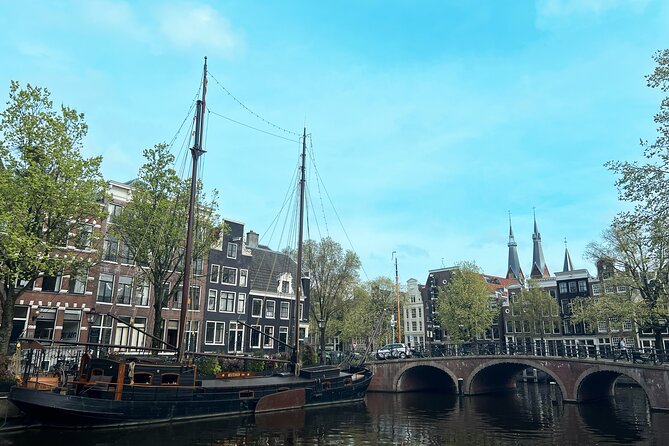
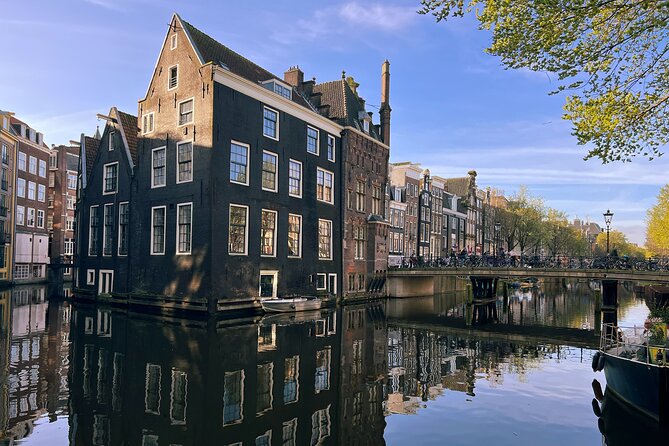
The canal ring, or Grachtengordel, receives the longest central portion of the route, about 30 minutes. The district was built for wealthy merchants during the Dutch Golden Age, and you will see canal houses in the northern baroque style along with many houseboats.
This is where the city’s famous appearance begins to make sense. Narrow façades, stepped or ornamented rooflines, and houses lined along waterways are not random decorations. They reflect the wealth, planning, and practical limits of a city built on wet ground.
I like having a guide here because canal streets can become a visual blur. After a few hours, you may see one elegant façade after another without knowing what to notice. Anna can point out architectural details and explain how the merchant districts differed from the older parts of town.
The route also gives you a better feel for houseboats. They are not just colorful objects for photographs. They are part of the living city, sharing space with historic houses, traffic, pedestrians, and bikes.
Do keep your attention on the pavement and crossings. Amsterdam is famous for bicycles, and the route’s references to moving around them are practical rather than decorative. The walk is intended for people who can remain alert and comfortable on city streets for two hours.
Thirty minutes in the Jordaan
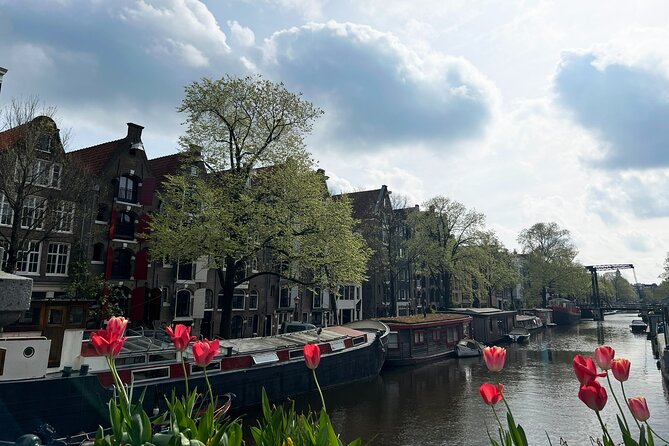
The tour then spends about 30 minutes in the Jordaan, a popular neighborhood known for picturesque streets, traditional brown cafés, and independent boutiques. This is a welcome shift from major monuments to a district valued for its everyday character.
The Jordaan gives you a chance to see Amsterdam at a neighborhood scale. You can look beyond royal buildings and trading offices toward small streets, local meeting places, and shops with a more personal feel. Anna’s explanations of present-day culture are useful here because the area is not only a historic backdrop.
This is also the part of the walk most suited to travelers who enjoy atmosphere over checklists. You are not entering a long series of attractions. You are walking, listening, and noticing how the neighborhood works.
The private format is a real advantage in the Jordaan. If you want to pause for a snack, ask about a café, or spend more time on architecture, you can raise the subject without holding up a large group. One account of the experience notes that Anna made time for snack stops and offered ideas for exploring after the tour, though those extras should not be treated as guaranteed parts of every departure.
Westerkerk and the Anne Frank House area
The final stop is Westerkerk, a Dutch Protestant church recognized for its stylish design and prominent spire. The walk ends nearby at Prinsengracht 279, in the vicinity of both the church and the Anne Frank House.
This ending is convenient. If the walk is one of your first activities in Amsterdam, you can continue exploring the surrounding area afterward. The end point also helps you connect the canal ring and Jordaan with one of the city’s best-known cultural districts.
The tour includes Jewish history beyond the Anne Frank House when that subject fits your interests. That is a valuable distinction. You are not limited to one famous story or one building. Anna can place Amsterdam’s Jewish past within the wider history of the city, though the exact depth of that discussion will depend on your questions and the time available.
The tour does not include admission to Westerkerk, the Anne Frank House, or any other attraction. All fees and taxes for the walking experience are included, but bottled water is not.
Anna’s style and the value of a private guide
The clearest reason to choose this experience is Anna herself. She handles planning changes with flexibility, communicates well in English, and adjusts the walk to the people in front of her. That matters when your group has mixed interests or when jet lag makes a dense lecture a poor choice.
Her approach combines facts with humor. She explains Amsterdam’s early navigation, architecture, and geography, then moves into artists, shipbuilders, guild members, traders, leaders, and other forces that shaped the city. The result is a broader picture than a tour focused only on famous façades.
A private guide also lets you ask questions without worrying about a group schedule. You can steer the conversation toward art, Jewish history, modern culture, or the history of commerce. Anna also guides Rijksmuseum visits, according to the supplied information, so visitors interested in Rembrandt, Vermeer, and Dutch maritime art may find her useful for a separate museum experience. That museum visit is not part of this walking tour.
At $96.02 per person, the price is not the cheapest way to see Amsterdam. The value depends heavily on group size. For one or two people, it is a fairly large spend for about two hours. For a family or small group, the private arrangement and group discounts may make the cost easier to justify, especially if you want a guide who can tailor the route rather than follow a fixed script.
The advertised duration is approximately two hours. One account describes a longer, three-hour experience, so timing may vary with questions, pauses, and personalization. I would avoid booking a tight appointment immediately afterward. Give yourself breathing room.
Who should book this Amsterdam walk?
I would choose this tour if you are visiting Amsterdam for the first time and want an orientation with real historical context. It is also a good match if you prefer conversation and local perspective over a large group with a loud meeting point and a fixed pace.
The walk suits:
- Families or small groups who want to stay together privately
- Visitors interested in architecture, trade, city planning, and social history
- People who want suggestions for the rest of their stay
- Anyone who likes asking questions as they go
- Visitors who plan to spend time near the Anne Frank House and Westerkerk
I would think twice if walking and standing for two hours is difficult. The experience is not recommended for people who use a walker, and mobility aids are not available. Service animals are welcome, and the meeting point is near public transportation.
Book it early if the timing matters to you. It is commonly reserved well ahead of the visit, with an average booking lead time of about 70 days. Confirmation arrives at booking, and free cancellation is available up to 24 hours before the local start time. Changes or cancellations inside that window are not accepted for a refund.
Should you book this private history tour?
Book it if you want Amsterdam to make sense quickly, especially at the start of your trip. The route covers the medieval core, old defenses, global trade, Dam Square, the canal ring, the Jordaan, and Westerkerk without reducing the city to a list of photo stops.
The strongest reasons are Anna’s personal approach, the chance to shape the conversation, and the useful finish near the Anne Frank House. The main drawback is cost, particularly for a very small group, along with the steady walking required.
For a first visit, I would schedule it early and use the final recommendations to plan the following days. If you already know central Amsterdam well or want inside access to attractions, this is not the right product. It is a thoughtful orientation walk, not an admission-based sightseeing package.
FAQ
How long is the historical walking tour?
The experience is advertised as approximately two hours. The exact length can vary if your group asks questions, takes pauses, or personalizes the route.
Where does the tour begin?
You meet at Café the Schreiertower, Prins Hendrikkade 95, 1012 AE Amsterdam, Netherlands. This is at the Weeping Tower.
Where does the tour end?
The walk ends at Westerkerk, Prinsengracht 279, 1016 DL Amsterdam, near the Anne Frank House and Westerkerk church.
Is this a private tour?
Yes. Only your group participates in the activity.
Is the tour offered in English?
Yes. English is the listed tour language.
Is the tour suitable for people with limited mobility?
The walk is not recommended for people who have trouble walking or standing for two hours, or for people who use a walker. Mobility aids are not available, but service animals are allowed.
More History Walks around Amsterdam
- Amsterdam: Historic City Sightseeing Canal Cruise
★ 4.5 · 444 reviews - Anne Frank and the Jewish History of Amsterdam Private Tour
★ 5.0 · 307 reviews - Amsterdam: 3-Course Meal in Historic 1st Class Waiting Rooms
★ 4.5 · 292 reviews - Amsterdam: Highlights & History Walking Tour
★ 4.8 · 266 reviews
More Walking Tours in Amsterdam
- Anne Frank’s Story – Guided Walking Tour through Amsterdam
★ 5.0 · 11,619 reviews - Amsterdam: Life of Anne Frank and World War II Walking Tour
★ 4.8 · 10,467 reviews - Absolutely Amsterdam – the Essential Introductory Walking Tour
★ 5.0 · 3,629 reviews - Amsterdam: Anne Frank Guided Small Group Walking Tour
★ 4.8 · 2,722 reviews
Just added around Amsterdam
- From Amsterdam: The Hague Private Trip and Mauritshuis Entry★ 4.3 · 4 reviews
- VIP Private Full Day Tour of the Netherlands★ 4.8 · 6 reviews
- Amsterdam Old-West Vegan Food Tour with Local Guide★ 4.7 · 3 reviews
- Amsterdam: Van Gogh Museum Guided Tour★ 4.8 · 262 reviews
- Van Gogh Museum Private Guided Tour★ 4.2 · 10 reviews
- Vecht River: Full-day Cruise with Lunch★ 4.8 · 9 reviews
- Van Gogh and Rijksmusuem Tour: Small Group Tour with Entry★ 4.7 · 3 reviews
- Amsterdam: Van Gogh Museum Ticket & Guided Tour★ 4.4 · 187 reviews
Historical Tours, compared.
Amsterdam Food and Cultural Tour with Tastings
Read our review →
Kinderdijk UNESCO World Heritage Entry Ticket
Read our review →
Hop-on Hop-off Old-Fashioned Heritage Tram Tour
Read our review →


Amsterdam High-End Dutch Food & History Tour – Up to 8 guests
Read our review →
Cruise through the Historic City Center with Guide
Read our review →
Browse the lists this tour appears in