
Reviewed · HISTORICAL TOURS
Amsterdam City Center & History – Exclusive Guided Walking Tour
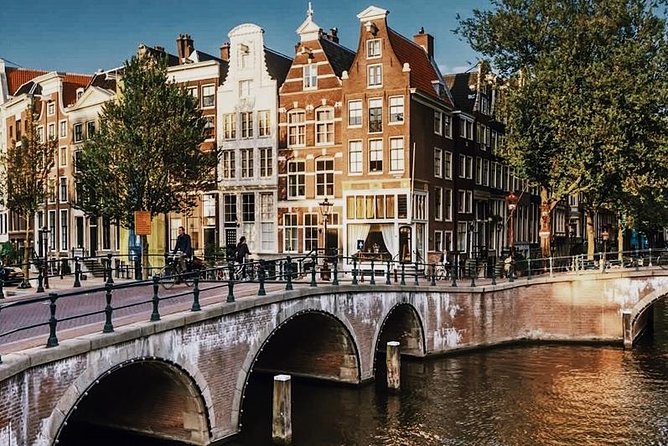
Amsterdam’s story unfolds best on foot, and this tour takes you through an unusually broad slice of it in just two and a half hours. You move from the harbor edge and medieval defenses to canal mansions, Protestant churches, former almshouses, and the quiet corners of the Jordaan.
I like the wide historical sweep, which gives you useful bearings before you tackle Amsterdam’s museums on your own. I also like the private guide format, since Anita, Diana, and Pedro have been praised for answering questions and adapting the walk to personal interests.
The trade-off is pace. Twenty stops in 150 minutes means many visits are brief exterior explanations, not long indoor tours. Rain, wind, celebrations, and security rules can also change how much you see inside.
Key points to know before you book
- Twenty historic stops in 2.5 hours: This is a fast city introduction, not a slow architectural walk.
- A private English-speaking guide: Your group receives the guide’s attention when you select the exclusive option.
- A smart first-days activity: You finish near the Jordaan with tips for exploring Amsterdam independently.
- Mostly exterior sightseeing: Several landmarks are viewed from outside, and admission fees are not generally included.
- A long route through changing neighborhoods: Comfortable shoes, water, and weather protection matter.
- A memorable finish at Het Papeneiland: The walk ends beside a 1642 brown café known for apple pie.
Starting beside Amsterdam’s harbor at St. Nicholas Basilica
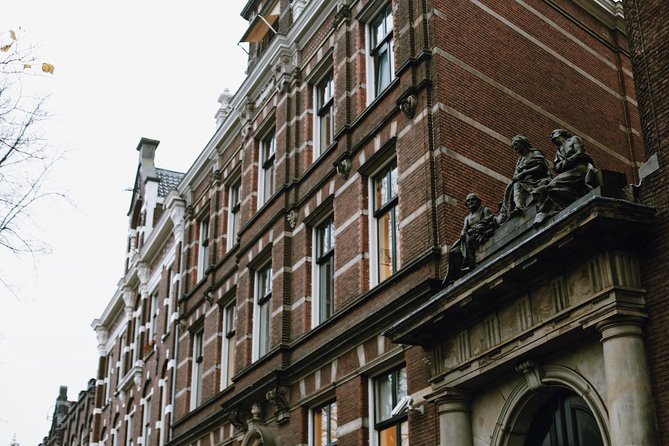
Meet at Prins Hendrikkade 73, across from the city’s central harbor area, and begin with St. Nicholas Basilica. The church was built in the late 19th century, after Roman Catholic worship had faced centuries of restrictions in Amsterdam.
That makes the basilica a useful opening lesson. Amsterdam’s religious story is not simply Protestant versus Catholic. It is a tale of changing laws, private worship, tolerance, and communities finding room in a crowded city. The building’s blend of architectural styles reflects that shifting story.
The stop is listed at about 10 minutes, with free admission. Treat it as an introduction rather than a full church visit. The tour then turns toward the water and the city’s medieval edge.
More City Tours in Amsterdam
- Amsterdam: 75 Minute City Canal Cruise with Audio Guide
★ 4.4 · 17,501 reviews - Amsterdam: City Centre Canal Cruise
★ 4.2 · 12,827 reviews - Amsterdam: Smoke and Lounge City Boat Cruise
★ 4.7 · 8,572 reviews
From the Weeping Tower to old Zeedijk
The Schreierstoren, often called the Weeping Tower, is a medieval remnant with an emotional name. Women once said farewell here to loved ones leaving by ship. You will see the tower from the outside, since admission is not included.
This is the kind of place that can disappear into the city unless someone points it out. Its value lies less in a long stop than in connecting Amsterdam’s walls and waterways with the ordinary fears of families tied to seafaring.
Next comes Zeedijk, one of Amsterdam’s oldest streets. Its name recalls the sea dike that once protected the city from the IJ. At Kolksluis, you can look at one of the city’s attractive lock bridges and see how water control shaped daily life.
The Zeedijk stop lasts about five minutes, so do not expect a detailed canal-engineering lesson. Still, it gives you a clear sense that Amsterdam was built by managing water, not merely beside it.
Nieuwmarkt and the many lives of the Waag
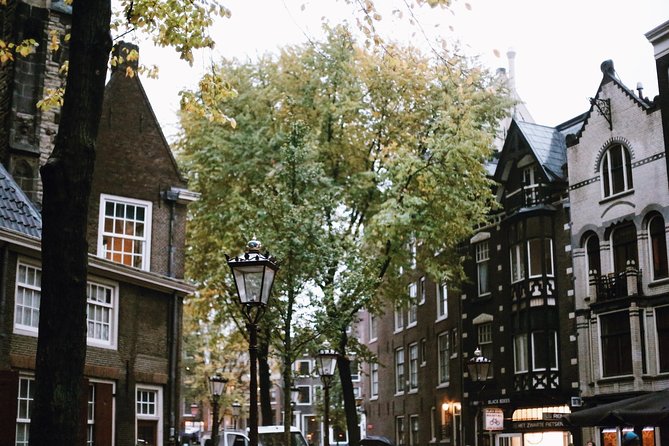
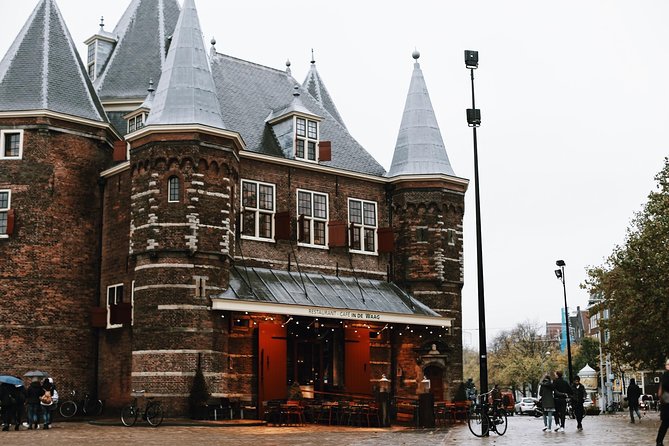
Nieuwmarkt has been a market and meeting place since the 17th century. Its position just inside the old city gate made it handy for traders bringing produce into town. Today, it is also a popular evening area.
The square’s main historical prize is De Waag, a 15th-century building that began as a city gate and part of Amsterdam’s defensive walls. It later served as a guildhall, museum, and fire station. In a few minutes, your guide can show you how one building changed as the city itself changed.
This is a good example of the tour’s method. You will not spend an hour on one monument. Instead, you collect short, useful stories that help you read the streets afterward.
Grand houses, narrow houses, and Dutch wealth

At the Trippenhuis, you see one of Amsterdam’s grandest 17th-century mansions. The wealthy Trip family owned it, and its scale tells you plenty about the money flowing through Amsterdam during the Dutch Golden Age.
Across from it is the Kleine Trippenhuis, one of the city’s narrowest houses. The contrast is the point. One family could display its wealth in a large residence, while high land taxes encouraged many others to build upward on tight plots.
The tour also passes the Oost-Indisch Huis, the headquarters of the Dutch East India Company. Its courtyard is linked to the early development of the world’s first multinational corporation. This stop offers a useful reminder that Amsterdam’s fine houses and canals were tied to overseas trade, commercial risk, and colonial power.
You see the courtyard for free, but other architectural stops may be exterior-only. If you want to enter a museum or house connected with these subjects, plan a separate visit.
More History Tours in Amsterdam
- Amsterdam Food and Cultural Tour with Tastings
★ 5.0 · 2,442 reviews - Amsterdam: Haunted History and Ghost Walking Tour
★ 4.5 · 488 reviews - Amsterdam High-End Dutch Food & History Tour – Up to 8 guests
★ 5.0 · 482 reviews - Amsterdam: Historic City Sightseeing Canal Cruise
★ 4.5 · 444 reviews
Churches, Rembrandt, and the modern Stopera
The Zuiderkerk was Amsterdam’s first purpose-built Protestant church. Designed by Hendrick de Keyser, it has an elegant tower that remains a strong part of the city view.
You then pass Museum Het Rembrandthuis, the former home and studio where Rembrandt lived and worked for almost 20 years. Five minutes is enough to place the building in context, but not enough for an indoor museum visit. Admission is not included, so art lovers should return later if they want the rooms, studio, and collection.
The route continues to the National Opera and Ballet, part of the Stopera complex that also houses city hall. The project took at least 60 years to reach completion, giving your guide a chance to explain how modern Amsterdam sometimes takes as long to argue over a building as earlier generations took to construct one.
This mix of old and new keeps the walk from becoming a parade of pretty façades. You see religious change, private wealth, artistic life, and modern civic planning in the same central district.
Canal houses and the quiet Begijnhof
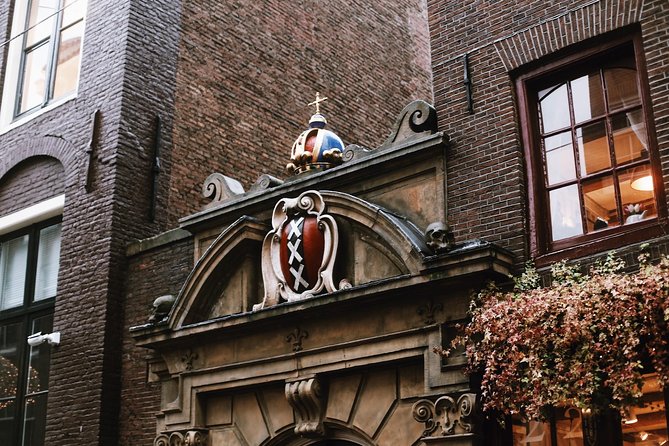
Huis aan de Drie Grachten is a rare 17th-century canal house with façades facing three canals. It is a small but telling detail: in Amsterdam, the unusual often hides in plain sight, and a guide helps you notice how buildings respond to the water around them.
The Begijnhof provides a different mood. This enclosed medieval courtyard was once home to Beguines, devout women who lived in a religious community without taking formal monastic vows. It is also home to one of Amsterdam’s oldest wooden houses.
I consider the Begijnhof one of the most valuable stops for first-time visitors because it gives you a break from traffic and busy streets. Keep your voice low and treat it as a residential and religious space, not just a photo setting. The route lists the stop as free, but some attractions along the way can have restricted interior access.
Dam Square and the Golden Bend
Dam Square is Amsterdam’s historic center. Here, the Royal Palace, the New Church, and the National Monument to WWII victims face one another across a space that has served political, royal, religious, and civic roles.
The square can feel crowded and exposed, so the guide’s explanation matters more than lingering. You will get the landmarks in one sweep, then move toward the Herengracht.
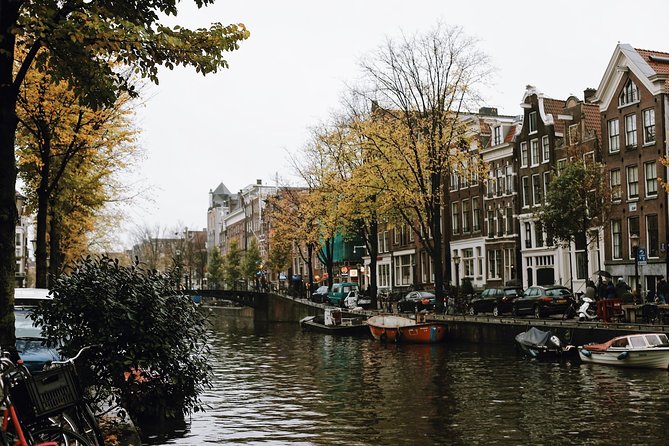
At the Golden Bend, the canal becomes a lesson in status. The richest and most ornate canal mansions line this section of the Herengracht, built by people who had the money to claim prime water frontage during the Dutch Golden Age.
The tour is especially helpful here because Amsterdam’s canals can look similar at first glance. A guide can show you where the grandest homes are and explain why the canal belt was more than a scenic waterway. It was a planned address system for the city’s elite.
Anne Frank House and the Westerkerk
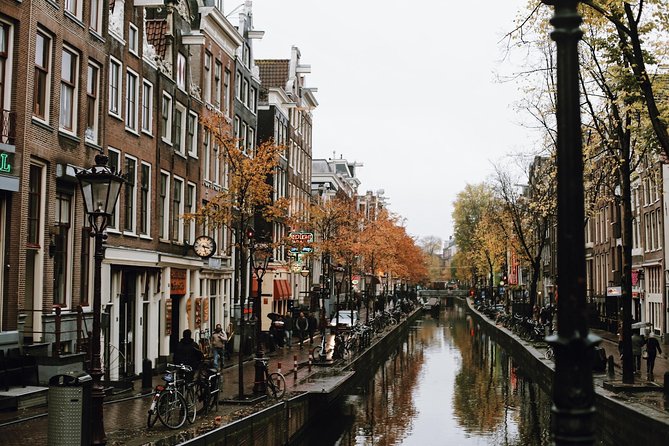
The walk pauses outside the Anne Frank House, where Anne Frank and her family hid during World War II. You do not enter as part of this tour, and admission is not included.
That distinction matters. If you want to visit the museum, arrange a separate ticket and allow much more time than this brief exterior stop. The guide can place the house within Amsterdam’s wartime story, but the tour is not a substitute for the museum experience.
Next door is the Westerkerk, whose tower is the tallest church tower in Amsterdam. The pairing is powerful: one building recalls wartime persecution and a young writer, while the other gives you a major landmark that helps orient you along the canal.
Security measures at major attractions mean some interiors cannot be visited during the walk. That is normal for this type of city tour, but you should book it for context and orientation, not guaranteed entry.
Gable stones, hofjes, and the character of the Jordaan
At Bloemgracht 87 to 91, look up for carved gable stones. These small markers use allegories and trade symbols to decorate the façades. They reward the habit of looking above shopfronts and street signs.
The route then reaches the Karthuizerhof, described as Amsterdam’s largest hofje. It was built as almshousing around a peaceful courtyard for poor and elderly residents. These courtyards are easy to miss, yet they reveal a side of city life that grand canal homes cannot: charity, housing, and community care.
The Noorderkerk was built for the Jordaan district in the 17th century. Its cross-shaped floor plan reflects Protestant ideas about worship and sightlines. Again, the building is not just an old church. Its design shows how religious beliefs could shape an entire neighborhood.
This section gives the walk its most human scale. Instead of only looking at merchants’ mansions and major monuments, you see small homes, carved signs, charitable housing, and a church built for local residents.
Finishing at Papeneiland with a practical Amsterdam send-off
The final stop is Het Papeneiland, a brown café dating from 1642 at the corner of the Prinsengracht and another canal. It is said to serve some of Amsterdam’s best apple pie, making it a pleasant place to end a long walk.
The café is not included as a meal or tasting, so bring money if you want to stop for food or a drink. The ending is well chosen because you finish in the Jordaan, an area that deserves further time beyond the tour.
You also leave with tips for exploring on your own. That may be the most useful part of the experience. A good orientation walk should not try to keep you dependent on the guide. It should help you decide where to return, what to book, and which streets deserve a slower look.
What the private format adds at $62.48
At $62.48 per person, the price makes the most sense for a small group that values direct conversation. You are paying for a 2.5-hour route, an English-speaking guide, and the chance to ask questions as the city unfolds around you.
The private format is especially useful for families, couples, or friends with different interests. You can ask about architecture, wartime history, canals, religion, food, or practical sightseeing rather than listening to a fixed speech meant for a large crowd.
Read the booking choice carefully. The exclusive guide applies to the private option, but not to the Save, Book Semi-Private option. Group discounts are available, so the cost per person may work better for a larger party.
The value drops if you expect museum admissions, hotel pickup, or a sit-down meal. None is included. You also need to pay for your own transport to the meeting point and gratuity is optional. Since the route begins near central public transport, reaching it should be straightforward, but hotel pickup is not part of the service.
Pace, weather, and what to bring
The tour runs in all weather. One guide, Anita, kept a group moving through rain and wind, which tells you to take the weather policy seriously rather than treating it as fine print.
Wear comfortable shoes. Bring water, an umbrella when rain is possible, and a hat in summer. No large bags or suitcases are allowed, which is sensible on narrow streets but important if you are heading straight from a train or hotel with luggage.
The route can change during national celebrations. You should still see the main highlights, but the order or exact path may differ, and the operator does not offer a refund or discount for that change.
The pace is moderate but continuous. The supplied guidance asks for a moderate level of physical fitness, and the number of stops means you should be ready to walk for most of the 150 minutes.
Who will get the most from this walk
I would choose this tour early in an Amsterdam stay, especially if you want a historical frame before visiting the Anne Frank House, Rembrandt House, or other museums. It also suits you if you like asking questions and prefer a personal guide to a large group.
The strongest part is the range. In one outing, you see Catholic and Protestant landmarks, maritime defenses, merchant wealth, East India Company power, wartime memory, social housing, and Jordaan streets.
It is less suitable if you want long indoor visits, a museum-focused tour, or a leisurely photography walk. The itinerary lists many stops at roughly five minutes each, so you will often hear a concise explanation, take a look, and keep moving.
The tour has a perfect 5 rating from 13 published ratings, with particular praise for Anita, Diana, and Pedro. Their useful qualities are clear: they explain Amsterdam’s past in an engaging way, answer questions, keep the group moving, and adjust to personal interests. That is exactly what you want from a city orientation.
Should you book this Amsterdam walking tour?
Book it if you want a private historical overview with local guidance, especially during your first days in Amsterdam. The route is broad, the ending in the Jordaan is practical, and the private setup gives you room to ask the questions that turn landmarks into places you understand.
Skip it if your priority is entering several attractions or moving at a slow, detailed pace. At $62.48 per person, it is best value when you use the guide’s insight to plan the rest of your stay, then return independently to the places that deserve more time.
FAQ
How long does the Amsterdam walking tour last?
The tour lasts approximately 2 hours and 30 minutes.
Where does the tour begin and end?
It begins at Prins Hendrikkade 73 in Amsterdam and ends at Het Papeneiland, Prinsengracht 2.
Is the tour private?
The tour is a private activity for your group when you select the exclusive option. The exclusive guide does not apply to the Save, Book Semi-Private option.
Is the tour offered in English?
Yes. The tour is offered in English.
Are attraction admission fees included?
The guided walking tour is included, but admission fees for several attractions are not. Many stops are exterior views, and increased security measures can prevent some interior visits.
What happens if it rains or the weather is poor?
The tour operates in all weather conditions. Dress appropriately and bring comfortable shoes, water, and an umbrella if rain is possible.
More History Walks around Amsterdam
- Anne Frank and the Jewish History of Amsterdam Private Tour
★ 5.0 · 307 reviews - Amsterdam: 3-Course Meal in Historic 1st Class Waiting Rooms
★ 4.5 · 292 reviews - Amsterdam: Highlights & History Walking Tour
★ 4.8 · 266 reviews - Anne Frank and Amsterdam Jewish History Walking Tour
★ 5.0 · 259 reviews
More Walking Tours in Amsterdam
- Anne Frank’s Story – Guided Walking Tour through Amsterdam
★ 5.0 · 11,619 reviews - Amsterdam: Life of Anne Frank and World War II Walking Tour
★ 4.8 · 10,467 reviews - Absolutely Amsterdam – the Essential Introductory Walking Tour
★ 5.0 · 3,629 reviews - Amsterdam: Anne Frank Guided Small Group Walking Tour
★ 4.8 · 2,722 reviews
Just added around Amsterdam
- From Amsterdam: The Hague Private Trip and Mauritshuis Entry★ 4.3 · 4 reviews
- VIP Private Full Day Tour of the Netherlands★ 4.8 · 6 reviews
- Amsterdam Old-West Vegan Food Tour with Local Guide★ 4.7 · 3 reviews
- Amsterdam: Van Gogh Museum Guided Tour★ 4.8 · 262 reviews
- Van Gogh Museum Private Guided Tour★ 4.2 · 10 reviews
- Vecht River: Full-day Cruise with Lunch★ 4.8 · 9 reviews
- Amsterdam: Van Gogh Museum Ticket & Guided Tour★ 4.4 · 187 reviews
- Van Gogh and Rijksmusuem Tour: Small Group Tour with Entry★ 4.7 · 3 reviews
Historical Tours, compared.
Amsterdam Food and Cultural Tour with Tastings
Read our review →
Kinderdijk UNESCO World Heritage Entry Ticket
Read our review →
Hop-on Hop-off Old-Fashioned Heritage Tram Tour
Read our review →


Amsterdam High-End Dutch Food & History Tour – Up to 8 guests
Read our review →
Cruise through the Historic City Center with Guide
Read our review →
Browse the lists this tour appears in