
Reviewed · WALKING TOURS
Walking Tour about Golden Age Architecture, private local guide
Amsterdam’s Golden Age is easiest to understand from street level, where grand merchant houses, warehouse gables, hoisting beams, and leaning façades tell the story. This private walk with local guide Anna links Dam Square, the canal belt, Jordaan, and Westerkerk in about 90 minutes.
I like the personal format, which gives you room to ask questions and stop for photographs. I also like the focus on design and engineering, including how Amsterdam’s builders worked on soft, marshy ground. The main drawback is pace: you will be walking and standing for most of the tour, with no time built in to visit interiors.
- Royal Palace engineering: Learn how a monumental building was supported on difficult clay and marshy ground.
- Canal-house clues: Read façade shapes, decorative stones, and roof beams as signs of wealth, work, and social status.
- Private attention: Your group tours alone with Anna, making it easier to ask questions and shape the conversation.
- A useful route: The walk connects Dam Square with Jordaan and ends near Westerkerk and the Anne Frank House.
- A short, focused experience: In 90 minutes, you see many important buildings without giving up half a day.
Why Amsterdam’s Golden Age Makes Sense on Foot
Amsterdam’s 17th-century success was built on trade. As the city grew into a major international commercial center, its merchants needed homes, offices, warehouses, churches, and public buildings to match their new influence.
That story is still written across the city’s façades. A narrow canal house might reveal a merchant’s wealth through its brickwork and ornament. A warehouse might look plain, but its steep gable, large windows, and roof beam explain exactly how goods moved in and out.
This tour is useful because it teaches you how to read those clues. Instead of seeing a row of attractive old houses, you begin to notice why one façade is wider, why another leans, and why a building carries a carved stone plaque.
Anna’s approach, based on the experience details and repeated praise for her guiding, seems especially suited to visitors who enjoy asking questions. She explains architectural styles alongside the people who lived and worked in these buildings, including the social and commercial forces that shaped the city.
The route is private, so you are not trying to hear a guide over a large crowd. For a couple, family, or small group, that personal setting can make the difference between simply collecting photographs and actually understanding what you are seeing.
Beginning Near Dam Square and the Royal Palace
The meeting point is the Royal Palace of Amsterdam at Nieuwezijds Voorburgwal 147. The opening discussion centers on Dam Square, the natural place to set the scene because it connects Amsterdam’s civic life with its Golden Age success.
You will hear how Amsterdam rose during the 17th century and how trade helped shape its buildings and public spaces. This introduction lasts only about five minutes, so it should give you the basic framework without using up much of the walk.
The Royal Palace is the first major architectural lesson. It was built as Amsterdam’s town hall during the Golden Age, not originally as a royal residence. That change in purpose helps explain its scale: the city was displaying its civic power and prosperity to residents, merchants, and visiting dignitaries.
The building’s Dutch Neoclassical style, materials, and construction methods receive special attention. The most useful point is the engineering challenge beneath the grand exterior. Amsterdam was built on soft ground, so creating a massive public building required careful planning and support.
You will spend about 10 minutes here, outside, with no admission ticket included. That is enough time for a clear introduction, though not enough for an interior visit. If you want to tour the palace itself, plan that separately.
More Private Tours in Amsterdam
- Rijksmuseum Amsterdam Small-Group Tour with Private Upgrade
★ 4.5 · 1,547 reviews - Van Gogh Museum Tour Reserved Entry Semi Private
★ 5.0 · 1,437 reviews - Private Amsterdam Red Light District and Coffee Shop Tour
★ 5.0 · 763 reviews
Huis Bartolotti and the Language of Wealth
From the palace, the walk continues toward Huis Bartolotti, a canal-side house associated with Dutch Baroque design. Its red brick façade, broad windows, and sandstone decoration make it an easy place to see how private buildings communicated status.
The house’s appearance reflects the wealth of its original owner and his trading links with Italy. That detail gives the architecture a human purpose. The ornament was not simply decoration for decoration’s sake. It helped announce the owner’s connections, taste, and success.
The stop lasts roughly five minutes. That may sound brief, but the tour is built around several short stops rather than one long lecture. You will hear the key point, look closely at the façade, and then keep moving through the historic center.
I like this format for Amsterdam because the city rewards repeated comparisons. One building alone can be interesting. Four or five façades viewed together let you see how owners adapted shared architectural ideas to different budgets, professions, and ambitions.
Torensluis and Amsterdam’s Crooked Houses
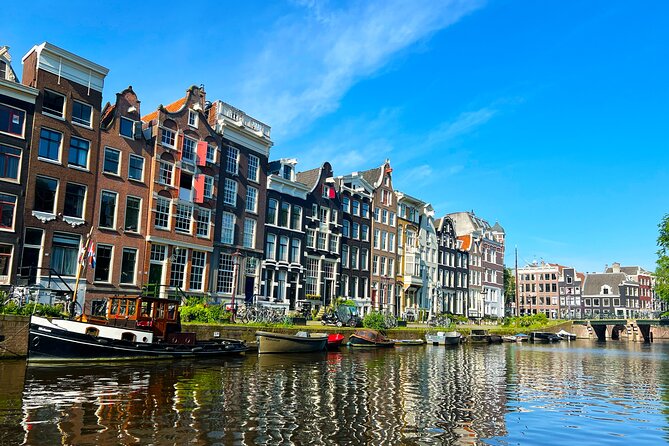
Torensluis is one of the wider bridges on the route and offers a useful viewing point. From here, you can compare four distinct façade designs linked to the city’s mercantile class.
The Baroque style appears here in a Dutch form, with detail and contrast adapted to Amsterdam’s narrow urban setting. Your guide points out how these buildings differ rather than treating the canal belt as one uniform block.
This is also a good place to consider Amsterdam’s crooked houses. Buildings lean for several reasons connected to age, construction, and the city’s soft ground. Their unusual angles are charming, but they also reveal the practical difficulties of building and maintaining a city on marshy terrain.
You will spend about 10 minutes at the bridge. It is a photography-friendly stop, but the real value is comparison. Look across the canal fronts and ask Anna why one façade feels formal, another playful, and another more practical.
De Dolphijn and a Link to Rembrandt
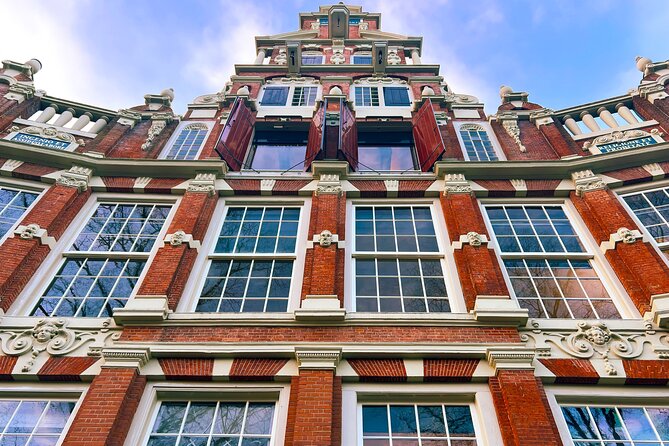
De Dolphijn adds a direct connection between architecture, maritime trade, and famous Amsterdam figures. The dolphin symbol associated with the house referred to wealth and the prosperity generated by the sea.
The building was once owned by Frans Banning Cocq, the captain shown in Rembrandt’s The Night Watch. That connection gives the canal house a place in both architectural and artistic history without requiring a museum visit.
This five-minute stop is a reminder that Amsterdam’s Golden Age was not an abstract period. The houses belonged to specific people whose business, political influence, and social standing shaped the city.
If you already know Rembrandt, this connection adds a pleasant extra layer. If you do not, it still helps you see how a private canal house could connect to the city’s public life and cultural memory.
More Walking Tours in Amsterdam
- Anne Frank’s Story – Guided Walking Tour through Amsterdam
★ 5.0 · 11,619 reviews - Amsterdam: Life of Anne Frank and World War II Walking Tour
★ 4.8 · 10,467 reviews - Absolutely Amsterdam – the Essential Introductory Walking Tour
★ 5.0 · 3,629 reviews - Amsterdam: Anne Frank Guided Small Group Walking Tour
★ 4.8 · 2,722 reviews
Ronde Lutherse Kerk and the Power of a Dome
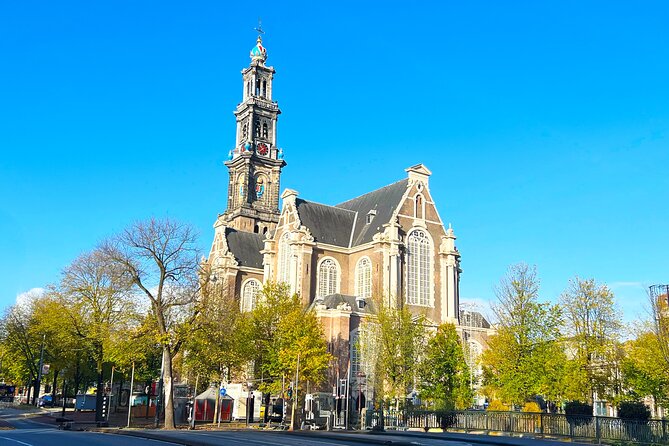
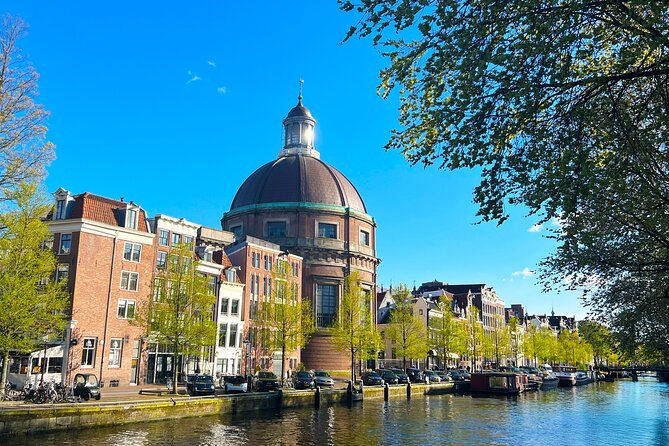
The Ronde Lutherse Kerk provides a short lesson in religious architecture. The focus is on the dome as a major achievement of Renaissance design.
The stop lasts about five minutes, so expect an exterior explanation rather than a detailed church visit. It works as a quick change of architectural mood after the merchant houses and bridges.
This part of the route is particularly useful if you tend to focus only on Amsterdam’s canal façades. Churches and civic buildings show that the city’s architectural ambitions were not limited to private wealth. Religious communities also used form and scale to express importance.
Prinsengracht Warehouses Built for Work
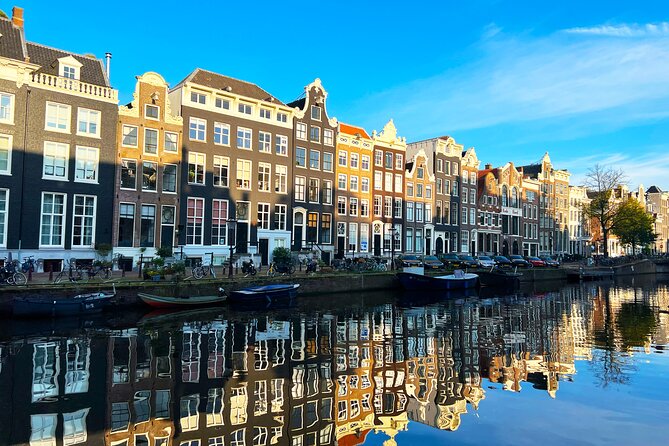
Along Prinsengracht, the focus shifts from elegant homes to warehouses. These buildings were designed around commerce, and their features are easy to understand once Anna points them out.
Look for tall, steeply pitched gables, large windows, and wooden hoisting beams near the roofs. Those beams were used to lift heavy cargo from boats along the canal. The houses were not merely attractive backdrops. They were working buildings connected directly to Amsterdam’s trade.
The exteriors often appear simpler than those of wealthy residences. That plainness served a purpose. Clean lines and limited ornament helped create practical storage and work spaces, while the size of the buildings reflected the power of the merchants who used them.
This stop lasts about five minutes. It is short, but it gives you a useful habit for the rest of your visit: look above eye level. Roof beams, gables, and upper windows often tell you more about a building’s original purpose than its ground-floor entrance.
Jordaan and the Stories Hidden in Gevelstenen
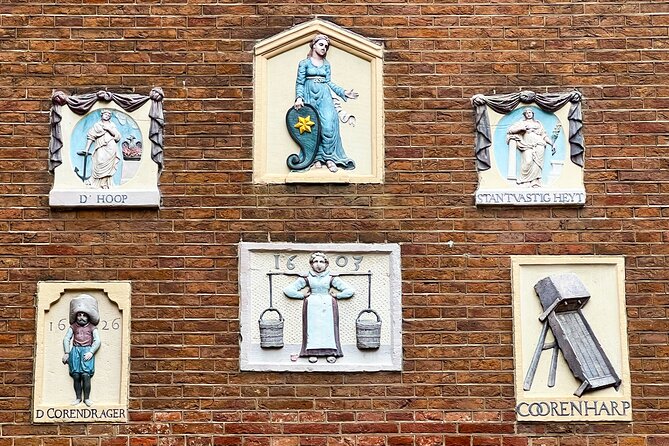
The Jordaan section receives the longest stop, about 20 minutes, and it is likely the most rewarding part for anyone who likes small details.
In the 17th century, Jordaan was a mixed residential and commercial district for craftspeople, laborers, and shopkeepers. Narrow canals and close rows of houses created a neighborhood where people lived, worked, and sold goods in the same area.
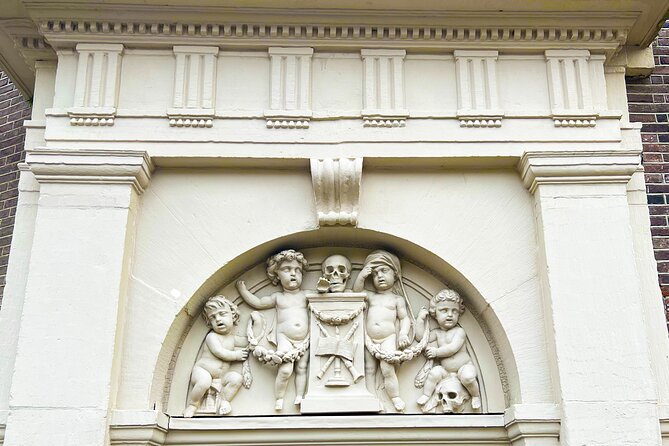
Anna’s main subject here is the gevelstenen, or façade stones. These small carved plaques are set into building fronts and can identify a profession, describe how a building was used, or mark something important about the people who lived there.
The stones turn a walk into a visual puzzle. You may find an image linked to a trade or a household, and the carving can reveal information that a modern street sign does not. They are easy to miss when you walk alone, especially if you are watching bicycles, boats, and traffic.
I value this part of the tour because it gives you something to keep using after the walk. Once you learn to look for façade stones, Amsterdam’s old neighborhoods become more readable. You are no longer seeing only brick rows and canal reflections. You are looking for the small signs left by earlier residents.
Westerkerk and the Route’s Strong Finish
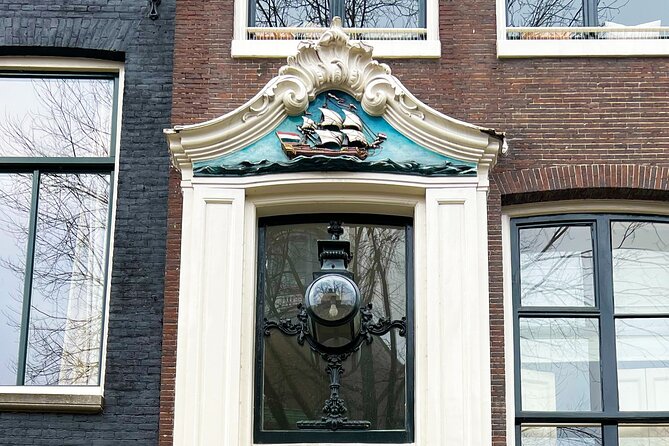
The tour ends at Westerkerk on Prinsengracht, near the Anne Frank House. This is a practical finish if you are planning to visit that area afterward, although the church visit itself is not included in the walk.
Westerkerk was built as a Calvinist church for Amsterdam’s growing population. Its large, airy interior and restrained design reflect the style of Calvinist worship spaces, where simple elegance mattered more than elaborate decoration.
The church tower rises 85 meters, or about 280 feet, above Jordaan. Its spire was completed in 1638 and carries Amsterdam’s imperial crown, a symbol connected with the city’s status.
The clock’s chimes also have a personal historical connection. Anne Frank described them in her diary, which gives the tower a powerful link to the nearby house and to the city’s 20th-century story.
Rembrandt is connected to Westerkerk as well, since the church is identified as his final resting place. With architecture, religion, art, and modern memory meeting here, the ending gives the walk a broader sense of Amsterdam’s past.
What the Private Format Is Worth at $73.59
The price is $73.59 per person, with group discounts available. That is not the cheapest way to see Amsterdam’s canals, especially when the walk lasts only about 90 minutes and includes no attraction admission.
The value comes from the subject and the private format. If you want a general orientation, a free walk or self-guided route may cover the basics. If you want to understand construction, façade design, merchant houses, and engineering, a specialist guide can save you a lot of time and missed details.
A private tour also changes the pace. You can ask Anna why a building leans, stop for a photograph, or request more detail about Rembrandt, church design, or canal warehouses. One person’s questions can shape the walk instead of being lost in a large group.
The experience is particularly good value for a small group that can use the group discount. For one person, the per-person cost is harder to justify unless architecture is a main interest. For two or three people who want a personal introduction, the price may feel more reasonable.
Practical Details Before You Book
The tour is offered in English and confirmation arrives at booking. It uses a mobile ticket and runs for approximately 1 hour and 30 minutes.
You meet at the Royal Palace, while the route begins around Dam Square and ends at Westerkerk, Prinsengracht 279. The finish is close to the Anne Frank House, making it easy to continue sightseeing in that part of central Amsterdam.
Plan to walk and stand for the full duration. The experience is not recommended if you have trouble walking or standing for 90 minutes, and it is not recommended for people who use a walker. Mobility aids are not available.
Service animals are allowed, and the route is near public transportation. Bottled water is not included, so bring your own if you want a drink during the walk.
Free cancellation is available up to 24 hours before the start time. Changes or cancellations made less than 24 hours before the start are not accepted for a refund.
Who Will Get the Most From Anna’s Walk
I would choose this tour if you enjoy architecture but do not want a dry lecture. The stops are short, the route covers several districts and building types, and the explanations connect design with trade, religion, engineering, and individual lives.
It also suits first-time visitors who want a useful introduction before exploring Amsterdam independently. Afterward, you will have specific things to notice: hoisting beams, façade stones, Baroque details, crooked houses, and the difference between a merchant home and a warehouse.
The tour may be less suitable if you want to enter buildings, climb a tower, or spend a long time at one site. It is an exterior walking tour, and the limited time means you will see many places rather than study one in great depth.
Anna’s strengths are her local connection, clear English, patience with questions, and ability to point out features you might otherwise pass without noticing. Those qualities matter most when you want a personal conversation rather than a set speech.
Should You Book This Golden Age Architecture Tour?
Book it if you want Amsterdam’s canal belt to make sense, not just look pretty. The route packs Dam Square, the Royal Palace, merchant houses, warehouses, Jordaan, and Westerkerk into a manageable 90 minutes, while Anna adds the details that guidebooks often leave out.
Skip it if your priority is a low-cost overview or indoor sightseeing. But if you are curious about how Amsterdam was built, who lived behind those façades, and how trade shaped the city, this private walk is a focused and personal choice.
FAQ
Where does the tour start?
The meeting point is the Royal Palace of Amsterdam at Nieuwezijds Voorburgwal 147, 1012 RJ Amsterdam. The opening portion focuses on Dam Square.
Where does the tour end?
The tour ends at Westerkerk, Prinsengracht 279, 1016 DL Amsterdam. This is near the Anne Frank House.
How long does the walking tour last?
The tour lasts approximately 1 hour and 30 minutes.
Is the tour private?
Yes. Only your group participates, and the experience includes a private guide.
Is the tour suitable for people with walking difficulties?
The tour is not recommended for people who have trouble walking or standing for 1.5 hours, or for participants who use a walker. Mobility aids are not available.
What happens if I need to cancel?
You can cancel up to 24 hours before the scheduled start time for a full refund. Cancellations or changes made less than 24 hours before the start are not accepted.
Just added around Amsterdam
- From Amsterdam: The Hague Private Trip and Mauritshuis Entry★ 4.3 · 4 reviews
- VIP Private Full Day Tour of the Netherlands★ 4.8 · 6 reviews
- Amsterdam Old-West Vegan Food Tour with Local Guide★ 4.7 · 3 reviews
- Amsterdam: Van Gogh Museum Guided Tour★ 4.8 · 262 reviews
- Van Gogh Museum Private Guided Tour★ 4.2 · 10 reviews
- Vecht River: Full-day Cruise with Lunch★ 4.8 · 9 reviews
- Amsterdam: Van Gogh Museum Ticket & Guided Tour★ 4.4 · 187 reviews
- Van Gogh and Rijksmusuem Tour: Small Group Tour with Entry★ 4.7 · 3 reviews
Walking Tours, compared.

Anne Frank’s Story – Guided Walking Tour through Amsterdam
Read our review →
Life of Anne Frank and World War II Walking Tour
Read our review →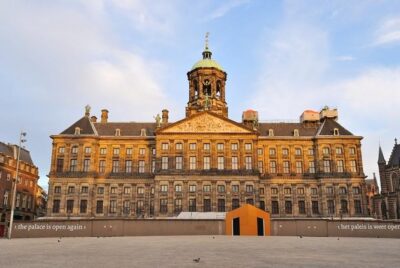
Absolutely Amsterdam – the Essential Introductory Walking Tour
Read our review →

Anne Frank Walking Tour – Guided in EN/DE/IT/ES
Read our review →

Anne Frank Walking Tour Amsterdam Including Jewish Cultural Quarter
Read our review →Browse the lists this tour appears in