
Reviewed · ROTTERDAM TOURS
Rotterdam Architecture: Centre and South Bank with watertaxi
Rotterdam makes its strongest impression from the water, and this tour saves that view for the moment when you have already walked through the city’s boldest buildings. You begin at Central Station, follow a compact route through postwar and modern architecture, then board a fast watertaxi across the Maas.
I like the way an architect guide connects the buildings to Rotterdam’s culture and future plans, rather than simply pointing out unusual shapes. I also like the route itself: Markthal, Cube Houses, Erasmus Bridge, and the South Bank give you a clear first look at the city. The main caution is the four-kilometer walk, so comfortable shoes are essential and the tour may not suit anyone with mobility or visual impairments.
Key points to know before booking
- Architect-led route: Learn how Rotterdam rebuilt and reshaped itself from a local architect’s point of view.
- A useful first-day overview: See Central Rotterdam’s major landmarks in three hours, with practical tips for the rest of your visit.
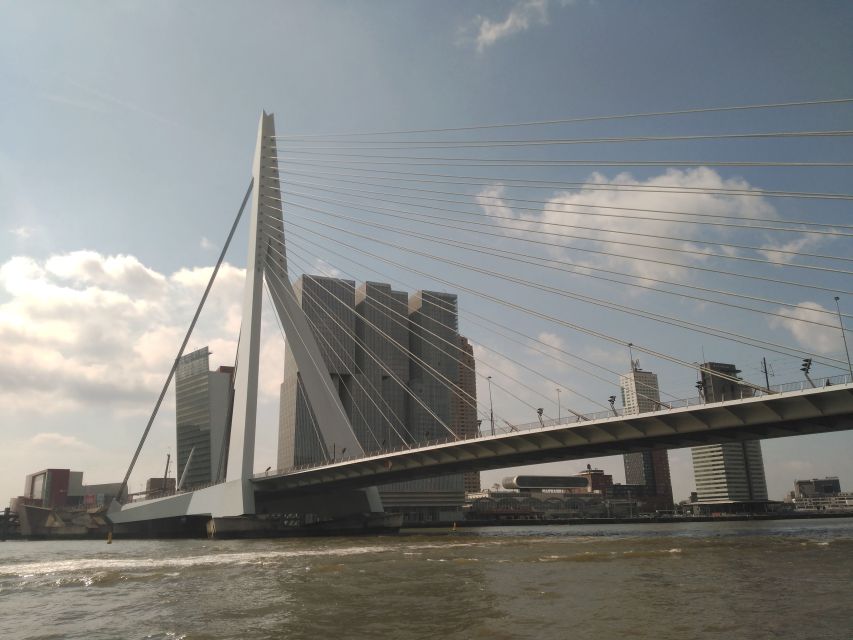
- Watertaxi across the Maas: Ride beneath the Erasmus Bridge for a fast change of scene and fine city views.
- Four kilometers on foot: Expect a steady walking tour, not a short stroll between nearby sights.
- South Bank contrasts: Finish among former harbor buildings, new architecture, cafes, restaurants, Hotel New York, and Fenixloods.
- Good value for architecture fans: At $82, the price includes the guide and watertaxi, but not drinks or transport to the meeting point.
Why this Rotterdam tour works
Rotterdam is not a city you understand from one postcard view. Its character comes from contrasts: old church beside modern market hall, postwar shopping street beside daring new design, working harbor past beside fashionable waterfront district.
This three-hour tour gives you a practical way to read those contrasts. You walk through the central area with an architect guide, then cross the Maas by watertaxi to see how the city continues southward. That combination matters. A walking tour gives you close views of materials, scale, and street plans. The boat gives you distance and perspective.
I would treat this as a strong orientation tour for a first visit. You will see many of the city’s headline sights, but you will not go inside each one for a long visit. The value comes from the connections between them and from having a guide explain why Rotterdam looks so different from other Dutch cities.
The English-language tour lasts three hours and costs $82 per person. That is not a bargain walking tour, but the water taxi is included, and an architect guide can add a level of explanation you will not get from a quick photo stop. Children under 12 can join free of charge, with the listed price covering only their speedboat fee.
A few more days out around Rotterdam worth weighing up
- Rotterdam: Harbor Sightseeing Cruise
★ 4.3 · 7,599 reviews - Rotterdam: 1-Hour Sightseeing Splash Tour
★ 4.5 · 3,299 reviews - Rotterdam: Rotterdam Zoo Blijdorp Entry Ticket
★ 4.6 · 2,754 reviews
Starting under the clock at Central Station
The meeting point is under the station clock beside the main entrance, outside Rotterdam Central Station. This is a sensible place to begin because the station itself introduces the city’s modern architectural character before the route even gets underway.
Arrive ready to walk. You should wear comfortable shoes, carry only a small bag, and leave large luggage elsewhere. The tour does not include hotel pickup or drop-off, so you need to make your own way to the station.
From here, the guide sets the tone for the city. Rotterdam was heavily damaged during the Second World War, and much of its central area was rebuilt with modern planning ideas rather than reconstructed in an old-fashioned style. An architect guide can help you see that this is not simply a collection of strange buildings. It is a city shaped by rebuilding, experimentation, and continuing change.
A past tour led by Tania received particularly strong praise for explaining both architectural highlights and future developments. If she is leading your group, you can expect a guide who adds forward-looking context and practical sightseeing suggestions. Guide availability can change, so book this experience for the format and route rather than for a guaranteed individual guide.
Lijnbaan and the postwar city
One of the first major stops is Lijnbaan, the famous postwar modernist shopping area. Its importance is not just visual. Lijnbaan represents a new approach to urban shopping, with a planned pedestrian setting and a design language very different from the traditional Dutch street.
This is where an architect guide earns the fee. On your own, you may notice that the area feels unlike Rotterdam’s older streets, but a guide can explain what the planners were trying to achieve and how the district fits into the city’s rebuilding story.
The route is designed for looking while walking. You should not expect a long indoor presentation or a private architectural lecture. Instead, the guide explains the city as you move through it, pointing out how the buildings, streets, and public spaces work together.
If shopping is your main interest, Lijnbaan may feel more like a passage than a destination. If you want to understand Rotterdam’s postwar identity, it is an important early stop.
Timmerhuis and OMA’s bold intervention
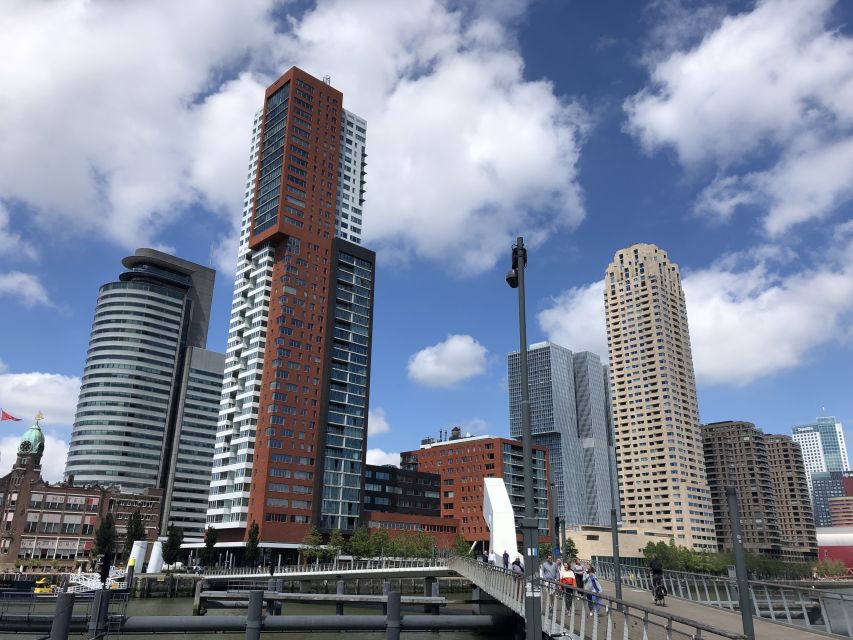
The tour continues to Timmerhuis, designed by OMA, the Rotterdam architecture firm known around the world. Timmerhuis gives you a clear example of the city’s willingness to put ambitious new design into the heart of the center.
The building is especially useful on this route because it helps you compare different generations of Rotterdam architecture. Lijnbaan reflects postwar planning. Timmerhuis shows a later approach, with architecture that responds to an established urban setting while still making a strong visual statement.
You will learn more by studying the building from street level than by rushing past it for a photograph. Look at how its form meets the surrounding streets and older structures. The guide’s role is to explain those relationships, along with the city’s plans for future development.
This is one reason I would choose this tour over a general city walk if architecture is a priority. The guide is not merely naming buildings. The route asks you to think about why each building is there and what it says about Rotterdam at that point in time.
Same canals, a completely different sort of afternoon:
- Rotterdam: Euromast Lookout Tower Ticket
★ 4.4 · 2,549 reviews - Rotterdam: Pancake Cruise
★ 4.4 · 1,986 reviews - Rotterdam: Harbor Cruise with Live Guide
★ 4.0 · 1,270 reviews - Rotterdam: Harbor Cruise on a Historic Ship
★ 4.2 · 812 reviews
St. Laurens Church beside the modern center
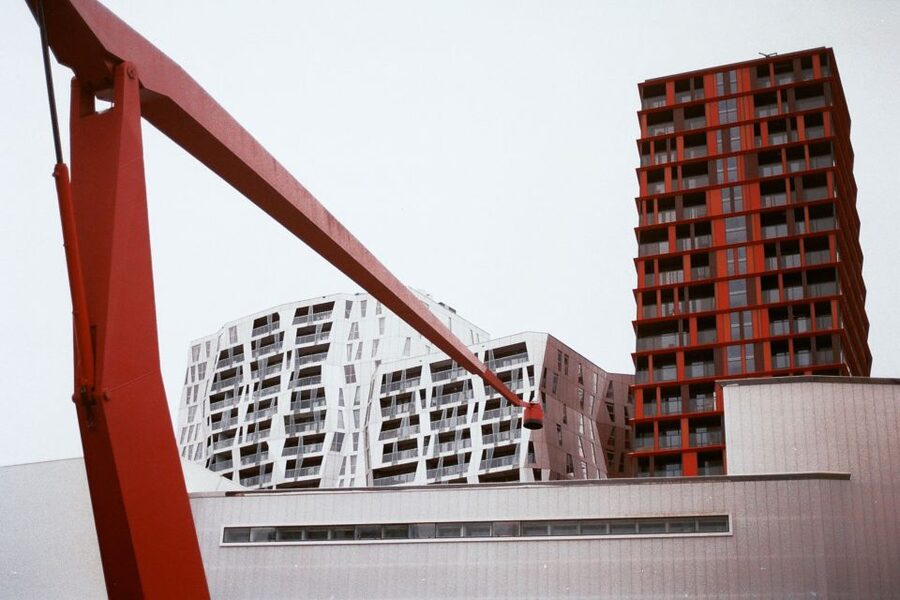
St. Laurens Church provides a needed historical counterpoint. After the modern buildings and postwar planning, you encounter one of the central area’s older landmarks.
The contrast is the point. Rotterdam can sometimes feel like a modern city with a few historic objects placed inside it. St. Laurens Church helps you see what survived and what was rebuilt around it. Its presence gives the central route a sense of time, even though the city’s public image is strongly tied to contemporary architecture.
The tour does not list an extended interior visit, so plan to appreciate the church mainly as part of the street route unless your guide says otherwise. You will get the most from this stop by asking how it relates to the surrounding modern city.
For first-time visitors, this section keeps the tour from becoming a parade of new buildings. Rotterdam’s appeal is partly in the friction between old and new, and St. Laurens makes that contrast easy to see.
Markthal and the Cube Houses
The route then reaches two of Rotterdam’s most recognizable sights: the Markthal and the Cube Houses. They are close enough to make a useful architectural pair, but they offer very different experiences.
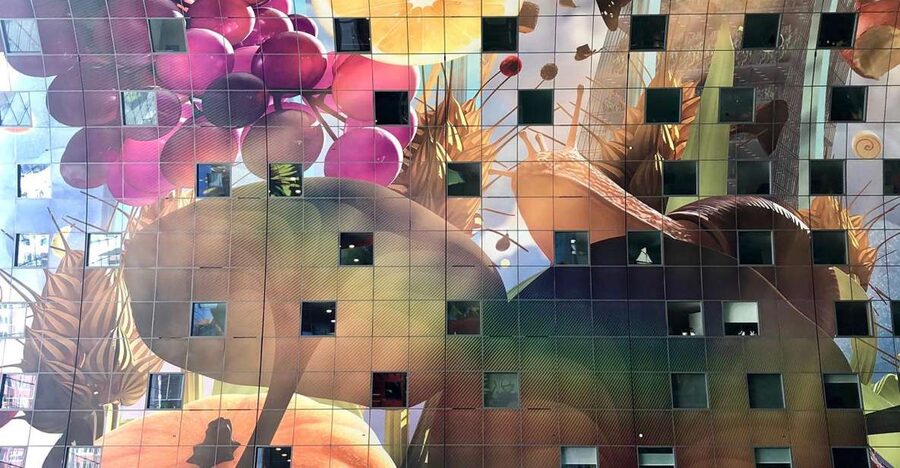
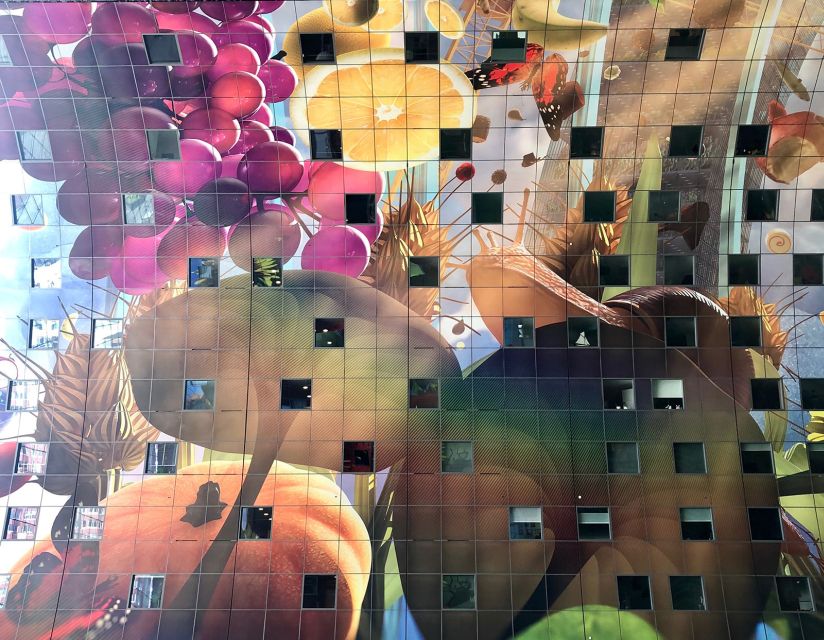
Markthal is the city’s famous indoor market hall, known for its huge covered market setting and eye-catching design. The building is not just a place to photograph from outside. Its public function matters. A market hall brings food, commerce, and daily life into a large architectural structure, making it easier to understand as part of the city rather than as a stand-alone attraction.
You may have time to look around, but this is still a guided walking tour with several stops. If you want to shop, eat, or examine the interior artwork at length, return later on your own. The guide’s explanation is more valuable here than trying to turn the stop into a full meal break.
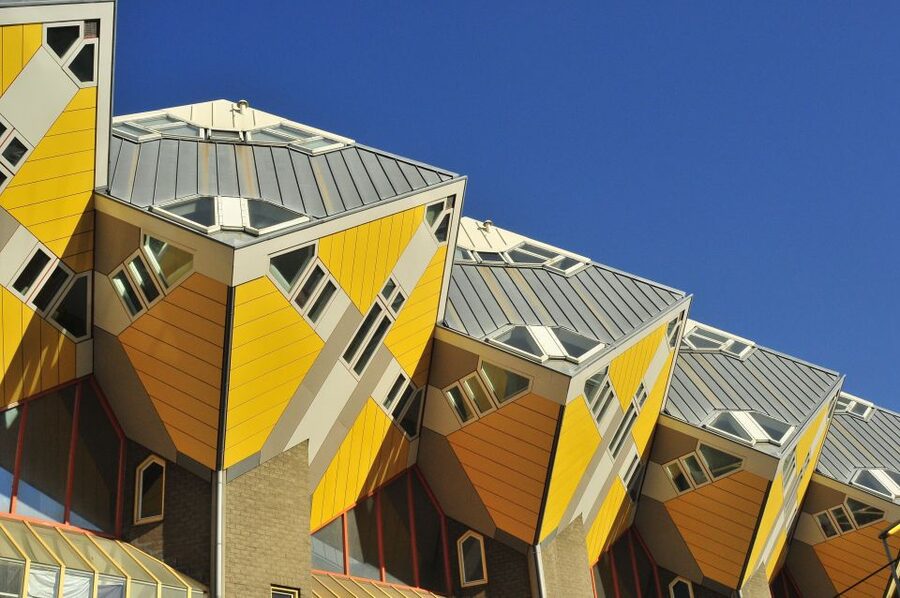
The Cube Houses offer a different lesson. Their tilted forms and unusual arrangement make them one of Rotterdam’s most instantly recognizable sights. They are fun to photograph, but the guide can also explain how the design changes the ordinary idea of a home and how these structures fit into the surrounding public space.
Do not expect a quiet, traditional neighborhood at this point. The area contains several major attractions, and the tour is about seeing how they fit together. For many visitors, this is the most visually packed part of the central route.
The watertaxi beneath the Erasmus Bridge
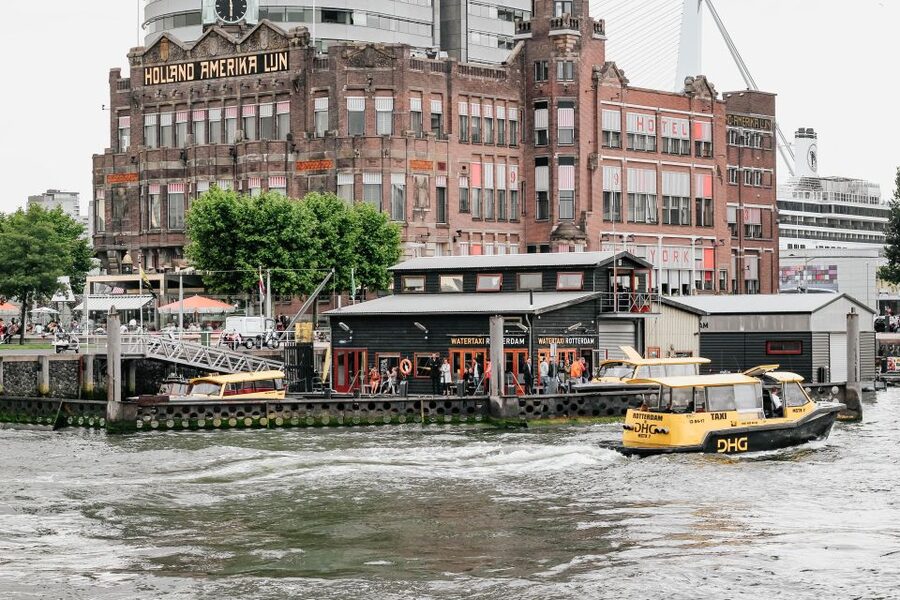
At the riverside, you board a watertaxi for the crossing to Rotterdam’s South Bank. This is the tour’s most memorable change of pace. After walking through streets and plazas, you are suddenly moving quickly across the Maas with the city opening around you.
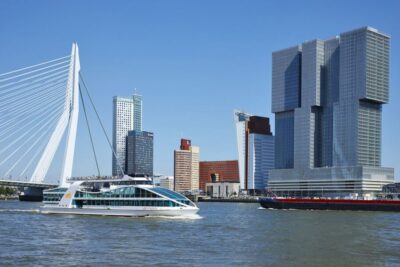
The ride passes beneath the Erasmus Bridge, Rotterdam’s most iconic landmark. From the water, you get a view that is difficult to copy from the street. The bridge’s scale becomes clearer, and the central skyline begins to make sense as a connected waterfront rather than a series of separate buildings.
The watertaxi is a speedboat, so this is more than a slow scenic ferry trip. You should expect a brief, lively ride rather than a long cruise with commentary. The water taxi fee is included in the tour price, which adds real value to the experience.
Keep your expectations practical. The ride is part of the walking route, not a replacement for a dedicated harbor cruise. You will get an exciting crossing and useful city views, but the guide’s main interpretation continues on foot once you reach the South Bank.
Rotterdam’s South Bank and the former harbor
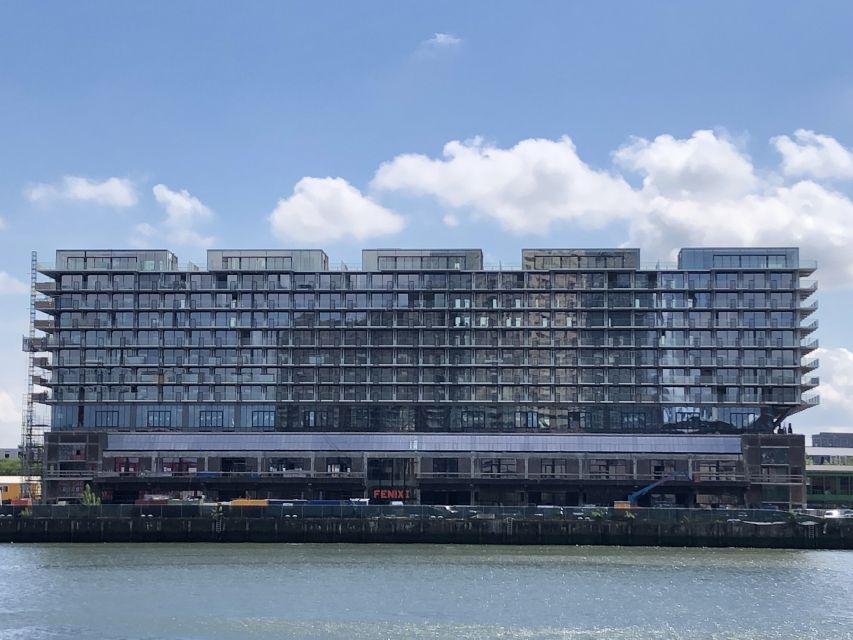
The South Bank is where the tour shows Rotterdam’s next chapter. Former harbor areas have been reshaped into a district filled with high-end architecture, cafes, and restaurants.
This part of the route helps you understand that Rotterdam is still changing. The central city’s postwar rebuilding is one story. The transformation of old harbor land into a modern waterfront district is another. You can see how new buildings and restored industrial spaces share the same area.
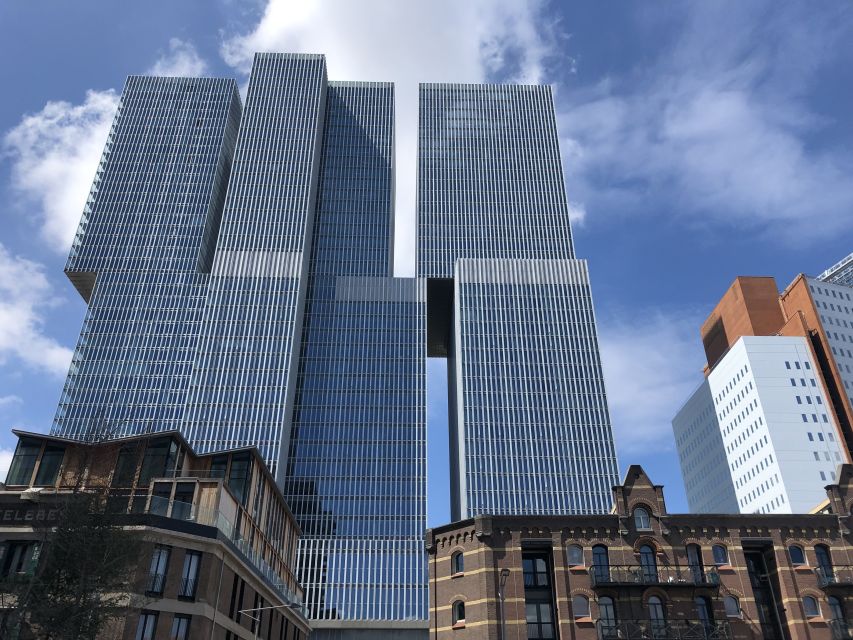
The tour includes views of the Rotterdam OMA building, historic Hotel New York, Fenixloods, and Fenix Food Factory. Each adds a different note. The OMA building connects the South Bank to Rotterdam’s modern architectural reputation. Hotel New York brings in the area’s older harbor and passenger-shipping identity. Fenixloods and Fenix Food Factory show how former industrial spaces can take on new public uses.
You should not expect a full food tour at Fenix Food Factory or a hotel visit at Hotel New York. These are sights along the route, with time to understand their place in the district. If you find a cafe or restaurant you like, note it and return after the tour, since the $82 price does not include drinks or meals.
This final section is particularly useful for planning the rest of your stay. You may spot places you want to revisit for lunch, dinner, or a slower walk. One of the strengths of the tour is that the guide can offer sightseeing tips for later, as Tania did for one group.
What the four-kilometer walk feels like
Four kilometers is manageable for many people, but it is not a token amount of walking. You will be on your feet through the center, moving between several landmarks before the watertaxi crossing and the South Bank portion.
The pace is likely to include stops for explanation, but you should still prepare for a steady outing. Wear comfortable shoes and avoid large bags or luggage. The tour is not designed for someone who wants to sit frequently or cover only a small area.
The activity information describes the experience as wheelchair accessible, but it also says it is not suitable for people with mobility impairments or visual impairments. Those points deserve careful attention. If you use a wheelchair or have specific access needs, contact the provider before booking and ask about the full walking route, boarding the watertaxi, and conditions at each stop.
Children under 12 may participate free, with the price listed only to cover the speedboat fee. The four-kilometer distance still matters for families. Young children may enjoy the watertaxi and Cube Houses, but parents should judge the walking length for themselves.
The $82 price and who gets the most value
At $82 per person, this is a premium walking tour. The price includes the live English-speaking guide and the watertaxi, but not drinks, meals, hotel pickup, or drop-off.
I see the value in three parts. First, you are not just paying for transport. You are paying for an architect-led explanation of a city where design is central to the experience. Second, the route covers a lot of ground in three hours, which is useful if your time in Rotterdam is short. Third, the watertaxi adds a memorable experience and links the city center with the South Bank in a natural way.
The price is less attractive if you mainly want independent sightseeing. You can see many of these buildings from public streets without joining a tour. It also may not suit you if you prefer long stops inside museums, markets, or historic buildings.
For an architecture fan, a first-time visitor, or anyone who wants a clear introduction before exploring alone, the cost is easier to justify. The perfect follow-up is a self-guided return to the Markthal, Cube Houses, South Bank cafes, or Fenix Food Factory after you know what you are looking at.
Practical details for a smooth outing
The tour is offered in English and lasts three hours. Starting times vary, so check availability before booking. Meet under the station clock outside the main entrance, not inside the station.
Bring comfortable shoes and keep your belongings light. Large bags and luggage are not allowed. Drinks are not included, so carry what you need if permitted, or plan to buy something after the tour.
You can cancel up to 24 hours before the start for a full refund. The reserve-now, pay-later option also helps if your Rotterdam schedule is still shifting.
The overall rating is five out of five from four verified bookings, with strong praise for the architectural explanations and advice about future development and later sightseeing. The small number of ratings means I would treat that score as encouraging rather than conclusive, but the comments point to the tour’s clearest strength: thoughtful guiding rather than simple landmark collecting.
Should you book Rotterdam Architecture Centre and South Bank?
Book it if you want to understand Rotterdam’s architecture, see the central highlights efficiently, and enjoy a fast watertaxi ride beneath the Erasmus Bridge. It is especially well suited to a first day in the city, when a good guide can help you decide where to return later.
Skip it if four kilometers of walking sounds tiring, if you want a slow food-focused outing, or if you need a tour built specifically around mobility or visual access. At $82, you should care about the guide’s interpretation, not just the checklist of sights.
For the right visitor, this is a smart introduction to Rotterdam: modern buildings, surviving history, former harbor districts, and a lively crossing between them.
FAQ
Where does the Rotterdam architecture tour begin?
Meet your guide under the station clock beside the main entrance of Rotterdam Central Station, outside the station.
How long is the tour?
The tour lasts three hours and includes about four kilometers of walking.
What language is the tour offered in?
The live tour guide speaks English.
Is the watertaxi ride included?
Yes. The water taxi fee is included in the tour price.
Can children join the tour?
Children under 12 can participate free of charge. The listed price for them covers only the speedboat fee.
What should I bring?
Bring comfortable shoes. Large bags and luggage are not allowed.
Just added around Rotterdam
- e-Scavenger hunt Rotterdam: Explore the city at your own pace★ 4.5 · 13 reviews
- Rotterdam: City Walk Audio Guide in 7 Languages on your Phone★ 3.5 · 6 reviews
- Rotterdam Must Do Tour: Highlights, History, WW2 and Architecture★ 5.0 · 20 reviews
- Breda Fun Puzzle Quest: True Lord Self-Guided Tour★ 4.0 · 9 reviews
- e-Scavenger hunt Breda: Explore the city at your own pace★ 4.5 · 27 reviews
- Delfshaven Self-Guided Tour: A Guide to Rotterdam’s Old Town★ 5.0 · 4 reviews
- Skip the Line: SS Rotterdam Steam Ship Entrance Ticket★ 4.5 · 18 reviews
- Discover Rotterdam: Classic Highlights Bike Tour with a Local★ 5.0 · 22 reviews
Rotterdam Tours, compared.

Browse the lists this tour appears in