

Reviewed · CITY TOURS
e-Scavenger hunt Utrecht: Explore the city at your own pace
Utrecht’s best sights are spread through a compact historic center, and this self-guided scavenger hunt gives you a reason to connect them on foot. You’ll begin at Domplein, then work through churches, canals, market streets, old neighborhoods, and quiet courtyards while answering questions on your phone. I like the freedom to stop for lunch or drinks, and I like that the route reaches places you could easily miss on an ordinary stroll.
The main trade-off is that this is a game first and a history lesson second. Some questions and map points can feel imprecise, and the explanations are often short. You’ll get the most from it if you enjoy solving clues, checking facts yourself, and treating the route as a playful framework for seeing Utrecht.
Key points at a glance

- Dom Tower sets the scene: Start at Utrecht’s 112.5-meter symbol on Domplein.
- A broad city route: Visit canals, churches, the flower market, Neude, old workers’ homes, and university grounds.
- Flexible timing: Allow about 2 to 4 hours, with room for food, drinks, photographs, or detours.
- Private group format: One team can include up to six people, and larger parties can split into teams.
- Phone-based play: You need your own smartphone and mobile data to follow the trail.
- Good for mixed ages: The questions and walking format suit friends and family groups with different interests.
Starting beneath Utrecht’s famous Dom Tower
The trail starts at Domplein 20, beside the Dom Tower. At 112.5 meters, this is the tallest church tower in the Netherlands and the symbol of Utrecht, so it is a sensible place to get your bearings.
The opening stop gives the hunt an immediate sense of place. You are not beginning beside an anonymous meeting point or a modern shopping street. You are standing in the city’s historic heart, with the tower rising above the square and the old center spreading out in several directions.
From here, the route introduces Utrecht through a string of short tasks. The format is simple: walk to the location, look closely, and answer the question in the app. You also need to tap bonus points when you reach the correct place. That small detail matters because it is easy to arrive at a stop and forget to claim the extra points.
The scoring adds a little friendly competition. If your group wants a serious contest, split into teams and compare final scores. If not, ignore the scoreboard and use the questions as prompts to notice details you might otherwise walk past.
More City Tours in Utrecht
- Utrecht: City Canal Cruise
★ 4.3 · 2,895 reviews - Utrecht 2-Hour Walking Tour | Discover The City With A Local
★ 5.0 · 138 reviews - Our Utrecht City Tour (Limited group size & optional Lunch)
★ 4.9 · 70 reviews
Churches, music, and Utrecht’s older center
One stop focuses on a collection of self-playing musical instruments. The display includes music boxes, clocks, pianolas, and barrel organs. It adds a quirky change of pace to the route, moving the hunt away from grand architecture and toward mechanical sound and craftsmanship.
The trail also takes you to one of Utrecht’s oldest churches. Construction began in 1039, and the church was inaugurated on May 1, 1048. Those dates give you a useful sense of the city’s age, even if the app’s explanation is not long enough to provide a full historical account.
The Janskerk, on Janskerkhof, brings another early medieval landmark into the route. Bishop Bernold founded it shortly after 1040, and it is dedicated to John the Baptist. The church is part of a square that helps show how Utrecht’s religious buildings shaped the old city.
The Nicolaïkerk, also called the Nicolaaskerk, is another important stop. Located at Nicolaaskerkhof 8, it broadens the church sequence and takes you toward a quieter part of central Utrecht. I like this part of the route because it gives the walk a clear historical thread without forcing you to follow a formal guided tour.
The limitation is that you should not expect every church stop to come with a full explanation. The hunt gives you facts to work with, but answers are not always discussed in much detail. If a particular building catches your interest, make a note of its name and look it up later.
Flowers and canals: Utrecht at its most inviting
The flower market is one of the more colorful stops. You’ll find cut flowers and plants in a comfortably busy setting, making this a good place to pause between questions. It is also a welcome reminder that Utrecht is not only about medieval buildings and church history.
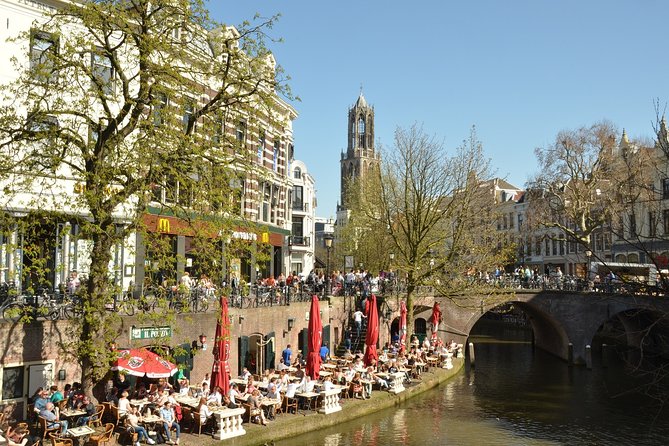
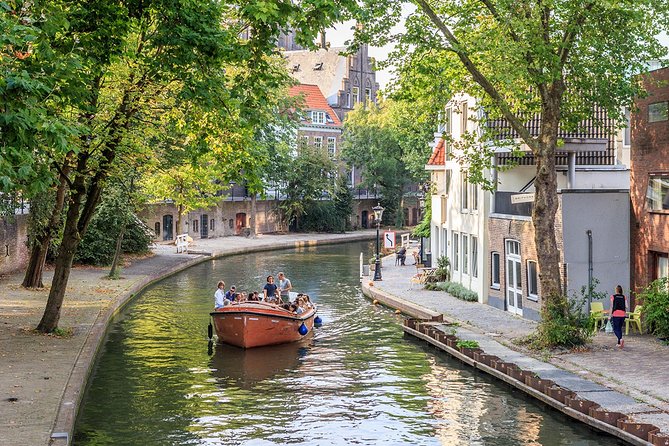
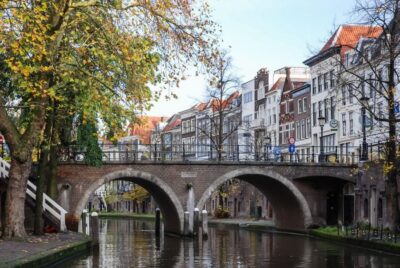
The Oudegracht, or Old Canal, is another major part of the trail. This canal runs through the center and is lined with restaurants and waterside spaces. It is one of the places where Utrecht feels distinctly different from other Dutch cities, thanks to its lower-level canal-side areas and long views along the water.
Give yourself time here. The route may ask you to identify something or answer a question, but you do not need to rush away once you have completed it. A drink or meal along the canal fits naturally into the schedule, and the flexible format means you can turn a two-hour hunt into a longer afternoon.
One participant described taking detours, stopping for lunch and drinks, and walking about 10 kilometers. That distance is not a fixed requirement, but it shows how easily the activity can expand if you wander. If you want a shorter outing, stay focused on the route. If you want a fuller city walk, use the hunt as your backbone.
University grounds and the Holland Water Defence
The route reaches the botanical garden on the Utrecht University campus. The garden is built around a former fort, part of the Holland Water Defence system. This gives the trail a different subject again: not just churches and canals, but plants, military engineering, water management, and the university setting.
This stop is useful because it adds variety to the walking route. You are not simply moving from one old facade to another. The former fort helps explain how Dutch defenses used water as part of a wider protective system.
The itinerary does not promise a full visit to every part of the botanical garden, so treat this as a route stop rather than a dedicated garden tour. If you enjoy gardens or historic defenses, you may want to allow extra time, though the supplied details do not specify additional entry arrangements or costs.
The Railway Museum also appears on the route. It is described as one of the Netherlands’ most exciting railway stations and as much more than a conventional museum. The stop adds transport history to the day and gives you another possible place to explore beyond the basic question.
Because the activity lasts about 2 to 4 hours, you may need to choose how closely you follow the game if you want a substantial museum or garden visit. The hunt and a full attraction visit can compete for time. Plan the trail as the main activity, then extend the day if your schedule allows.
More scavenger hunts around Utrecht:
- Utrecht Scavenger Hunt and Highlights Self Guided Audio Tour
★ 4.0 · 10 reviews - e-Scavenger hunt Maastricht: Explore the city at your own pace
★ 4.5 · 110 reviews - e-Scavenger hunt Middelburg: Explore the city at your own pace
★ 4.5 · 55 reviews - e-Scavenger hunt Den Bosch: Explore the city at your own pace
★ 4.5 · 37 reviews
Neude, City Hall, and the stories behind old streets

Neude is one of Utrecht’s best-known squares, but the trail gives it a small piece of local word history. The name comes from node, meaning swamp, and the area was once much lower than the square you see today.
That kind of fact suits the scavenger hunt well. It is brief, easy to remember, and tied directly to the ground beneath your feet. You may not receive a long lecture, but you get a detail that helps turn a square into a place with a past.
Utrecht City Hall offers a larger historical marker. The oldest parts date to 806, and the building changed over five centuries into the form seen today. The contrast between an ancient foundation and a later appearance is a useful reminder that historic city buildings are often rebuilt, extended, and reshaped rather than preserved in one untouched form.
Paushuize, on Pausdam, adds a monumental building from the beginning of the sixteenth century. Its name and setting make it one of the more distinctive architectural stops in the center. The trail uses it to link Utrecht’s medieval story with its later civic and religious history.
The route also includes the foundation building on Agnietenstraat. Completed in 1761, it was originally a boarding school for orphaned boys and is considered one of the Netherlands’ notable examples of rococo architecture. This is the sort of stop you might pass without context, so the question helps you look twice.
De Zeven Steegjes and Sterrehof

De Zeven Steegjes is one of the last working-class neighborhoods in central Utrecht. Its characteristic workers’ houses near the Oudegracht bring a more everyday side of the city into the walk.
This is one of the route’s strongest choices. Grand churches and public buildings tell you how powerful institutions shaped Utrecht. Small workers’ houses show where ordinary city life took place. You get a better sense of the center when both appear in the same outing.
The trail ends back at the meeting point and includes Sterrehof, an atmospheric courtyard that is valued as a national monument. Courtyards such as this can be easy to miss because they are quieter and less obvious than the main squares. They reward a slower pace and careful attention to entrances and side streets.
Do respect the character of residential areas. The supplied information does not set special visiting rules, but a considerate approach is always wise in working neighborhoods and courtyards. Keep voices down, avoid blocking doorways, and focus on the details rather than treating the area like a photo set.
How the phone game works in practice
You receive confirmation at booking and use a mobile ticket to access the activity. The hunt is offered in English, and you bring your own smartphone and mobile data. Those requirements are simple, but check them before you set out because the game depends on the phone for navigation, questions, answers, and scoring.
The app is generally easy to navigate, though some location pins may not line up perfectly with the exact place where an answer can be found. In practice, this means you should use your eyes and the surrounding buildings rather than following the map blindly.
Hints may not always be as helpful as you want. One reported issue was that a clue point felt far from the actual answer, turning a pleasant search into unnecessary backtracking. The best approach is to allow a little patience and keep the group together when a question seems unclear.
The questions mix observation, local facts, and simple puzzle solving. They are interactive and educational, but the historical explanations are short. If you want a polished audio guide or detailed commentary at every stop, this will feel thin. If you want a light challenge that gives structure to a city walk, it works better.
The route can also include an occasional wrong or outdated answer. That is frustrating when the app marks a correct response wrong, especially for a team focused on its score. I would treat the score as a bonus rather than the purpose of the outing.
Price, pace, and group value
The listed price is $37.21 per group of up to six people. That makes the cost especially attractive for a full group, since the price is not charged per person. Split among six, it works out to roughly $6.20 each before any currency or booking variations.
For two people, the value is still reasonable if you want a private activity with a prepared route. You are paying for the game structure and app rather than a live guide. There is no guide to answer follow-up questions, adjust the route, or explain a building in depth.
The stated duration is about 2 to 4 hours. That range is realistic for a flexible city trail because your walking speed, photo stops, lunch, and detours will shape the day. The route can also lead to around 10 kilometers if you wander, so comfortable shoes are a practical choice.
The activity runs every day from noon to midnight according to the supplied schedule. That broad window makes it useful for a free afternoon or evening, though the time details should be checked when booking because the listed operating period extends through December 8, 2026.
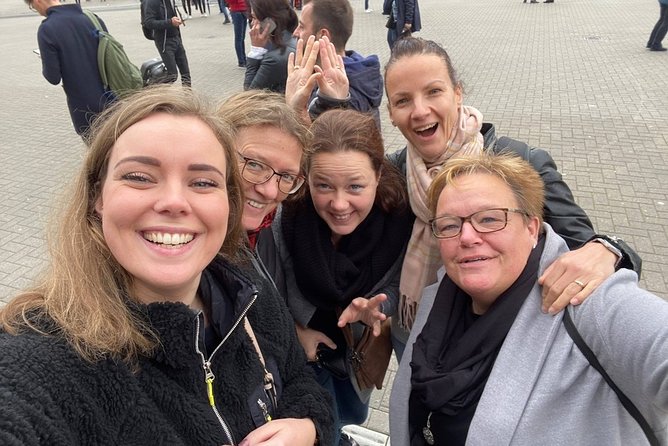
This is a private activity for your own group. It suits friends, families, office groups, and a girlfriends’ day out. Most people can participate, service animals are allowed, and the format is described as user-friendly for people with hearing impairments. Since there is no live spoken guide, the phone-based format may be preferable for some groups.
Who will enjoy this Utrecht city trail
I would choose this for a group that likes to walk, joke around, solve questions, and make its own schedule. It is particularly useful if you have only part of a day in Utrecht and want a route that covers more than the obvious canal and tower views.
Families and mixed-age groups can also make it work because the activity combines sightseeing with a game. Younger participants get a task to complete, while adults can pay attention to architecture and history. The private format avoids the pressure of keeping up with strangers.
It is less suitable if you want a quiet, serious history tour or detailed interpretation at every stop. The route is designed to keep you moving, and some facts are presented without much background. You should be comfortable using your phone and willing to solve a problem when a pin or clue is not perfectly clear.
Should you book the Utrecht e-scavenger hunt?
Book it if you want a flexible way to cover Utrecht’s historic center, especially with up to six people sharing the price. The strongest parts are the route variety, the private format, the freedom to stop for food, and the chance to reach places such as De Zeven Steegjes and Sterrehof that may not appear on a quick city walk.
Skip it if you want a live guide, exact navigation, or detailed explanations of every church and monument. For the best result, bring charged phones and mobile data, tap every bonus point, allow extra time for detours, and treat the final score as part of the fun rather than a test of historical accuracy.
Free cancellation is available when you cancel at least 24 hours before the start time. Cancellations or changes inside that window are not refunded or accepted.
FAQ
Where does the Utrecht e-scavenger hunt start?
It starts at Domplein 20, 3512 JD Utrecht, Netherlands.
Where does the activity end?
The trail ends back at the meeting point.
How long does the scavenger hunt take?
The estimated duration is about 2 to 4 hours.
How many people can join one group?
The activity is for a team of up to six people. It is private, so only your group participates.
What language is offered?
The experience is offered in English.
Do I need to bring a smartphone and mobile data?
Yes. A smartphone and data are not included, so you need to provide your own.
Can I cancel for a full refund?
Yes, if you cancel at least 24 hours before the experience start time. Cancellations within 24 hours are not refunded.
Just added around Utrecht
- Utrecht: Food Tour with many stops at vegan restaurants!★ 5.0 · 8 reviews
- Utrecht: Vegan Food Bike Tour – 6 Tastings (excl. bike)★ 5.0 · 7 reviews
- Utrecht Walking Tour with a local comedian as guide★ 4.8 · 5 reviews
- Utrecht: Ludwig’s Original Pub Crawl with VIP Club Entry★ 3.3 · 42 reviews
- Utrecht: Rietveld Schröderhuis UNESCO Entry Ticket★ 4.8 · 119 reviews
- Utrecht: Hoge Woerd Museum Entry Ticket with Audio Tour★ 3.3 · 3 reviews
- Utrecht Quiz Tour★ 3.2 · 31 reviews
- Utrecht: Lofen Palace with Entry Ticket & Guide (Dutch)★ 4.4 · 41 reviews
City Tours, compared.
75 Minute City Canal Cruise with Audio Guide
Read our review →


City Canal Cruise and Heineken Experience Ticket
Read our review →

Browse the lists this tour appears in