

Reviewed · HISTORICAL TOURS
Amsterdam: Private Pedicab Historical Sightseeing Tour
Amsterdam’s old center is easiest to understand when you can move through it slowly. This private pedicab tour takes you from Dam Square through the canal ring, Jewish Quarter, Chinatown, Amstel River, and Museumplein without asking you to walk the whole route. Guide Bram de Haan adds maps, photographs, and local stories as he drives.
I like the small private format, which lets you ask questions and set a preferred finish point. I also like the way the route links famous sights with less obvious corners, such as the old city gate at Nieuwmarkt and the houseboats near Montelbaanstoren. The main drawback is the two-hour limit: you will see many places, but most stops are brief rather than full visits.
Key points at a glance
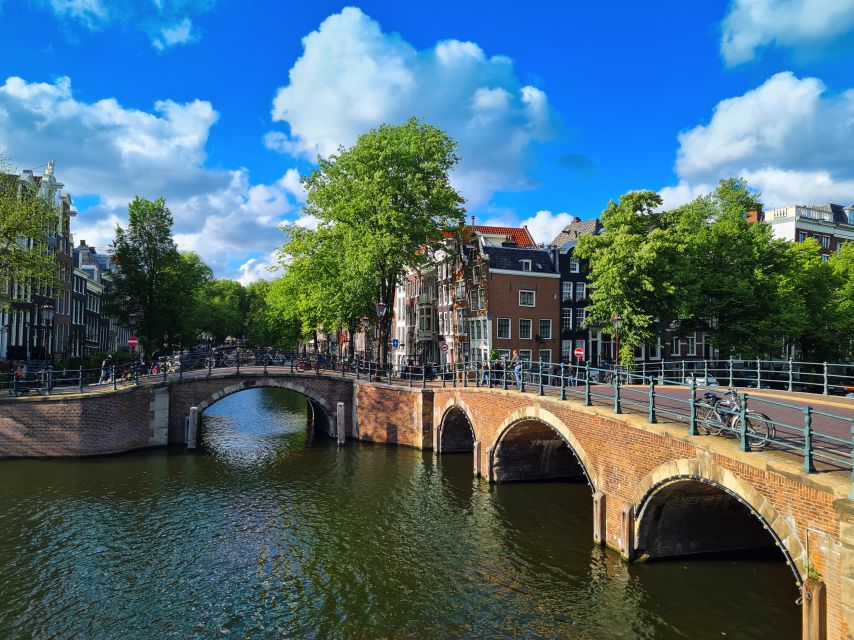
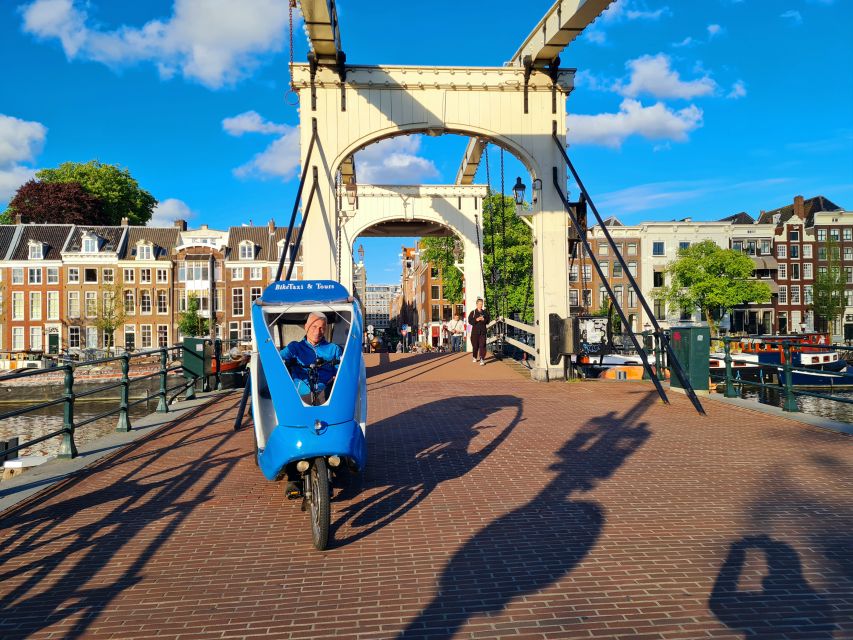
- Private pedicab for up to two people: You get a personal ride rather than a large group tour, with hotel pickup and drop-off included.
- A broad Amsterdam route: The tour covers Dam Square, Zeedijk, Chinatown, Nieuwmarkt, the Jewish Quarter, Amstel River, the canal ring, and Museumplein.
- Strong historical focus: Bram uses photographs and maps to explain how Amsterdam developed, including its Jewish history and wartime occupation.
- A good choice for limited walking: You can see a large part of the center from your seat, with stops along the way for views and orientation.
- Blanket provided in cool weather: This matters because the pedicab is open to the air, and Amsterdam can feel chilly even on a mild day.
- Weight rules are important: The combined passenger weight cannot exceed 200 kilograms, and the activity is listed as unsuitable for anyone over 100 kilograms.
Why a pedicab works well in Amsterdam

A pedicab gives you a useful middle ground between walking and a standard vehicle tour. You sit above street level, move at a gentle pace, and can look up at canal houses instead of watching traffic from behind glass. The compact vehicle can also use streets that are not practical for larger cars.
This matters most in Amsterdam’s historic center. The old streets are close together, and the canal ring is best appreciated in a slow series of views rather than from one fixed lookout. You will see different building fronts, bridges, houseboats, and waterways as the route bends through the city.
The private setup is another advantage. With only your party and the guide, you can ask about a particular building, request a photo stop, or adjust the final drop-off point. The tour is designed for up to two people, so it suits a couple or two companions who want a quiet introduction to Amsterdam.
I would not treat it as a substitute for museum admission or a long walking tour. The pedicab gives you an excellent first look, but the sightseeing is mainly from the vehicle, with selected stops. If you want to spend an hour inside the Rijksmuseum or examine every synagogue in detail, you will need a separate visit.
More History Tours in Amsterdam
- Amsterdam Food and Cultural Tour with Tastings
★ 5.0 · 2,442 reviews - Amsterdam: Haunted History and Ghost Walking Tour
★ 4.5 · 488 reviews - Amsterdam High-End Dutch Food & History Tour – Up to 8 guests
★ 5.0 · 482 reviews
Dam Square, the city’s starting point
The tour begins at Dam Square, the central point from which Amsterdam grew. It is a useful place to start because several major buildings sit close together: the Royal Palace, the New Church, and the National Monument.
You will get an introduction to the square and its place in the city before moving into the older streets. The opening stop helps you connect Amsterdam’s present-day center with its beginnings, rather than treating the city as a collection of unrelated sights.
Dam Square can be crowded, so the pedicab’s slower pace is helpful once you leave the open plaza. This is an orientation stop, not a palace tour. You should plan a separate visit if you want to go inside the Royal Palace or New Church.
Zeedijk and a glimpse of Chinatown
From Dam Square, the route continues to Zeedijk. The name refers to the old dike that protected the city, though today it is a busy historic street lined with cafés, shops, and older buildings.
One detail here is especially appealing: you will see Amsterdam’s oldest surviving café with its original interior. The tour does not include food or drinks, so think of this as a visual and historical stop rather than a tasting break.
A little farther along, you get a look toward Chinatown. This part of the route shows how Amsterdam’s identity changed over time. The old defensive street, traditional buildings, and Chinese influence sit close together, making Zeedijk a compact lesson in the city’s many layers.
Because this is a short city tour, you may not have time to wander the street at length. If the café or Chinatown interests you, note the location and return later on foot.
Nieuwmarkt and the medieval city gate
Nieuwmarkt offers one of the clearest historic landmarks on the route. Its main building is a 15th-century city gate positioned in the middle of the square.
The gate helps explain how Amsterdam once controlled movement through its walls and defenses. Seeing it in the open square gives you a better sense of the city’s earlier boundaries than a general lecture about medieval Amsterdam would.
This is also a practical point for understanding the transition from the old center toward the eastern districts. Bram’s explanations are supported by visual material, including historical photographs and maps, so you can compare the city as it was with what you see now.
The stop is still an overview. You will not receive a long architectural tour of every building around Nieuwmarkt, but you will leave with a clear reason for the square’s shape and importance.
More Private Tours in Amsterdam
- Rijksmuseum Amsterdam Small-Group Tour with Private Upgrade
★ 4.5 · 1,547 reviews - Van Gogh Museum Tour Reserved Entry Semi Private
★ 5.0 · 1,437 reviews - Private Amsterdam Red Light District and Coffee Shop Tour
★ 5.0 · 763 reviews - Anne Frank and Jewish Quarter Amsterdam Private Walking Tour
★ 5.0 · 684 reviews
Montelbaanstoren and the old waterfront
A few minutes later, the pedicab reaches Montelbaanstoren. This old watch and defense tower formed part of Amsterdam’s expanded defenses in the early 16th century.
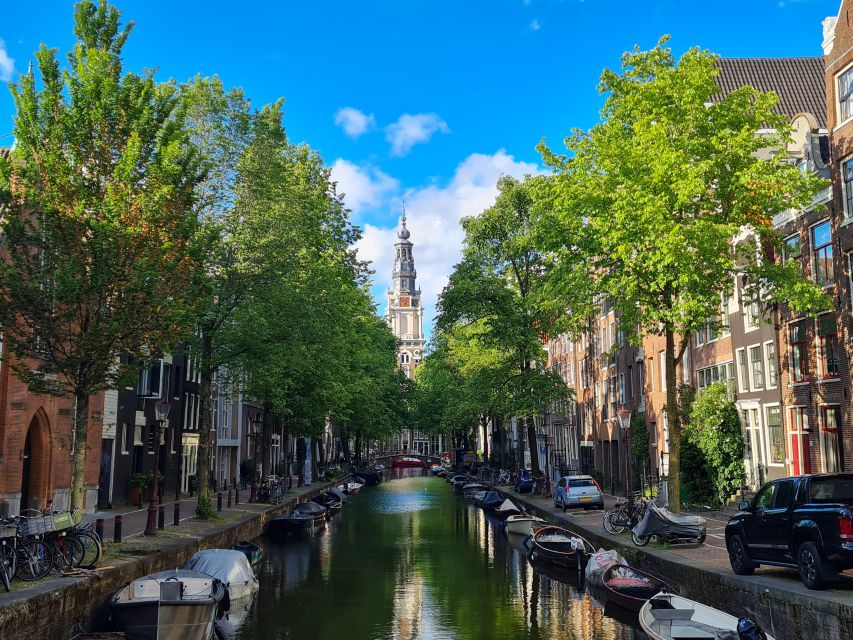
The tower is interesting on its own, but the view nearby adds to the stop. You can look toward the Oude Waal, where houseboats line the water with 17th-century canal houses behind them. It is one of the route’s more useful photo points because it combines working waterfront life with traditional Amsterdam architecture.
I like this part of the tour because it avoids making Amsterdam only about its postcard canals. The houseboats show how the waterways are still part of everyday life, while the tower points back to a time when the city needed fortified boundaries.
The pedicab’s open design helps here. You can take in the view without trying to find a place to stop a large vehicle. Still, the exact amount of time available for photographs depends on the day’s traffic and the pace of the tour.
The Jewish Quarter and Amsterdam’s wartime memory
The Jewish Quarter is the most serious part of the route. You will see the Great Synagogue, the first synagogue Jewish people were allowed to build in Western Europe more than 350 years ago, along with the Portuguese Synagogue across the street.
Nearby is the Holocaust Names Monument, made with 102,000 bricks bearing the names of Dutch Jewish victims of the Second World War. This is not a light sightseeing stop, and it deserves your attention. The tour connects the monument with Amsterdam’s Jewish community and with the history of the city under Nazi occupation.
Across from the monument are 17th-century canal houses once inhabited by successful Sephardic Jewish immigrants involved in the diamond trade. That contrast is important. You see both the cultural and economic contribution of Amsterdam’s Jewish community and the terrible destruction it later faced.
Bram is particularly strong when explaining this part of the city. He uses photographs and maps to make the changes easier to understand, including the city’s development and the occupation by Hitler’s army. If you prefer a quiet, reflective visit to the monument, let him know. A pedicab tour can offer context, but it cannot replace the time and concentration of a dedicated Jewish history visit.
The Hermitage and the Amstel River
The route then passes the Hermitage, housed in a large 17th-century widow’s house. The building itself is part of the story. Amsterdam’s canal-side houses were not all built for the same purpose, and this stop gives you a look at how large residences were used and adapted over time.
From there, the pedicab reaches the Skinny Bridge, one of Amsterdam’s best-known bridges. The bridge is especially attractive at night, when hundreds of light bulbs outline its narrow structure. During a daytime tour, you will see the bridge and get a broad view over the canalized Amstel River.
The Amstel is the main and widest canal in the city, and this is one of the best places on the route for photographs. You can frame the water, bridge, and surrounding buildings in one view.
Do not expect the nighttime lighting during a standard daytime departure. Starting times vary, so check availability if seeing the bridge illuminated matters to you. Either way, this stop gives you a welcome open view after the tighter streets of the old center.
Reading the 17th-century canal ring
The ride continues through Amsterdam’s canal district, the half-circle neighborhood that wraps around the old center. This is where you see the greatest number of familiar canal houses, many of which were once homes or workplaces for successful merchants.
The guide points out how the houses differ and what their similarities reveal about their building period. Amsterdam’s canal houses are often narrow and tall, but small changes in shape, façade, and decoration can tell you more about when and why they were built.
This is a good reason to take the tour early in your stay. After Bram explains the basic patterns, you can recognize them during later walks and canal cruises. You are not just collecting photographs. You are learning how to read the city.
The route also lets you see how old architecture sits beside modern Amsterdam. Houseboats, bicycles, traffic, and active streets share space with buildings several centuries old. The pedicab provides a comfortable way to take in that contrast without rushing from one landmark to the next.
Rijksmuseum and Museumplein
The final planned stop is Museumplein, a large green square from the 19th century and home to two of the Netherlands’ most important museums, the Rijksmuseum and the Van Gogh Museum.
The pedicab drives through the Rijksmuseum tunnel and stops in the middle of the square. That tunnel is one of Amsterdam’s memorable urban passages, and the stop gives you a clear sense of the museum district’s scale.
Museumplein works well as the end of a sightseeing loop. You can finish at your hotel, or choose another agreed location in advance. If you plan to visit either museum afterward, ask about ending there, though you should confirm the desired location before the ride begins.
The tour does not include museum entry. Its value here is orientation. You learn where the museums are, how the square connects to the rest of the city, and which institutions deserve more of your time.
Bram’s guiding style and the value of local context
Guide Bram de Haan is the named guide associated with this experience, and his role is more than simply driving. He explains the sights in English, Dutch, or German and uses visual aids such as photographs and maps.
That approach is useful for Amsterdam because the city’s story is layered. A canal can be a pretty view, a former trade route, a defensive feature, and a residential address all at once. Maps and old images help you see those changes instead of hearing a string of dates that quickly blur together.
The private group also changes the tone. You can ask why a street is shaped a certain way, pause for a photograph, or request more explanation at a particular stop. Several past bookings have also extended the ride to three hours, but the advertised experience is two hours, so arrange any extra time directly rather than assuming it is included.
Comfort, mobility, and practical limits
This tour can be a good fit if you have limited walking ability. You remain seated for much of the sightseeing, and hotel pickup and drop-off remove the need to reach a distant meeting point. The pedicab offers a practical way to cover several districts without tiring yourself out.
It is not a fully defined accessibility service, however. The information does not specify wheelchair access, step-free boarding, or storage for mobility equipment. Ask the provider before booking if you need any of those features.
Bring warm clothing. A blanket is provided in cold weather, and that has been useful on cool, rainy days, but the pedicab is still exposed to the weather. I would choose a warm layer even in spring or early autumn.
Pay close attention to the weight restriction. The combined passenger weight must not exceed 200 kilograms, and the experience is listed as unsuitable for anyone over 100 kilograms. Since the two limits are presented together, contact the provider if your party is close to either threshold.
Price, timing, and overall value
The cost is $230 for a private group of up to two people. For two people, that works out to $115 each for two hours, including hotel pickup, drop-off, the ride, and the guide’s historical explanations.
That is not the cheapest way to see Amsterdam. A walking tour or public transport will cost less. The value comes from the private vehicle, the broad route, the ability to avoid much of the walking, and the chance to ask questions throughout the ride.
I think the price makes more sense for a couple, two friends, or an older pair who would otherwise need a private taxi between districts. It is also easier to justify if you want a first-day overview that helps you plan later visits to the Jewish Quarter, canal ring, and museums.
The two-hour length keeps the tour manageable, but it also means the sightseeing is selective. You will pass many places and stop at the main points, yet you will not have time for long interior visits. Free cancellation is available up to 24 hours before departure, and you can reserve now and pay later, which gives you some useful flexibility when your schedule is still changing.
Who should book this Amsterdam pedicab tour?
I would choose this experience if you want a private introduction to Amsterdam rather than a long walking route. It suits first-time visitors, couples, older adults, people with limited walking ability, and anyone who likes history explained through buildings and neighborhoods.
It is also a good option if you have only a short time in the city. In two hours, you cover a wide section of Amsterdam and learn where the major museums and historic quarters are located.
I would choose another activity if your main goal is museum time, nightlife, food tasting, or a detailed visit inside the synagogues and memorial sites. This is a moving overview with meaningful stops, not a full day of individual attractions.
With its private format, local guide, broad route, and strong historical focus, the tour earns its place as a practical first look at Amsterdam. Book it if comfort, context, and coverage matter more to you than the lowest possible price.
FAQ
How long is the Amsterdam pedicab tour?
The tour lasts two hours. Starting times depend on availability.
How many people can join the private pedicab?
The price covers a private group of up to two people.
Which languages are available?
The live guide can conduct the tour in English, Dutch, or German.
Does the tour include hotel pickup and drop-off?
Yes. Pickup and drop-off are included. You should wait outside in front of your hotel.
What should I bring?
Bring warm clothing. A blanket is provided in case of cold weather.
Are there passenger weight restrictions?
Yes. The maximum combined passenger weight is 200 kilograms, and the experience is listed as unsuitable for people over 100 kilograms.
More History Walks around Amsterdam
- Amsterdam: Historic City Sightseeing Canal Cruise
★ 4.5 · 444 reviews - Anne Frank and the Jewish History of Amsterdam Private Tour
★ 5.0 · 307 reviews - Amsterdam: 3-Course Meal in Historic 1st Class Waiting Rooms
★ 4.5 · 292 reviews - Amsterdam: Highlights & History Walking Tour
★ 4.8 · 266 reviews
Just added around Amsterdam
- From Amsterdam: The Hague Private Trip and Mauritshuis Entry★ 4.3 · 4 reviews
- VIP Private Full Day Tour of the Netherlands★ 4.8 · 6 reviews
- Amsterdam Old-West Vegan Food Tour with Local Guide★ 4.7 · 3 reviews
- Amsterdam: Van Gogh Museum Guided Tour★ 4.8 · 262 reviews
- Van Gogh Museum Private Guided Tour★ 4.2 · 10 reviews
- Vecht River: Full-day Cruise with Lunch★ 4.8 · 9 reviews
- Van Gogh and Rijksmusuem Tour: Small Group Tour with Entry★ 4.7 · 3 reviews
- Amsterdam: Van Gogh Museum Ticket & Guided Tour★ 4.4 · 187 reviews
Historical Tours, compared.
Amsterdam Food and Cultural Tour with Tastings
Read our review →
Kinderdijk UNESCO World Heritage Entry Ticket
Read our review →
Hop-on Hop-off Old-Fashioned Heritage Tram Tour
Read our review →


Amsterdam High-End Dutch Food & History Tour – Up to 8 guests
Read our review →
Cruise through the Historic City Center with Guide
Read our review →
Browse the lists this tour appears in