
Reviewed · MUSEUMS
Amsterdam: National Maritime Museum Skip-the-Line Ticket
Amsterdam’s National Maritime Museum makes Dutch sea power feel wonderfully physical. You can walk through the replica East Indiaman Amsterdam, squeeze into the captain’s quarters, sit in a sailor’s hammock, and even handle a cannon. It is far more involving than a museum of ships behind glass.
I like the museum’s excellent audio tour, which gives useful context without forcing you into a group, and the range of displays, from mapmaking and figureheads to the Royal Barge and modern solo sailing. The main drawback is simple: there is a lot to see, and the 10:00 AM to 5:00 PM opening hours can feel tight if you want to take your time.
Key points to know before you go
- Board the 1749 ship Amsterdam: Explore decks, cabins, the bow, cargo areas, and hands-on displays inside a full-size replica of a VOC East Indiaman.
- See Amsterdam’s maritime story in one place: Paintings, sea charts, navigation tools, carvings, ship models, naval objects, and royal vessels connect trade, war, exploration, and daily life at sea.
- Use the 60-minute audio tour: Commentary is available in English, Spanish, Chinese, Dutch, French, German, Italian, Japanese, Korean, Portuguese, and Russian.
- Try the Golden Age VR experience: A virtual flight over central Amsterdam shows the city and harbor at the start of the 17th century.
- Plan for children as well as adults: Interactive screens, movable objects, sounds, colors, and shipboard activities give younger visitors plenty to do.
- Allow more than one hour if possible: The museum can be seen quickly, but the ship, Royal Barge, map displays, and interactive exhibitions reward a slower visit.
Why Amsterdam’s maritime museum matters
Amsterdam’s wealth and influence were tied to the water. The National Maritime Museum explains that connection through objects you can see rather than through a long string of dates.
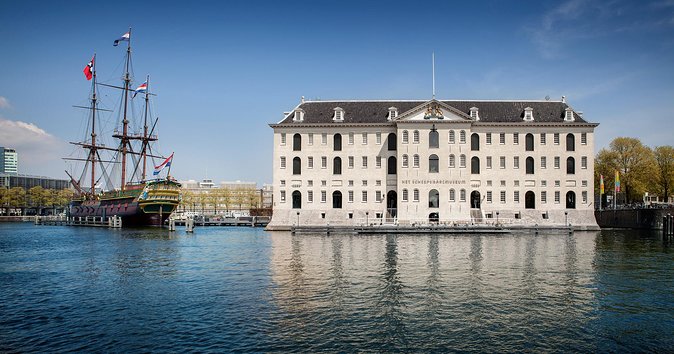
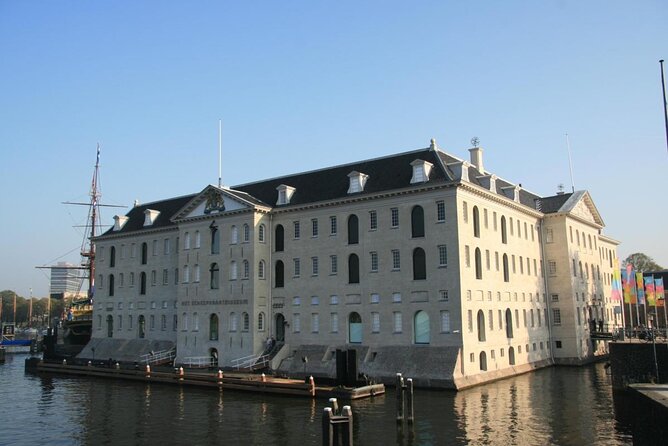
The museum occupies the former Admiralty storehouse, built in 1656. That setting matters. You are not entering a modern box built only for exhibitions. You are walking into a working piece of Amsterdam’s port past, now arranged around a striking covered courtyard.
The museum’s story reaches beyond sailing ships. You can follow Dutch trade, naval power, exploration, mapmaking, colonialism, and the slave trade. The treatment is not simply a celebration of Dutch success. The audio commentary and displays also address the darker parts of that success, which gives the visit a more honest shape.
I find that useful because maritime museums can sometimes reduce history to handsome ships and clever navigation. Here, the objects help explain who gained wealth, who carried out the work, and what the Dutch expansion meant for other people.
More museums and galleries in the Netherlands:
- Amsterdam: Van Gogh Museum Ticket
★ 4.7 · 52,054 reviews - Moco Museum Amsterdam Entrance Tickets with Banksy & More
★ 4.4 · 10,088 reviews - Amsterdam: The Upside Down Museum Entrance Ticket
★ 4.4 · 9,506 reviews
Entering the 1656 Admiralty storehouse
Start in the central courtyard. Its huge glass roof is not just a practical cover for the open space. The design repeats an old nautical map and uses 1,200 pieces to create a striking overhead pattern.
The courtyard is a good place to get your bearings before choosing an exhibition. It also gives the museum room to breathe. After the darker galleries and detailed displays, you can look up, pause, and decide where to go next.
The courtyard itself can be visited free of charge from 10:00 AM to 5:00 PM daily. Your ticket is most useful for the museum galleries and the replica ship, so do not confuse the free courtyard access with full admission to the collection.
The building’s size and layout make this a comfortable stop in poor weather. You can spend time indoors without having to rush between separate city sights. Staff are described as helpful, which is useful when you are trying to understand the layout or choose activities for children.
Boarding the replica ship Amsterdam
The ship is the main reason I would recommend this museum to anyone with even a passing interest in sailing. The replica of the 1749 VOC East Indiaman Amsterdam lets you move through a ship rather than simply admire one from a distance.
You can walk across the decks, enter the cabins, look into the captain’s quarters, and see how cramped life could be for sailors. The displays include life-like scenes about sea travel, giving the ship a human scale. A sailor’s hammock makes the point better than a paragraph of text ever could.
Children can fire a cannon as part of the hands-on presentation, while adults may spend more time looking at the ship’s construction and the demands of long-distance trade. Down in the hold, interactive activities give younger visitors something to do while adults examine the vessel.
The ship is especially strong because it connects several parts of the museum’s story. Trade was not an abstract business carried out on a map. It depended on wooden hulls, crowded quarters, navigation skills, harsh routines, and considerable risk.
Give yourself time here. It is easy to assume that boarding the ship will take ten minutes, then find yourself stopping at every cabin and deck. The vessel is also the part most likely to make the visit memorable for children.
Some sections may feel narrow or require careful movement. The museum is wheelchair accessible, but a historic-style ship with decks, cabins, and confined spaces may not offer the same ease of movement in every area. If access is important to you, ask staff for the best route on arrival.
Taking a virtual flight over Golden Age Amsterdam
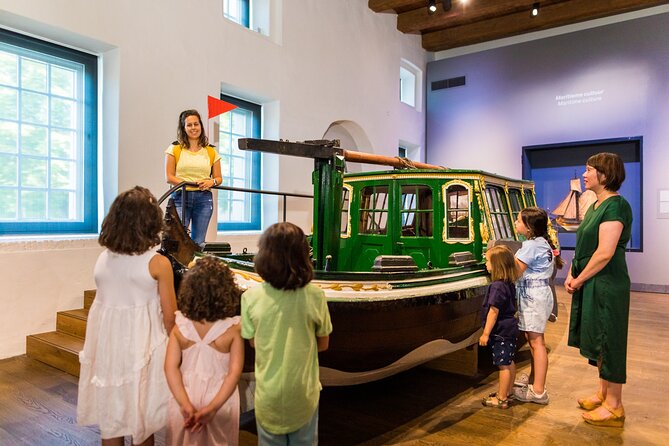
Inside the ship’s bow, you can take a virtual reality trip over central Amsterdam as it appeared during the Dutch Golden Age. The experience presents the city as a working harbor at the beginning of the 17th century.
This is a smart use of technology because it helps you see the city as a connected port rather than a collection of pretty canals. Amsterdam’s streets, water routes, ships, and trade all fit together in a way that can be hard to picture from ground level.
The VR section is one of the easiest activities to share with children, but adults who enjoy maps and urban history should not skip it. It gives visual shape to the museum’s larger question: how did a city surrounded by water become such an important European harbor?
The VR experience is short compared with the full museum visit, so it works best as one part of your day rather than the sole reason to buy a ticket. If there is a wait, use the time to see another nearby display and return when you can.
A few more days out around the Netherlands worth weighing up
- Skip the Line: Youseum Amsterdam Ticket
★ 4.5 · 183 reviews - Amsterdam National Maritime Museum Skip-the-line-Ticket
★ 4.0 · 105 reviews - Keukenhof Skip-the-line Tickets: Countryside & Farm Private Tour
★ 5.0 · 43 reviews - Private Keukenhof Park and Tulip Fields Tour (Skip-The-Line)
★ 4.5 · 42 reviews
Maps, figureheads, and the tools of navigation

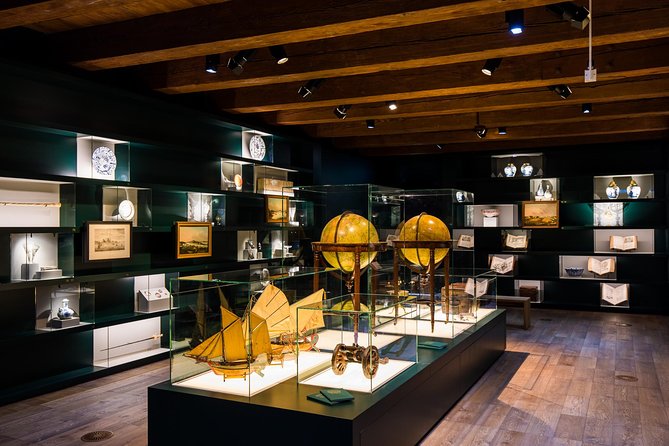
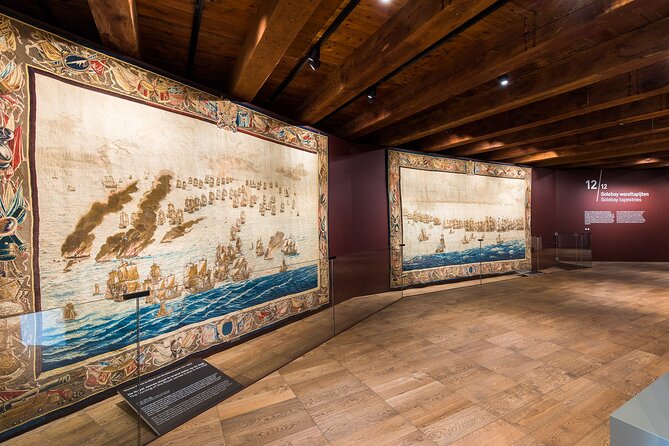
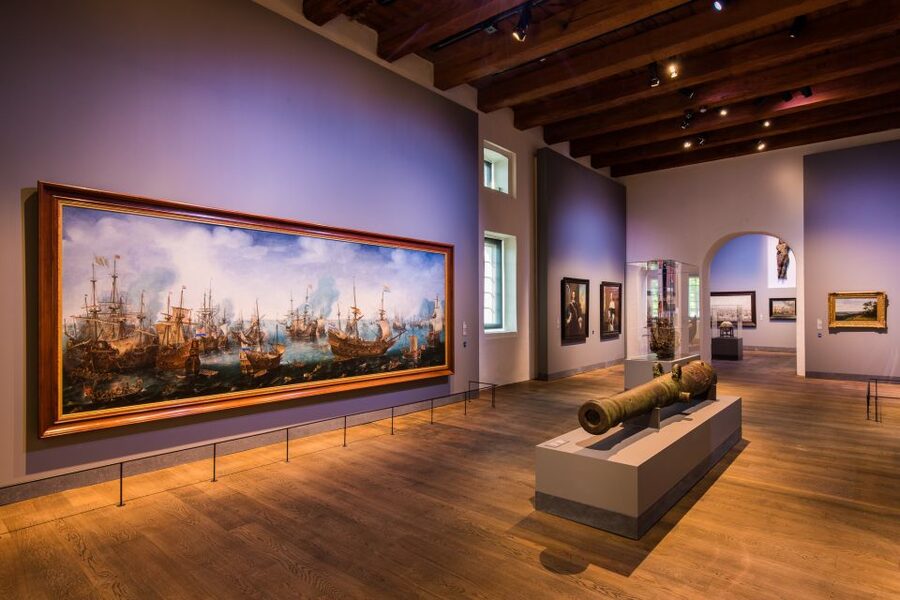
The collection includes sea charts, navigation instruments, paintings, ship models, carvings, and figureheads. Together, they show how sailors understood and represented the sea before modern technology made navigation easier.
The mapmaking displays deserve extra time. A chart is both a practical tool and a record of what people knew, feared, controlled, or misunderstood. You can see how maritime power depended on information as much as on ships and weapons.
Figureheads and carvings add a more personal touch. These objects once faced the water, exposed to weather and salt, yet they were made with care. Their detail gives you a glimpse of the pride and symbolism attached to ships.
The navigation instruments may appeal most to visitors who enjoy practical history. You can see the tools that helped sailors calculate position and direction, then compare that uncertainty with modern navigation. The audio tour makes these objects easier to understand, especially if you are not already familiar with nautical terms.
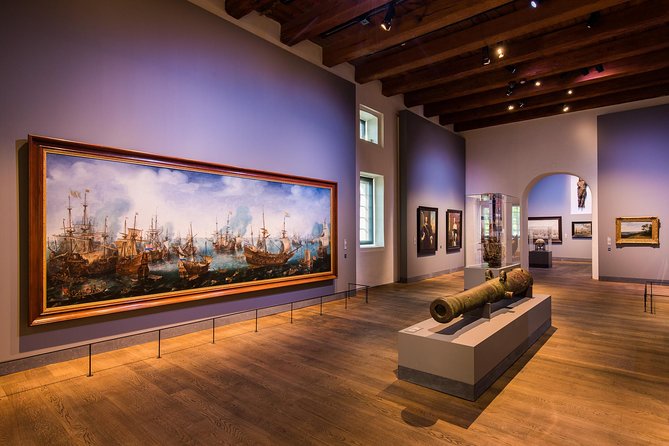
Paintings and ship models broaden the visit beyond technical equipment. Models show how vessels were built and arranged, while paintings place them in naval battles, trade routes, royal settings, or harbor scenes.
The galleries are well arranged and clearly described, but the sheer number of subjects can make the connections feel loose at times. If you prefer a single, tightly ordered story, choose a few themes before you start: trade, naval power, navigation, or life aboard ship.
The Royal Barge and the human side of power

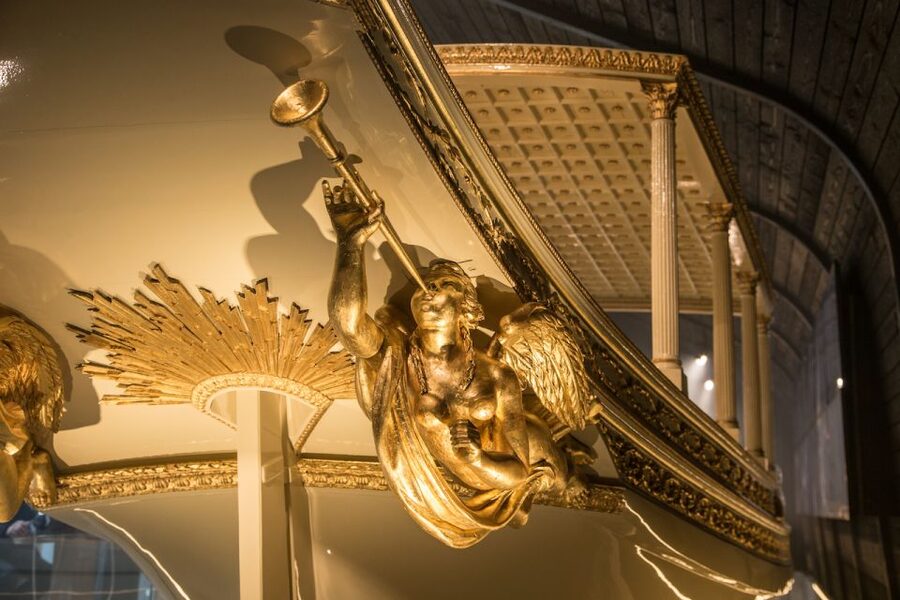
The Royal Barge provides a change of scale and mood. After seeing working ships and sailors’ quarters, you encounter a vessel designed to represent ceremony and authority.
Look at it alongside the East Indiaman. One ship shows the demands of long-distance trade, while the other expresses royal display. That contrast helps you understand how maritime power operated at different levels, from sailors and merchants to the monarchy.
The collection also reaches into more recent sailing. One exhibition follows a solo voyage around the world, asking you to think about what it means to travel alone by sea today. Modern technology changes the risks, but the basic challenge of managing yourself far from land remains striking.
This movement from historic shipping to modern solo sailing keeps the museum from becoming trapped in the past. You see that the sea is not only a subject of Dutch history. It remains a test of skill, endurance, and judgment.
Family activities and hands-on displays
Families should not assume this is a museum only for adults. Several exhibitions are designed for younger children, with touch screens, videos, movable parts, sound, color, and physical activities.
The ship is the strongest family area because children can move through real spaces and imagine the daily work of a crew. The cannon activity, sailor’s hammock, and hold displays turn maritime history into something physical.
That said, the museum is not an amusement park. Children who need constant action may lose interest in the painting, chart, and instrument galleries. I would let younger visitors lead for part of the visit, then choose one or two adult-focused rooms rather than trying to inspect every object.
The building’s open courtyard helps here. It gives your family a place to pause without leaving the museum setting. The cafe is another useful break, especially if you are planning a longer visit.
The audio tour and how to use it
A free 60-minute audio tour is included with admission. It is available in 11 languages: English, Spanish, Chinese, Dutch, French, German, Italian, Japanese, Korean, Portuguese, and Russian.
I like the fact that you can set your own pace. A guided group would give you a fixed route, but the audio tour lets you stop for a painting, skip a section, or spend longer inside the ship.
The commentary is particularly valuable for the difficult parts of Dutch maritime history. Trade, colonialism, and the slave trade are not subjects that should be treated as background decoration, and the audio material helps place the objects in their wider setting.
You do not need to listen to every minute to benefit. Use it for the main galleries and the objects that seem least familiar. On a short visit, concentrate on the ship, mapmaking, the Royal Barge, and the exhibits dealing with Dutch trade and colonial power.
How much time should you allow?
Your ticket is valid for one day, and the museum is open from 10:00 AM to 5:00 PM. You can pass through the main highlights in about an hour or so, but that approach leaves much of the collection untouched.
I would allow at least two to three hours for a satisfying visit. Add time if you are traveling with children, want to use the full audio tour, or plan to stop at the cafe.
A full day is reasonable for serious maritime enthusiasts. There are enough paintings, maps, models, instruments, naval objects, and interactive displays to fill it. The museum also works well as a flexible half-day stop because you can focus on the ship and the best-known exhibitions without committing your entire schedule.
The early closing time is the main planning issue. If you arrive late in the afternoon, go straight to the replica ship and the VR experience before working through the galleries.
Is the $24 ticket good value?
At $24 per person, the ticket is fairly priced if you plan to see the ship and spend at least a couple of hours inside. The included audio tour adds useful value, and the skip-the-line entry is helpful when you want to make the most of a limited day in Amsterdam.
The value is strongest for three groups: maritime enthusiasts, families, and visitors who want a clear explanation of Amsterdam’s rise as a port. You get more than a display of old boats. The museum links art, technology, commerce, military power, royal ceremony, and modern sailing.
If you only want a quick look at the building or courtyard, the ticket is harder to justify because the courtyard is free to visit. Likewise, visitors who dislike museums with many separate themes may find the collection broad rather than tightly focused.
Free cancellation up to 24 hours before the visit and the reserve-now, pay-later option make the ticket easier to fit into a changing schedule. The attraction is wheelchair accessible, though the ship’s confined areas may be more difficult than the main building.
Who should book this experience?
Book it if you want to understand why Amsterdam became a major harbor and you prefer objects, models, and physical spaces to a purely chronological museum. The replica Amsterdam is the star, but the maps, figureheads, Royal Barge, and audio commentary make the visit more than a ship tour.
Families should book if their children enjoy touch screens, sound, role-play, and exploring cabins. Adults with a serious interest in Dutch naval history, the VOC, navigation, or colonial history can easily spend half a day here.
You may want to skip it if your Amsterdam schedule is already packed and you can spare only a brief stop. In that case, the free courtyard will give you a look at the historic building, but you will miss the ship and most of the museum’s value.
FAQ
Where is the National Maritime Museum located?
The museum is at Het Scheepvaartmuseum, Kattenburgerplein 1, 1018 KK Amsterdam, in North Holland.
How long is the ticket valid?
The ticket is valid for one day.
What does the admission ticket include?
It includes entrance to the National Maritime Museum, a visit to the replica 18th-century ship Amsterdam, and an audio tour.
Is a guided tour included?
No. A guided tour is not included, but a free 60-minute audio tour is available.
Which languages are available for the audio tour?
The audio tour is available in Spanish, Chinese, Dutch, English, French, German, Italian, Japanese, Korean, Portuguese, and Russian.
Is the museum wheelchair accessible?
Yes, the National Maritime Museum is wheelchair accessible.
Can I cancel the booking?
Yes. You can cancel up to 24 hours in advance for a full refund. You can also reserve now and pay later.
Just added around the Netherlands
- Volendam: E-Scooter Rental★ 4.5 · 41 reviews
- Volendam: Volendams Museum Entry Ticket★ 4.4 · 14 reviews
- Volendam: E-Bike Rental including Highlights-Routes★ 4.9 · 23 reviews
- Volendam: 2.5-Hour Cheesemaking Workshop & Clog Making Tour★ 4.5 · 17 reviews
- From Amsterdam: The Hague Private Trip and Mauritshuis Entry★ 4.3 · 4 reviews
- Vlissingen: Maritime Museum Entry Ticket★ 4.6 · 7 reviews
- Volendam: 2-Hour Clogmaking Workshop and Cheese Tour★ 3.9 · 17 reviews
- Zundert: Vincent van Gogh House Entrance Ticket★ 3.9 · 43 reviews
Museums, compared.


Moco Museum Amsterdam Entrance Tickets with Banksy & More
Read our review →





Browse the lists this tour appears in