
Reviewed · HISTORICAL TOURS
Small Group LGBTQ+ History Tour in Amsterdam
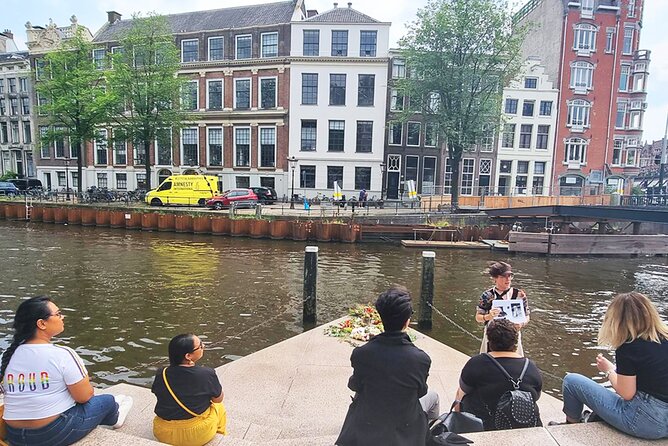
Amsterdam’s LGBTQIA+ story is not confined to one museum or one famous street. This two-hour walk links nightlife, canals, churches, literature, state violence, resistance, and the world’s first legal gay marriage. It gives you a new way to read the city’s familiar places.
I like the small group limit of eight, which makes a story-led walk feel personal rather than scripted. I also like the range of subjects, from clubgoers and a married king to queer Resistance fighters and a trans soldier in an 18th-century militia. The main drawback is practical: you are outdoors for the entire tour, and poor weather can lead to a cancellation or a change of date.
Key points to know
- Seven central Amsterdam stops: The route connects Rembrandtplein, the Munt Tower, Koningsplein, Keizersgracht, the Gay Monument, Herengracht, and Torensluis.
- A maximum of eight people: The intimate size suits visitors who want to ask questions and stay close to the guide.
- Guides with a strong storytelling style: Guus and Elyzabeth are named guides associated with this experience, and the focus is on bringing overlooked people back into the city’s story.
- History beyond modern nightlife: The tour reaches back several centuries, covering literature, religion, military service, political violence, marriage, and resistance.
- A useful central ending: The walk finishes at Torensluis, near the Multatuli sculpture, in central Amsterdam.
- Good value for history fans: At $47.34 per person, you pay for a focused two-hour walking experience with a local guide rather than entry to a major attraction.
Why this Amsterdam walk feels different
Many Amsterdam tours concentrate on canals, grand merchants’ houses, art, or the city’s famous nightlife. This one uses those same streets to ask a different set of questions: Who lived openly? Who had to hide? Which names were left out of standard history? And how did ordinary people protect one another?
The result is not just a tour of gay bars or modern rights milestones. You move through several centuries of LGBTQIA+ life and resistance. Some stories involve well-known public figures. Others center on shopkeepers, writers, soldiers, clubgoers, and people whose contribution has often been overlooked.
That broad range is the tour’s strongest feature. You get social history, political history, and personal stories in the same walk. The guide’s job is important here. The tour works best when the history is told with warmth and clarity, and the feedback associated with Guus and Elyzabeth points to an engaging, passionate approach.
The group cap matters, too. With no more than eight people, you are less likely to feel lost at a busy corner or separated from the guide. You can also ask questions without holding up a large crowd.
More History Tours in Amsterdam
- Amsterdam Food and Cultural Tour with Tastings
★ 5.0 · 2,442 reviews - Amsterdam: Haunted History and Ghost Walking Tour
★ 4.5 · 488 reviews - Amsterdam High-End Dutch Food & History Tour – Up to 8 guests
★ 5.0 · 482 reviews
Rembrandtplein: nightlife, royalty, and marriage
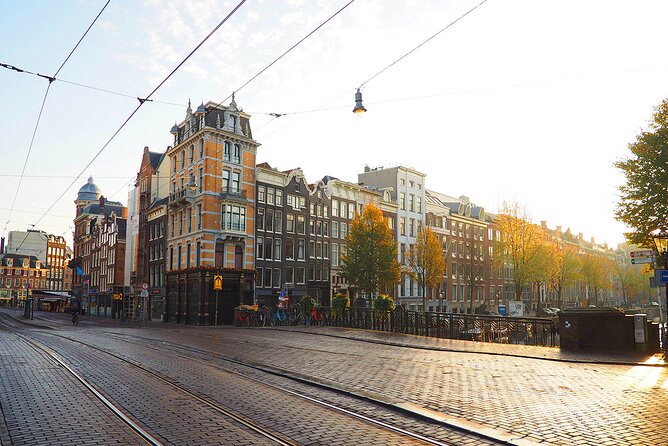
The first stop is Rembrandtplein, one of Amsterdam’s main nightlife centers. It is a smart place to begin because the square immediately connects the past with the city you see today: social life, entertainment, meeting places, and public identity.
Here you hear a quick overview of Amsterdam before moving into stories of LGBTQ clubgoers. The stop also covers a married king who had affairs with men and Amsterdam’s role in the world’s first legal gay marriage.
The contrast is useful. You are not given a simple story of steady progress. Public life, private relationships, social pressure, and legal recognition have not always moved at the same speed. A lively square can look very different when you understand who was allowed to gather there and who had to keep parts of life private.
This opening section lasts about 20 minutes. It sets the tone for the rest of the walk without asking you to enter an attraction. You should expect to listen while standing outside, so comfortable shoes and suitable clothing are more useful than anything formal.
Munt Tower: a shopkeeper under state pressure
The walk continues to the Munt Tower, or Munttoren, for about 15 minutes. The subject here is more intimate and troubling: a shopkeeper who tried to protect friends in the face of state violence.
This stop shows why local history can be so powerful. Instead of treating discrimination as an abstract policy, the story puts you beside a person forced to make a difficult choice. The location also reminds you that major events were lived out in ordinary streets by people who ran shops, met friends, and tried to survive.
The tower is a familiar Amsterdam landmark, but the story attached to it is not the usual postcard version. That is one of the best reasons to book this walk early in your visit. It can change what you notice later when you pass the same places on your own.
Koningsplein: a familiar name with a concealed past
At Koningsplein, another 15-minute stop explores the LGBTQIA+ connection behind a familiar name. The story also looks at an attempt by the Catholic church to keep that connection hidden.
The point is not simply to memorize a name or a date. You are encouraged to think about who controls public memory. A place can carry a conventional label while holding another story underneath it, one that institutions may prefer not to discuss.
This section adds religious and cultural tension to the tour. It also broadens the subject beyond the more familiar modern language of identity and rights. The history here concerns reputation, secrecy, institutional power, and the long effort to preserve or suppress certain accounts.
A few more days out around Amsterdam worth weighing up
- Amsterdam: Van Gogh Museum Ticket
★ 4.7 · 52,054 reviews - Amsterdam Classic Saloon Boat Cruise with Drinks and Cheese
★ 5.0 · 31,825 reviews - Amsterdam Luxury Canal Cruise + Unlimited Drinks & Bites option
★ 5.0 · 30,518 reviews - Amsterdam: Heineken Experience Ticket
★ 4.6 · 30,055 reviews
Keizersgracht: literary love and the Pope of the Gays

Keizersgracht provides the longest and most varied story stop, at about 20 minutes. The canal is connected with the Pope of the Gays, a 17th-century literary lesbian love triangle, and a pompous doctor who may have accidentally given lesbians legal cover.
Those subjects sound unusual, and that is exactly their value. The tour does not present LGBTQIA+ history as a short list of famous laws and public figures. It includes literary lives, social labels, medical authority, and the strange ways people found room to live within restrictive systems.
The phrase Pope of the Gays points to the tour’s playful side, while the love triangle and doctor’s story add complexity. You are likely to encounter people who were not neatly described by modern categories. That can be a useful reminder that the past does not always fit today’s vocabulary.
This is also a good example of why the guide matters. Several stories at Keizersgracht have enough moving parts to become confusing in a large group. With eight people or fewer, you have a better chance of following the characters and asking for clarification.
The Gay Monument: remembrance beside celebration
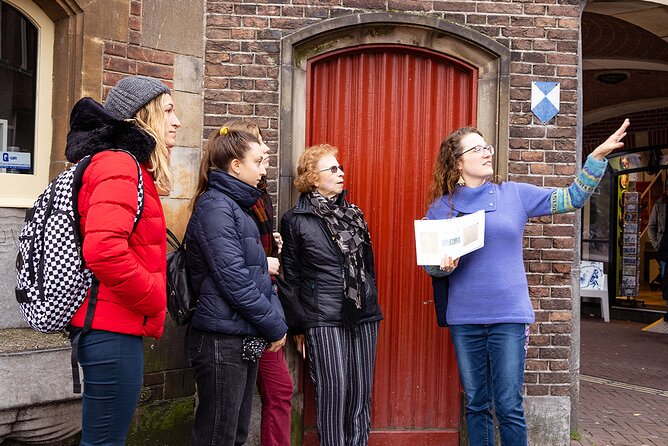
The Gay Monument is the emotional center of the route. The stop lasts about 15 minutes and explains how the monument has served both celebration and mourning for Amsterdam’s LGBTQIA+ community since its unveiling.
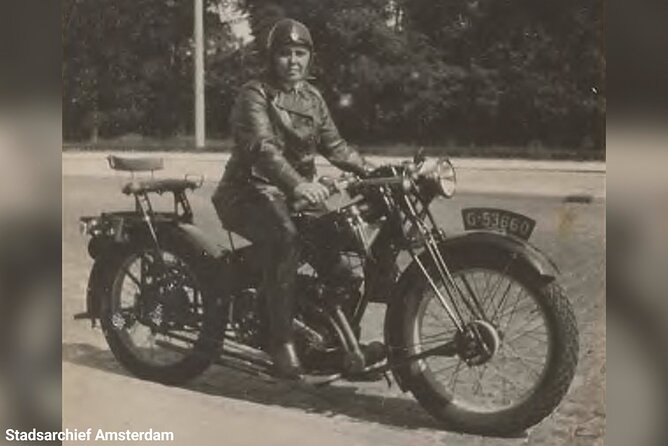
This is not treated as a simple photo stop. The monument carries more than one meaning, and the tour uses it to honor a formidable lesbian hero. The setting gives you a moment to consider the people remembered publicly, as well as those whose lives and work were not always given a place in the official record.
I appreciate this balance. A story about rights can become too polished if it focuses only on milestones. A story about suffering can become too heavy if it leaves no room for joy or solidarity. The Gay Monument allows both ideas to be present.
You will have time to look at the monument and listen, but this is still a walking tour, not a long memorial visit. If you want extended time for photographs or private reflection, plan to return later.
Herengracht: queer resistance in an ordinary canal house
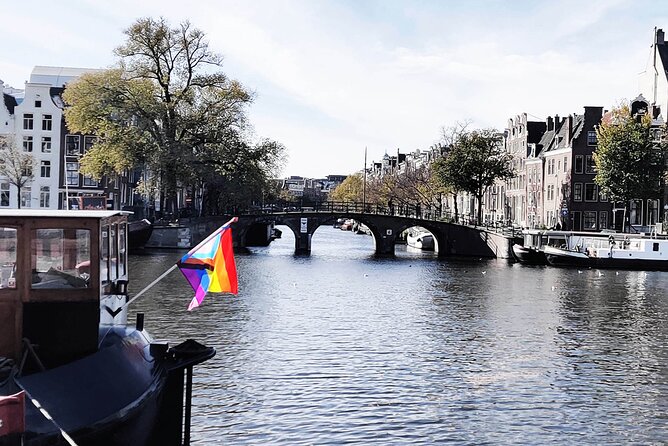
The Herengracht stop, about 15 minutes, turns to queer Resistance fighters who worked in an inconspicuous canal house.
The setting is important. Amsterdam’s canal houses often appear grand from the outside, but the tour directs your attention to the people and actions that took place behind respectable facades. The house may not look dramatic, and that is part of the lesson. Courage does not always announce itself.
This section brings the tour into a period of direct danger and organized resistance. It also links LGBTQIA+ history to the wider history of people who protected others under oppressive conditions. You are not just hearing about identity. You are hearing about choices, risk, cooperation, and action.
For me, this is the kind of stop that makes a familiar street feel newly legible. Afterward, you may look at canal houses less as scenery and more as places where people made decisions that mattered.
Torensluis: a trans soldier’s unexpected message
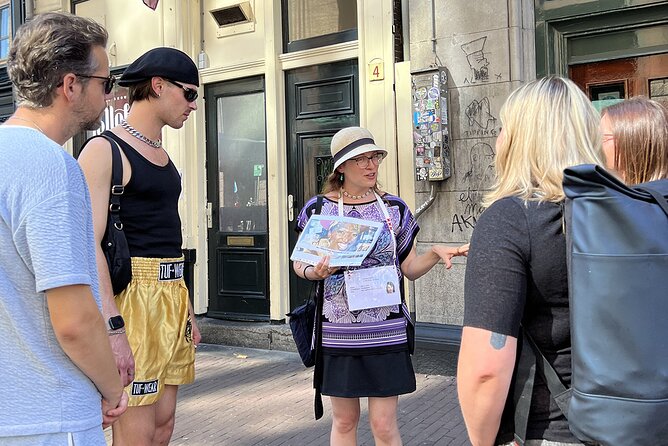
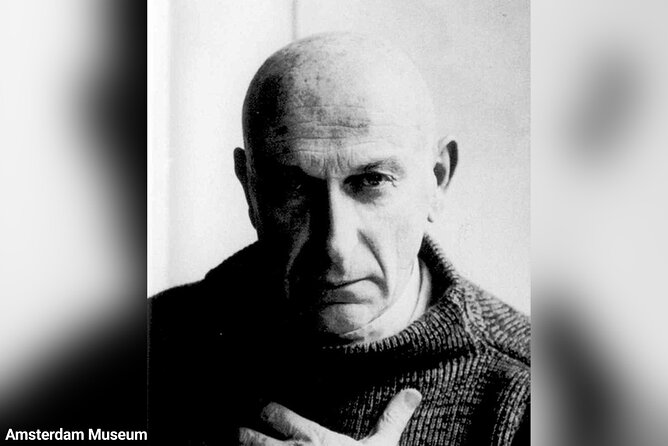
The tour ends at Torensluis, with about 20 minutes devoted to the story of a trans soldier who served in Amsterdam’s 18th-century militia.
It is an intriguing final subject because it asks you to think about gender, service, public identity, and the limits of historical categories. The ending message is described as surprising, so you should expect the final story to leave you thinking rather than simply tying everything up with a neat conclusion.
The walk finishes on the Torensluis bridge by the Multatuli sculpture. That is a practical ending in central Amsterdam, and it gives you a clear place from which to continue exploring. The final stop also works well as a closing reminder that the city’s LGBTQIA+ past includes people who do not fit easily into a modern checklist.
Two hours, eight people, and a steady walking pace
The tour lasts approximately two hours and covers seven stops. That is long enough to build a connected story, but short enough to fit into a morning or afternoon of sightseeing.
You should expect a walking experience rather than a series of formal site visits. Admission tickets are not required at the listed stops, and the value comes from the guide’s interpretation and storytelling. The route moves through central Amsterdam, so you will be outside, standing at public locations, and listening in a city environment.
The small group is one of the clearest advantages. A limit of eight lets the guide adjust the pace and answer questions. It also creates a more relaxed setting for a subject that may be personal or emotionally significant.
The tradeoff is that the tour does not offer the shelter or seating you would get in a museum. The experience requires good weather, and it may be canceled if conditions are poor. On a cold, wet, windy day, even a good story is harder to enjoy, so check the forecast and dress for the conditions.
What $47.34 buys you
At $47.34 per person, this is not the cheapest way to spend two hours in Amsterdam. You are not paying for a major attraction ticket, a canal cruise, or a meal. You are paying for a local guide, a carefully connected route, and access to stories you would be unlikely to find by simply walking between landmarks.
The price makes the most sense if you value interpretation. If you only want a quick orientation to the city, a free walk or guidebook may cover your needs. If you want a focused look at LGBTQIA+ history, the cost is more reasonable because the tour gives you a clear theme and several centuries of context in one compact experience.
The group limit strengthens the value. A large tour might cost less per person, but it can make questions difficult and reduce the personal feel. Here, the guide is the main attraction, so having a small group matters.
Guides who make the history personal
Guus and Elyzabeth are named guides connected with this experience. The strongest praise centers on the way the guides tell stories, bring overlooked people into view, and make the two hours pass quickly.
Guus led a tour in cold, wet, and windy conditions and kept the group engaged. That detail is useful because it shows both the benefit and the challenge of the format. A strong storyteller can carry an outdoor walk through difficult weather, but you should still plan carefully.
Elyzabeth is described as an engaging guide who helped a long-time Amsterdam resident see the city differently. That is a meaningful measure of the tour’s value. You do not need to be visiting Amsterdam for the first time to learn something here. The route offers a new reading of streets and landmarks that may otherwise seem familiar.
The tone also appears to be friendly and personal. The guide is presented as a local history enthusiast with a sense of the LGBTQIA+ community, not simply someone reciting dates. That makes this tour a good fit if you prefer human stories over a formal lecture.
Who should book this walk
I would recommend it most strongly to:
- LGBTQIA+ visitors who want a focused connection to Amsterdam
- History fans interested in social and cultural change
- Repeat visitors who have already seen the major central sights
- Local residents who want a different reading of familiar places
- Anyone who enjoys small-group storytelling and unusual historical subjects
You do not need specialist knowledge. The tour begins with an overview of Amsterdam and builds from there. Still, you should enjoy listening, walking, and considering stories that may challenge simple ideas about identity, institutions, and progress.
This may not be the right choice if you want indoor attractions, a fast overview of every major sight, or a tour focused mainly on architecture. It also may not suit you if standing outdoors for two hours is uncomfortable.
The experience is offered in English. Most people can participate, service animals are allowed, and the route is near public transportation. Confirmation normally arrives at booking, though bookings made within two days of the start time may take up to 48 hours to confirm, subject to availability.
You can cancel for a full refund up to 24 hours before the start time. Changes or cancellations made later are not accepted for a refund. If bad weather forces the operator to cancel, you are offered another date or a full refund.
My booking advice
Book this tour if you want Amsterdam’s LGBTQIA+ past placed in the streets where these stories unfolded. The strongest reasons are the small group, the range of subjects, and the guides’ emphasis on people who are often left out of standard city history.
I would book it near the start of an Amsterdam stay. The route can change how you see Rembrandtplein, the canals, the Gay Monument, and the old canal houses for the rest of your visit. Bring weatherproof clothing, wear comfortable shoes, and arrive ready to listen rather than simply take photographs.
Skip it if you mainly want famous landmarks or indoor comfort. For everyone else, especially history-minded visitors and repeat guests, $47.34 is a fair price for two focused hours with a local storyteller and a fresh way to understand Amsterdam.
FAQ
How long does the LGBTQ+ History Tour in Amsterdam last?
The tour lasts approximately two hours.
How many people can join the tour?
The tour has a maximum of eight participants.
What language is the tour offered in?
The tour is offered in English.
Where does the tour begin?
The tour starts at Utrechtsestraat 4, 1017 VN Amsterdam, Netherlands.
Where does the tour end?
The tour ends at Torensluis, by the Multatuli sculpture, at 1012 VK Amsterdam, Netherlands.
What places does the tour visit?
The route includes Rembrandtplein, the Munt Tower, Koningsplein, Emperor’s Canal, the Gay Monument, Herengracht, and Torensluis.
Is admission to the stops included?
The listed stops have no admission ticket charge. The experience includes a local guide who tells the stories and provides the LGBTQIA+ historical context.
Are service animals allowed?
Yes. Service animals are allowed.
Can I cancel for a full refund?
Yes. You can cancel at least 24 hours before the start time for a full refund. If poor weather causes the operator to cancel the tour, you are offered a different date or a full refund.
More LGBTQ-Friendly in Amsterdam
- Amsterdam: Rainbow Rural Bike Tour With Local Gay Guide
★ 5.0 · 4 reviews
More History Walks around Amsterdam
- Amsterdam: Historic City Sightseeing Canal Cruise
★ 4.5 · 444 reviews - Anne Frank and the Jewish History of Amsterdam Private Tour
★ 5.0 · 307 reviews - Amsterdam: 3-Course Meal in Historic 1st Class Waiting Rooms
★ 4.5 · 292 reviews - Amsterdam: Highlights & History Walking Tour
★ 4.8 · 266 reviews
Just added around Amsterdam
- From Amsterdam: The Hague Private Trip and Mauritshuis Entry★ 4.3 · 4 reviews
- VIP Private Full Day Tour of the Netherlands★ 4.8 · 6 reviews
- Amsterdam Old-West Vegan Food Tour with Local Guide★ 4.7 · 3 reviews
- Amsterdam: Van Gogh Museum Guided Tour★ 4.8 · 262 reviews
- Van Gogh Museum Private Guided Tour★ 4.2 · 10 reviews
- Vecht River: Full-day Cruise with Lunch★ 4.8 · 9 reviews
- Van Gogh and Rijksmusuem Tour: Small Group Tour with Entry★ 4.7 · 3 reviews
- Amsterdam: Van Gogh Museum Ticket & Guided Tour★ 4.4 · 187 reviews
Historical Tours, compared.
Amsterdam Food and Cultural Tour with Tastings
Read our review →
Kinderdijk UNESCO World Heritage Entry Ticket
Read our review →
Hop-on Hop-off Old-Fashioned Heritage Tram Tour
Read our review →


Amsterdam High-End Dutch Food & History Tour – Up to 8 guests
Read our review →
Cruise through the Historic City Center with Guide
Read our review →
Browse the lists this tour appears in