
Reviewed · CITY TOURS
e-Scavenger hunt Nijmegen: Explore the city at your own pace
Nijmegen’s city trail turns sightseeing into a friendly contest. Your group follows GPS prompts, finds landmarks, answers questions, and collects points while moving through one of the Netherlands’ oldest cities. You can start whenever you like, stop for lunch, and pick up the game again when you are ready.
I like the no-pressure format and the way the route links well-known sights with less obvious corners of the old center. I also like the small-group setup: at $37.35 for up to six people, it can be good value for a family or group of friends. The main drawback is the technology. You use a simple online app or webpage on your own phone, and the map, questions, and answers may take some getting used to while walking.
Key points to know before you start
- A flexible three-hour city game: Start, pause, and finish when it suits your group.
- A route through central Nijmegen: The trail reaches churches, museums, squares, old ruins, the Waal, and the historic Lange Hezelstraat.
- Best for two to six people: You play as one private group, which makes it easy to discuss answers and share the phone.
- A quiz with real searching: Some clues are simple, while others require careful looking and a bit of thought.
- Bring your own phone and data: Neither a smartphone nor mobile data is included.
- Allow extra time for food and stops: Some groups take longer than three hours, especially when adding lunch or drinks.
A city tour with a scoreboard
This is not a traditional walk with a guide leading you from one monument to the next. Instead, Qula gives you a digital city game and sends you from point to point. At each location, you answer questions or complete a search assignment. The goal is not only to reach the end, but also to build the highest score you can.
That makes the experience especially useful if your group has mixed interests. One person may enjoy the history, another may like solving puzzles, and someone else may simply want a reason to wander through Nijmegen without planning every turn.
The format is family-friendly, though the level of challenge can vary. Some questions are straightforward. Others can be surprisingly difficult, and a few may ask about the wider story of Nijmegen rather than the exact building in front of you. That mix keeps the game from feeling like a list of dry facts, but it can also feel slightly loose if you expect every question to match its stop closely.
The app is there to guide you, but it is not the same as having a person explain the city. You will need to read instructions, switch between the map and the questions, and decide together where to look. A group that enjoys talking through a puzzle will have more fun than one that wants a smooth, hands-off tour.
More scavenger hunts around the Netherlands:
- e-Scavenger hunt Maastricht: Explore the city at your own pace
★ 4.5 · 110 reviews - e-Scavenger hunt Middelburg: Explore the city at your own pace
★ 4.5 · 55 reviews - e-Scavenger hunt Den Bosch: Explore the city at your own pace
★ 4.5 · 37 reviews
Starting at Kelfkensbos
The activity begins at Kelfkensbos, a central location near the historic heart of Nijmegen. You receive the starting instructions after booking, then use your own smartphone to log in and begin the game.
The opening area puts you close to several of the route’s most important sights, so you do not spend the first part of the activity trekking out to the edge of town. Before pressing start, I would make sure everyone has enough phone battery, mobile data, and a way to keep the screen dry if the weather turns wet.
The game is available every day, with the listed operating hours covering the full day from midnight to midnight. That does not mean you need to play at midnight, of course. It means the experience has no narrow scheduled departure. You choose the time that works for your group.
From Marienburgkapel to the Stevenskerk
The first part of the route includes Marienburgkapel and the Latijnse School Nijmegen. These stops help set the tone: you are not simply walking down the most obvious shopping street. You are asked to notice buildings, details, and the shape of the old city around you.
The Marienburgkapel offers a strong early stop because it gives the game a historic setting right away. At the Latijnse School, the questions may prompt you to look more closely at the architecture and the city’s past. The point is not to stand in front of a monument for a long lecture. You gather information in short pieces, then move on.
The listed route also includes Stadsschouwburg & Philharmonie Haarlem. That name refers to a venue in Haarlem, not Nijmegen, so it appears out of place in a Nijmegen route. I would check the live app after booking and confirm the correct stop before setting out. If the name is a data error, the app should show the intended Nijmegen location. If it does not, contact the provider before beginning.
The Stevenskerk is one of the route’s major landmarks. Its size and position make it an easy place to use as a reference point, and it gives you a chance to pause and look up from the phone. The game works best when you treat each stop as a reason to observe the city, not just as a screen-based task to clear.
Grote Markt and the heart of old Nijmegen
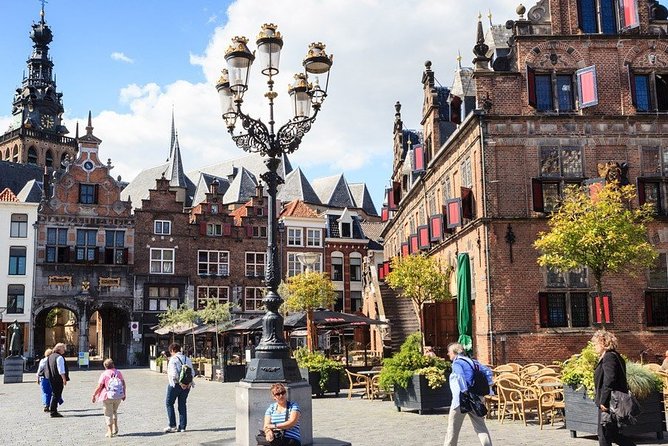
From the Stevenskerk, the trail continues to Grote Markt. This is a natural place for a city game because it brings together architecture, public life, and the practical rhythm of central Nijmegen.
The questions here may ask you to inspect a façade, sign, or feature that you would otherwise walk past. That is one of the better parts of the format. You are given a reason to pay attention without being tied to a guide’s timetable.
The Waagh is another memorable stop in this central section. It is one of the buildings that helps give the square its character, and it works well as a visual clue for a group trying to orient itself. De Waagh also gives the route a clear sense of place: you are not answering general trivia in a random street, but connecting questions to Nijmegen’s historic center.
If you want to stop for lunch, this is a practical section of the route. The game can be paused, and you can continue afterward. That flexibility is one of the strongest reasons to choose this activity instead of a fixed walking tour.
More ways to see the Netherlands in a day:
- Amsterdam: 75 Minute City Canal Cruise with Audio Guide
★ 4.4 · 17,501 reviews - Amsterdam: City Centre Canal Cruise
★ 4.2 · 12,827 reviews - Amsterdam: Smoke and Lounge City Boat Cruise
★ 4.7 · 8,572 reviews - Amsterdam: City Canal Cruise and Heineken Experience Ticket
★ 4.5 · 5,367 reviews
Valkhof Park and the city’s older layers
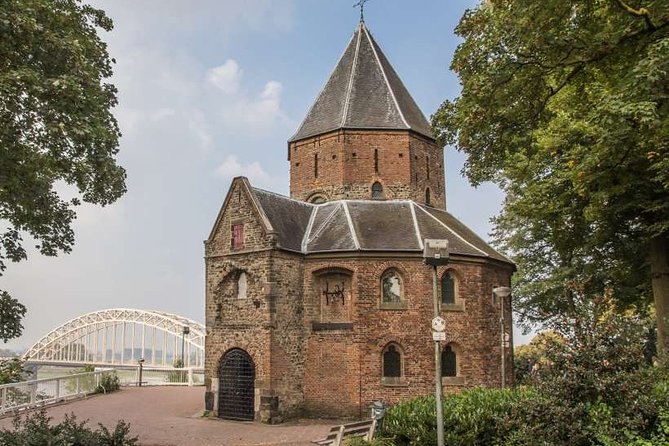
The trail then heads toward Valkhof Park, Valkhof Museum, and the Valkhof Chapel, also known as the Sint-Nicolaaskapel. This is where the walk gains more depth. You are seeing a park, a museum, and a surviving chapel in the same part of the city, with the route using questions to connect them.
Valkhof Park is also where you may notice that Nijmegen is not perfectly flat. The route includes some uphill and downhill walking. The slopes are manageable for most participants, but they are worth keeping in mind if someone in your group has difficulty with uneven or hilly streets.
The Valkhof Museum is a useful stop even if you do not go inside. The trail can introduce the museum and its place in Nijmegen’s cultural life, while the surrounding area gives you a break from the denser streets of the center. If you want to visit the museum properly, check how that fits with your game time, since the city trail itself is designed as an outdoor activity.
The Valkhof Chapel adds another layer of old Nijmegen. Its compact scale contrasts with the larger Stevenskerk, and it gives the game another chance to make you look closely. The route’s value here comes from the combination of movement and small discoveries. You are not expected to absorb a long history lesson in one place.
The Waal, Waalbrug, and wide views
The route includes De Waal and the Waalbrug, taking the game toward the river and one of Nijmegen’s best-known views. This section gives the walk a welcome change of pace. After streets and monuments, you get more open space and a broader view.
The Waalbrug is also a strong navigation point. If your group has lost track of the route, a major bridge is easier to identify than a small plaque or narrow lane. Still, use the GPS map carefully. The app helps you find the general area, but it may not always give you the clearest walking line.
The river section is a good place to pause and compare scores. Since there is no fixed time limit, you do not need to hurry through the view just to keep up with a guide. Take a moment to enjoy the setting, then return to the questions.
Weather matters here. In rain or cold, the game remains playable, but using a phone outdoors becomes less pleasant. One group completed the activity in wet, cold conditions and still found it enjoyable, largely because there was no time pressure. That is useful advice: bring suitable clothing, but do not assume poor weather automatically ruins the day.
Museum Van Lymborch Brothers House and De Waagh
The Museum Van Lymborch Brothers House brings the route back toward Nijmegen’s artistic and historic side. It is the kind of stop that adds variety to the walk. Instead of seeing only churches and civic buildings, you also get a connection to medieval art and the city’s creative past.
The trail does not replace a full museum visit, and you should not expect long explanations at every point. Its job is to point out why the location matters, then give you a question or assignment that makes you take notice.
Returning to De Waagh reinforces the importance of the market area. By this stage, you may recognize how the old center is arranged, which makes the city easier to explore on your own afterward. The game can act as a first orientation walk, especially if Nijmegen is new to you.
City hall, ruins, and the muZIEum
The route includes Stadhuis and the Barbarossa ruin, also listed as the ruin of the apse of Sint-Maartenskapel. These stops show how much of Nijmegen’s story appears in fragments. You may see a functioning civic building at one point, then a remaining wall or ruin that hints at an earlier period.
That contrast is useful for a quiz format. The questions can ask you to compare dates, details, or visual clues, rather than simply identify a famous monument. Some assignments may feel only broadly connected to the location, so keep an open mind about the kind of answer being sought.
muZIEum adds a different sort of stop. It is not another church, square, or ruin, so it breaks up the historic sequence. The route’s variety is one of its strengths, especially for families and mixed-age groups that might lose interest if every stop looked alike.
The questions and search tasks are part of the entertainment, but they can also slow you down. If your group wants to earn a high score, allow time to check details instead of guessing quickly. If you mainly want to see the city, do not let one stubborn question turn the afternoon into a battle.
Velorama and Lange Hezelstraat
Velorama National Bicycle Museum gives the route another change of subject. Nijmegen is a good setting for a bicycle-related stop, and the museum adds a practical link to Dutch culture and transport.
As with the Valkhof Museum, the city game only gives you the outdoor route and its prompts. If you want to explore inside, plan extra time and check the museum’s opening arrangements separately. The listed activity lasts about three hours, but groups have taken longer, especially when adding a meal, a drink, or longer pauses.
Lange Hezelstraat is one of the most atmospheric streets on the route. Its older buildings and shopfronts make it a pleasant place to slow down and look around. It also helps the trail finish with a sense of Nijmegen as a lived-in city, not just a collection of monuments.
The final stop is listed simply as Nijmegen, and the activity ends back at the meeting point. That makes the route practical for groups who want to continue into the center afterward.
What the app does well, and where it needs patience
The biggest success is the freedom to set your own rhythm. You can begin when your group is ready, stop for food, take a wrong turn without missing a scheduled departure, and continue later. That relaxed structure received strong approval, with 92 percent of users recommending the activity and an overall rating of 4.4 from 25 ratings.
The app also gives you a reason to search. You are not just reading facts as you walk. You are looking for answers, checking buildings, and debating which detail matters. Some questions are difficult enough to keep adults interested, while the family-friendly setup gives younger participants a role.
The weak point is navigation and interface design. The platform is described as a simple webpage, and you may need to switch repeatedly between the map and the question screen. There is no clear walking route for every section, so you should be ready to use your own map app if the next direction is unclear.
The content can also be uneven. A question may relate to the broader history, a local event, or a notable person rather than the exact spot where you are standing. That gives the game variety, but it can feel disconnected if you expect every prompt to have an obvious visual answer.
Price, group size, and practical value
At $37.35 per group of up to six people, the price works out well for a full group. Six people pay about $6.23 each, before any food, museum admission, or transport costs. For two people, the same price feels less attractive because you are paying the full group rate.
The private format is useful. You do not need to keep pace with strangers, and your group can decide how competitive or relaxed the game should be. Large parties can also use the activity, but the included city trail is for a team of no more than six, so bigger groups may need to divide into teams.
You must supply the smartphone and data. That is a small but important cost in practice. Bring a charged phone, and consider having a second phone ready so the group can keep the map open while another person reads the question.
The activity is free to cancel up to 24 hours before the start time for a full refund. Changes or cancellations made less than 24 hours before the local start time are not accepted for a refund.
Who should choose this Nijmegen experience?
I would choose this for friends, families, couples who enjoy puzzles, and anyone who wants a flexible introduction to Nijmegen. It is especially good when you want to combine sightseeing with lunch, coffee, or a drink instead of following a strict schedule.
It suits people who like making decisions together. You will need to interpret clues, find answers, and sometimes accept that the route or wording is not perfect. If you want a polished app with effortless turn-by-turn directions and detailed commentary at every monument, this may disappoint you.
The route is user-friendly for people with hearing impairments, service animals are allowed, and most people can take part. It is near public transportation, though the supplied details do not specify particular bus or train connections.
Should you book the Nijmegen city trail?
Book it if you want a private, low-cost way to see many sides of Nijmegen, and if your group enjoys a little friendly competition. The combination of historic churches, market squares, museums, ruins, river views, and the old Lange Hezelstraat gives you a broad look at the city.
Skip it if you dislike working from a phone or want a guide to handle navigation and explain every stop. The route can be uneven in places, some questions may feel only loosely tied to their locations, and the simple app requires patience.
For most groups of four to six, the price is reasonable. Start with a charged phone, leave room for a lunch break, and verify the Haarlem venue reference in the app before you set off. With those expectations, this city game offers a playful way to get to know Nijmegen at your own pace.
FAQ
How long does the Nijmegen e-scavenger hunt take?
The activity lasts approximately three hours. You can take longer if you pause for lunch, drinks, sightseeing, or extra time solving questions.
How many people can play together?
The included city trail is for a team of up to six people. The activity is private, so only your own group participates.
Where does the city trail start and finish?
It starts at Kelfkensbos, 6511 Nijmegen, Netherlands, and ends back at the meeting point.
Can I choose when to start?
Yes. You can take the tour anytime you choose during the listed operating period, and there is no fixed departure time.
Can I pause the game for lunch?
Yes. You can stop or pause whenever you like, then continue the game afterward.
Do I need to bring a smartphone?
Yes. A smartphone and data are not included, so you need to provide both to use the online city game app.
Can I cancel for a full refund?
Yes. You can cancel at least 24 hours before the experience start time for a full refund. Cancellations or changes made less than 24 hours before the local start time are not accepted for a refund.
Just added around the Netherlands
- Volendam: Volendams Museum Entry Ticket★ 4.4 · 14 reviews
- Volendam: E-Bike Rental including Highlights-Routes★ 4.9 · 23 reviews
- Volendam: E-Scooter Rental★ 4.5 · 41 reviews
- Volendam: 2.5-Hour Cheesemaking Workshop & Clog Making Tour★ 4.5 · 17 reviews
- From Amsterdam: The Hague Private Trip and Mauritshuis Entry★ 4.3 · 4 reviews
- Vlissingen: Maritime Museum Entry Ticket★ 4.6 · 7 reviews
- Volendam: 2-Hour Clogmaking Workshop and Cheese Tour★ 3.9 · 17 reviews
- Zundert: Vincent van Gogh House Entrance Ticket★ 3.9 · 43 reviews
City Tours, compared.
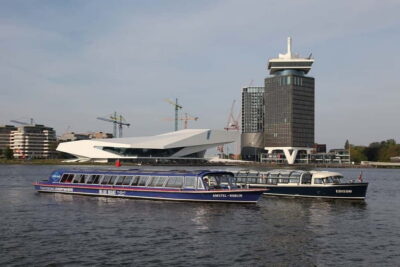
75 Minute City Canal Cruise with Audio Guide
Read our review →


City Canal Cruise and Heineken Experience Ticket
Read our review →

Browse the lists this tour appears in