

Reviewed · CITY TOURS
Amsterdam Pedicab City Tour (2 hours)
Amsterdam makes you work for its best sights. Canals twist, streets change names, bicycles zip past, and many landmarks sit farther apart than they look on a map. A private pedicab tour with Bram de Haan solves that problem neatly, carrying two people through the old center and beyond while Bram explains what you are seeing.
I like the personal scale of this ride, and I like the old photographs and maps Bram uses to compare Amsterdam’s past with the city you see today. The blue pedicab is also a practical help if you want to cover ground without a long walk. The main drawback is the price: $237.65 per group of up to two makes sense for a private outing, but it is not a budget tour, and two hours can feel short for such a full route.
Key points at a glance
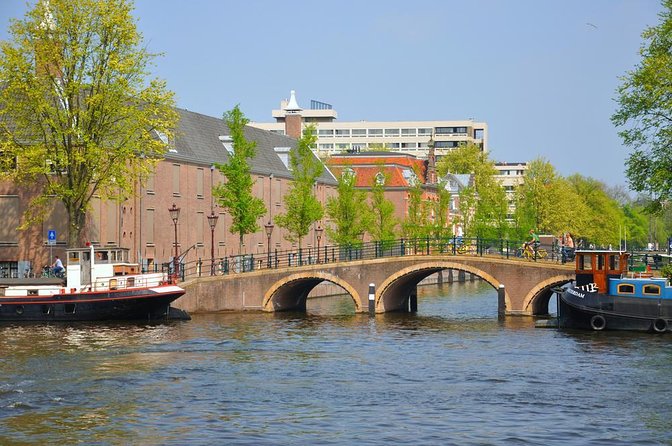
- A private blue pedicab for two: You get Bram’s full attention rather than sharing the ride with a large group.
- A wide city route: The tour links the old center, Chinatown, the Jewish Quarter, the Amstel, the canal ring, and Museumplein.
- Old Amsterdam brought along: Bram uses photographs, maps, and drawings to explain how streets and buildings changed.
- Minimal walking required: You usually remain in the pedicab, with short stops for photos and explanations.
- Useful in cool or wet weather: A waterproof blanket is provided when needed, but you should still dress warmly.
- A fast first look at Amsterdam: It works especially well early in your visit, when you want to get your bearings quickly.
Why a pedicab works well in Amsterdam
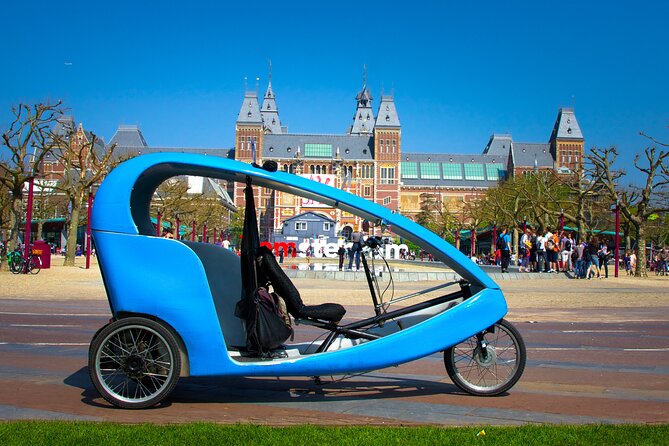
The appeal here is not just novelty. A pedicab lets you see more of Amsterdam in two hours than you could comfortably cover on foot, while still moving slowly enough to notice canal houses, bridges, old defenses, and neighborhood details.
You sit close to street level, so the experience feels more immediate than a coach ride. You can look up at the narrow canal houses, watch bicycles flow through an intersection, and hear Bram explain the city as you move. When something catches your eye, he can pull over for a photograph or a longer explanation.
The private format matters. The pedicab holds up to two passengers, and only one pedicab is available per time slot. That gives you a flexible route and direct conversation with Bram. You can ask about architecture, Jewish Amsterdam, old maps, museums, or modern city life without waiting for a group of 15 people to catch up.
The ride is also friendly to tired feet. Several stops are brief, often five to ten minutes, and many sights are viewed from outside. That is a benefit if you are arriving after a long journey, traveling with an older relative, or trying to see the city without adding another major walking day.
There is one practical limit: the total passenger weight cannot exceed 210 kilograms. The tour is offered in English, and pickup is available. Wait in front of your hotel and look for the blue pedicab.
More City Tours in Amsterdam
- Amsterdam: 75 Minute City Canal Cruise with Audio Guide
★ 4.4 · 17,501 reviews - Amsterdam: City Centre Canal Cruise
★ 4.2 · 12,827 reviews - Amsterdam: Smoke and Lounge City Boat Cruise
★ 4.7 · 8,572 reviews
Dam Square and the old city core
Dam Square is a natural starting point because it sits at the heart of Amsterdam’s old center. This is where the city began to grow, and the square brings several major symbols together: the Royal Palace, the New Church, and the National Monument.
You get about five minutes here, enough for a quick orientation and photographs rather than a full visit inside any building. Bram’s role is to explain how the square fits into Amsterdam’s growth, not to guide you through the palace or church interiors.
From there, the pedicab heads toward Zeedijk, one of the old dikes around the center. This is a useful early stop because it shows how Amsterdam’s relationship with water shaped its streets. The area also contains the city’s oldest cafe, with an original interior and an old-fashioned atmosphere. Bram promises a darker story connected to the place, which gives this short stop a bit more bite than a standard photo pause.
Zeedijk, Chinatown, and Nieuwmarkt
Amsterdam’s Chinatown is described as the oldest Chinese neighborhood on mainland Europe. In a few minutes, you pass Chinese restaurants, supermarkets, and a Chinese temple. It is a small but telling change of scene, showing how the old center has taken on new cultural layers over time.
The stop at Nieuwmarkt lasts about ten minutes, giving Bram more room to explain the square’s past. The old city gate in the center once formed a main entrance through Amsterdam’s fortified walls. The square marks the point where the medieval city met the later expansion of the 17th century.
I like this part of the route because it connects everyday Amsterdam with the city’s defensive past. You are not simply ticking off a famous square. You are seeing how walls, gates, dikes, trade, and expansion shaped the street plan beneath the modern city.
Montelbaanstoren and Rembrandt’s former home
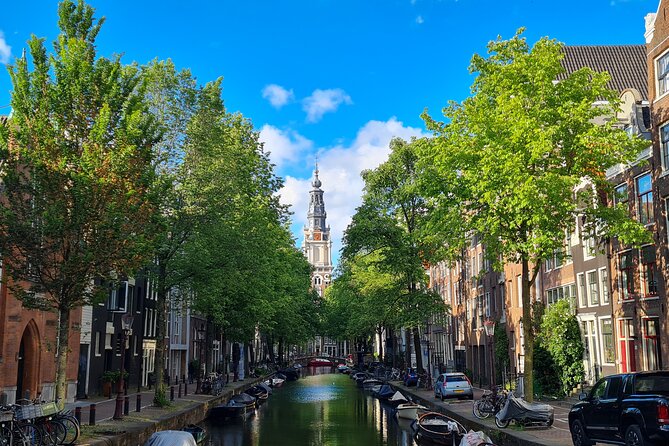
The Montelbaanstoren is an early 16th-century watchtower built as part of Amsterdam’s expanded defenses. From here, you also get a view toward the Oude Waal, where houseboats sit against a backdrop of 17th-century canal houses.
This is the kind of stop that benefits from a local guide. The tower is easy to photograph, but its position makes more sense once you understand the old defensive line and the importance of ships entering the city. The houseboats add a modern Amsterdam touch to the scene.
Next comes the exterior of Rembrandt’s former home. You will not enter the Rembrandt House Museum, since admission is not included, but Bram points out the building where the painter lived during the successful years of his life.
That distinction is important. If you want the full museum visit, plan it separately. This tour gives you an efficient outside view and historical context, while saving your museum time and admission costs for another part of your day.
A few more days out around Amsterdam worth weighing up
- Amsterdam: Van Gogh Museum Ticket
★ 4.7 · 52,054 reviews - Amsterdam Classic Saloon Boat Cruise with Drinks and Cheese
★ 5.0 · 31,825 reviews - Amsterdam Luxury Canal Cruise + Unlimited Drinks & Bites option
★ 5.0 · 30,518 reviews - Amsterdam: Heineken Experience Ticket
★ 4.6 · 30,055 reviews
The Jewish Quarter and Portuguese Synagogue
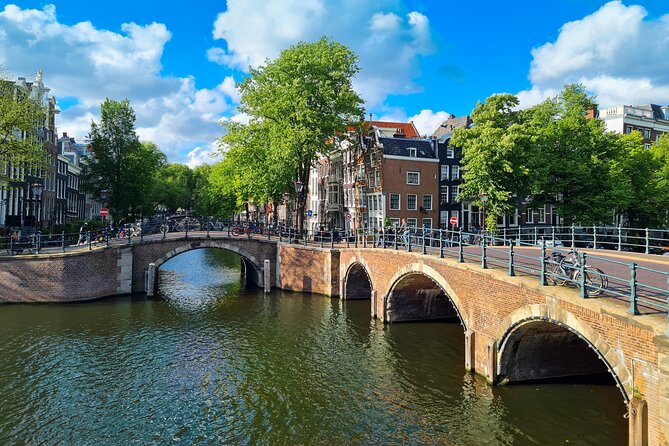
The Jodenbuurt, or Jewish Quarter, is one of the most serious and meaningful parts of the route. Much of the old neighborhood was demolished after the Second World War, but surviving streets, homes, synagogues, and other buildings still show how central Jewish life was to Amsterdam.
Bram spends about ten minutes in this area. That longer pause is welcome because the subject deserves more than a passing glance. You can ask questions, look at surviving architecture, and understand the changes that reshaped the neighborhood.
The Portuguese Synagogue is viewed from outside. Built in 1675, it is one of the oldest synagogues that Jewish people were permitted to build in Western Europe, and it is the largest synagogue in Amsterdam. Opposite it are other synagogues that now form part of the Jewish Museum.
The tour does not include entry to the synagogue or museum. Still, seeing the buildings together gives you a useful introduction and may help you decide if you want to return for an interior visit.
The route also passes the National Holocaust Names Monument. The stop is only about two minutes, but the site carries great weight. Its 102,000 brick stones bear the names of Dutch Jewish victims of the Second World War. This is a place for quiet attention rather than a rushed photo.
H’ART Museum and the Amstel
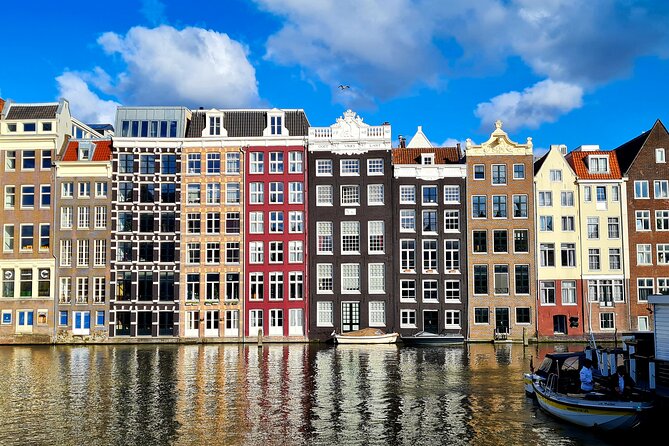
The pedicab passes H’ART Museum, formerly the Hermitage Museum in Amsterdam. The building was once a large 17th-century widow’s care home and is now associated with the Russian Hermitage collection.
This is another outside view, so do not expect museum entry. Its value is in the building’s former use and the way Bram connects the structure to Amsterdam’s social and architectural past.
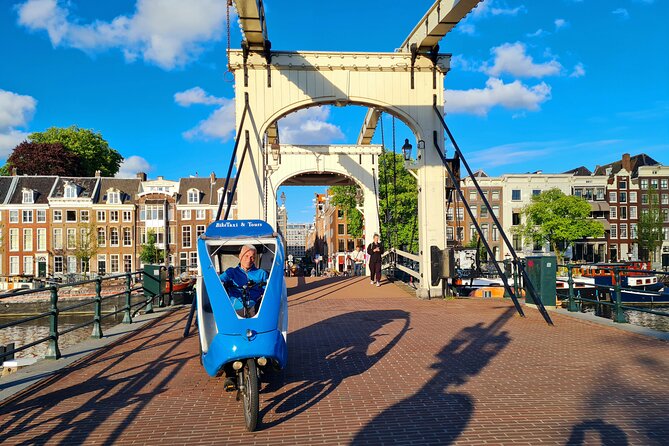
The route then reaches the Magere Brug, or Skinny Bridge. This is one of Amsterdam’s best-known bridges, and it gives you a fine view along the Amstel, the canalized river that forms the city’s main and widest waterway.
The bridge is especially photogenic at night, when its lights outline the narrow structure. In daylight, you get a clear look at the river, the bridge design, and the surrounding canal views. Bram allows time for photographs, and this is one of the stops where you will want to have your camera ready.
The canal ring and Amsterdam’s merchant houses

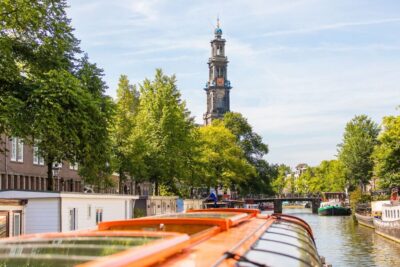
The canal ring is the city’s great 17th-century expansion zone. On a map, its half-circle canals wrap around the old center. From the pedicab, you see the canal houses that once belonged to successful merchants.
These buildings can look similar at first, but Bram explains the differences and shared features that reveal when and why they were built. That kind of detail helps you read the city instead of simply admiring a row of pretty facades.
Amsterdam’s canal houses are narrow, tall, and often slightly different from one another. Their shape reflects the value of land along the water and the city’s merchant economy. A local guide can point out small architectural clues that are easy to miss when you are walking alone and watching for bicycles at the same time.
You spend about ten minutes in the canal district. That is enough for a good overview, but not enough to explore every canal or neighborhood. Think of this as a broad introduction rather than a complete architectural tour.
Museumplein and the Rijksmuseum tunnel
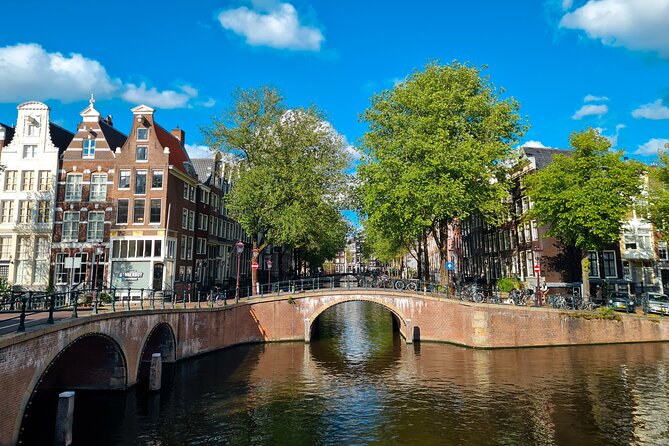
Museumplein is the last major stop and one of Amsterdam’s grandest open spaces. The Rijksmuseum occupies one side, while the Concertgebouw faces the square. The Van Gogh Museum, Stedelijk Museum, Moco Museum, and Diamond Museum are nearby.
Bram stops so you can enjoy the views and learn how this cultural district fits into the city. You will not enter any of the museums, so this part works best as orientation. If you plan to visit one, you can use Bram’s overview to decide which deserves your limited time.
A particularly enjoyable feature comes at the end, when the pedicab passes through the famous bicycle tunnel beneath the Rijksmuseum. Classical music from street performers may be heard there. The route then gives you a good view of the back of the Rijksmuseum, completed in 1885 and designed by Catholic architect Pierre Cuypers.
The tunnel is an amusing Amsterdam moment, but it also shows why a pedicab can be more flexible than a standard vehicle. You are moving through a part of the city designed for bicycles and pedestrians, not buses.
Bram’s stories and the value of a private guide
The strongest part of this experience is Bram himself. He was born and raised in Amsterdam, and he adds personal memories to the city’s broader story. He also brings photographs, maps, and drawings, including images connected to his family, so you can compare older Amsterdam with the streets in front of you.
That visual material makes a real difference. Amsterdam has changed through expansion, wartime destruction, new migration, shifting neighborhoods, and modern redevelopment. An old photograph can show you what is missing, what survived, and why a street looks the way it does now.
Bram also adjusts the experience to your interests. If you care most about Jewish Amsterdam, architecture, canals, museums, or local changes, say so at the start. The route is broad enough to offer a cross-section of the city, but the private format gives you more room to ask for extra attention in one area.
He has also helped with simple local needs, such as pointing out the nearest grocery shop and giving directions back to a hotel. That is not a formal part of the tour, but it reflects the practical value of having a local person beside you at the start of a stay.
Weather, comfort, and the two-hour limit
Amsterdam weather can change quickly. You should dress warmly, especially in the cooler months or on breezy mornings. A waterproof blanket is provided when rain arrives, and it can also help on a chilly day, but it is not a substitute for a coat.
The pedicab is designed for two people and is described as comfortable and easy to enter and leave. Still, you should expect an open-air ride. Poor weather can lead to a new date or a full refund, and the experience requires suitable weather to operate.
Two hours is enough for a broad city introduction, not a slow examination of every stop. Several locations receive only two to five minutes, while the Jewish Quarter, Nieuwmarkt, canal ring, and Museumplein receive longer pauses. If you want more time for photographs or questions, ask about extending the ride, though any extra time should be confirmed directly rather than assumed.
Is $237.65 good value?
At $237.65 for up to two people, the cost works out to about $118.83 per person if the pedicab is full. That is a lot for a two-hour sightseeing ride, but you are paying for private transportation, hotel pickup, a flexible route, and Bram’s undivided attention.
The value improves if walking is difficult, if you have only a short time in Amsterdam, or if this is your first morning in the city. You cover the old center, eastern historic districts, the Amstel, the canal ring, and Museumplein without organizing several separate tram or walking trips.
It is less compelling if you are a solo budget visitor, already comfortable navigating Amsterdam by bicycle or public transport, or mainly want to enter museums. The price does not include snacks or museum admissions, and the tour focuses on exterior views.
Free cancellation is available if you cancel at least 24 hours before the start time. Last-minute cancellations and changes are not refunded, so keep the weather rule and cancellation deadline in mind before booking.
Who should book this Amsterdam pedicab tour?
I would choose this ride for a couple, two friends, or a family pair who want a private introduction without a long day on foot. It is also a thoughtful option for older relatives, provided the 210-kilogram combined passenger limit is met.
It suits first-time visitors who want to see how Amsterdam fits together. The route moves from medieval defenses to immigrant neighborhoods, Jewish landmarks, merchant canals, museums, and modern street life. You get a useful sense of the city’s shape before deciding where to spend more time.
I would not choose it as your only Amsterdam activity. You will need separate visits for the Rembrandt House Museum, Portuguese Synagogue, Jewish Museum, H’ART Museum, Rijksmuseum, and other cultural sites. The pedicab gives you the outside view and the story, then you can return on foot for a longer visit.
Should you book it?
Book it if you value personal attention, want to limit walking, and enjoy history explained through old photographs and local stories. Bram’s flexible approach and broad route make this a strong first look at Amsterdam, especially for a pair willing to pay for a private experience.
Skip it if $237.65 feels too high for two hours or if your main goal is museum entry. For everyone else, schedule it near the beginning of your stay, dress for the weather, and ask Bram to shape the conversation around your interests. That is when this blue pedicab becomes more than a ride: it becomes a practical way to understand the city before exploring it on your own.
FAQ
How long is the Amsterdam Pedicab City Tour?
The tour lasts approximately two hours.
How many people can ride in the pedicab?
The tour is for a private group of up to two people. The combined passenger weight must not exceed 210 kilograms.
Is hotel pickup available?
Yes. Pickup is offered. Wait in front of your hotel and look for the blue pedicab.
What language is the tour offered in?
The tour is offered in English.
Does the price include museum admission?
No. The route views several museums and historic buildings from outside, but entrance tickets are not included.
Is transportation included?
Yes. Private transportation by pedicab is included.
What happens if the weather is poor?
The experience requires good weather. If it is canceled because of poor weather, you will be offered another date or a full refund.
Can I cancel for a full refund?
Yes, if you cancel at least 24 hours before the experience start time. Cancellations or changes made less than 24 hours before the start time are not accepted for a refund.
More 2-Hour Experiences in Amsterdam
- Amsterdam: 2-Hour Canal Cruise incl. Drinks & Dutch Snacks
★ 5.0 · 594 reviews - Amsterdam 2-hour Private Canal Cruise with Live Guide and Drinks
★ 5.0 · 296 reviews - Amsterdam 2-Hour Evening Cruise With Live Guide and Bar
★ 5.0 · 134 reviews - Amsterdam: 2-Hour Sightseeing Tour by Rickshaw
★ 4.7 · 81 reviews
Just added around Amsterdam
- From Amsterdam: The Hague Private Trip and Mauritshuis Entry★ 4.3 · 4 reviews
- VIP Private Full Day Tour of the Netherlands★ 4.8 · 6 reviews
- Amsterdam Old-West Vegan Food Tour with Local Guide★ 4.7 · 3 reviews
- Amsterdam: Van Gogh Museum Guided Tour★ 4.8 · 262 reviews
- Van Gogh Museum Private Guided Tour★ 4.2 · 10 reviews
- Vecht River: Full-day Cruise with Lunch★ 4.8 · 9 reviews
- Amsterdam: Van Gogh Museum Ticket & Guided Tour★ 4.4 · 187 reviews
- Van Gogh and Rijksmusuem Tour: Small Group Tour with Entry★ 4.7 · 3 reviews
City Tours, compared.
75 Minute City Canal Cruise with Audio Guide
Read our review →


City Canal Cruise and Heineken Experience Ticket
Read our review →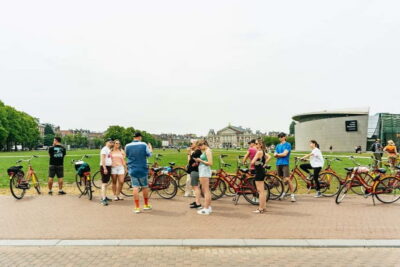

Browse the lists this tour appears in