
Reviewed · CYCLING TOURS
Amsterdam in World War Two Cycle Tour
Amsterdam’s wartime story is not confined to museums. It is written into ordinary apartment blocks, quiet squares, school buildings, and streets where Jewish families were arrested and resistance fighters were killed. This small-group bicycle tour takes you through Amsterdam South, where wartime photographs are matched to the places in front of you.
I like two things right away: the group limit of six keeps the history personal, and cycling lets you cover a wide area without spending the day on foot. Rudy, who grew up in these neighborhoods and teaches history, brings a local connection to the route. The main consideration is practical: you need to be comfortable cycling, and you should confirm the bike arrangements and exact meeting procedure before booking.
Key points worth knowing
- A six-person group: You can ask questions and keep close to the guide instead of trailing behind a large crowd.
- Anne Frank’s Amsterdam home: Merwedeplein shows the Frank family’s life before the Secret Annex.
- Resistance and repression: The route visits former Gestapo offices, resistance sites, and places tied to reprisals.
- Photos at present-day locations: Rudy uses wartime images to show how much has changed, and how much has not.
- A quieter side of Amsterdam: Most of the route runs through Amsterdam South, away from the busiest central streets.
- A serious subject handled outdoors: Cycling gives the tour movement, but the stories include deportation, execution, collaboration, and loss.
Why Amsterdam South is the right place for this tour
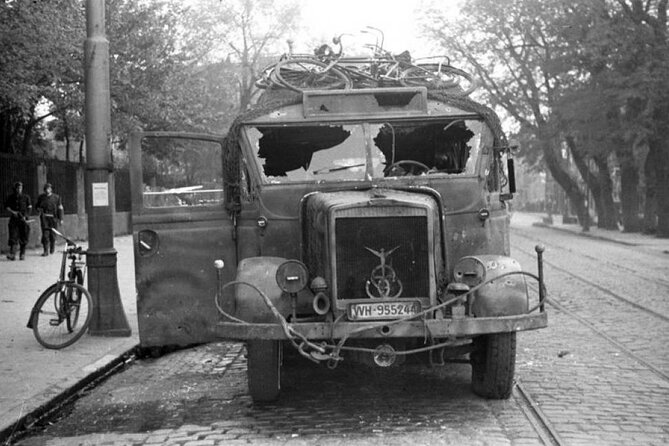
Many first-time visitors focus on Anne Frank House, Dam Square, and the canal belt. Those places matter, but they do not tell the whole wartime story. Amsterdam South adds the streets where families lived, children went to school, police units carried out raids, and German offices directed the occupation.
The bicycle matters here. The route links Victorieplein, Merwedeplein, Museumplein, the Apollobuurt, Olympiaplein, and the Vondelpark area. Walking between all these points would take much longer, while a bus would leave you looking through glass and missing the small details at street level.
You also get a sense of scale. A Nazi office on a quiet residential corner can feel more disturbing than a formal memorial because the setting looks so normal today. Your guide can point to a doorway, a house number, or a monument, then hold up a photograph showing the same place during the occupation.
The route is not light sightseeing. It deals with arrests, deportation, stolen property, executions, collaboration, and the tense days after Germany surrendered. That seriousness is part of its value, but it also means you should allow time afterward to process what you have heard.
More Bike Tours in Amsterdam
- Amsterdam: Guided Bike Tour City Centre in EN/DE/FR/ES
★ 4.7 · 4,187 reviews - Countryside Bike Tour from Amsterdam: Cheese, Clogs & a Windmill
★ 5.0 · 1,485 reviews - Amsterdam: Hidden Gems & Highlights Guided Bike Tour
★ 4.8 · 1,404 reviews
Starting at Victorieplein and the June 1943 raid
The historical route begins at Victorieplein, once called Daniël Willinkplein. The square is tied to one of the major raids in Amsterdam, carried out on June 20, 1943.
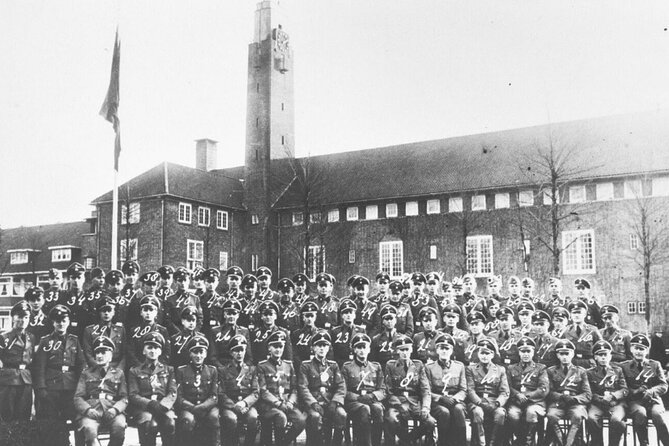
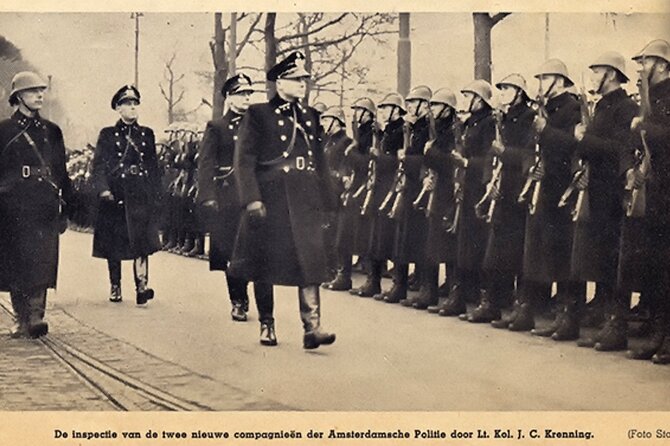
Jewish residents were arrested there during a so-called Judenaktion. Dutch police units, including the Amsterdam police battalion, and police volunteers connected with the Dutch National Socialist Movement assisted the German authorities. Those arrested were taken to places such as Olympiaplein for registration before being transported to Westerbork in the east of the Netherlands.
This opening stop gives the tour its moral and human focus. The story is not only about German orders. It also examines the Dutch institutions and collaborators who helped enforce them. That makes the tour more useful than a simple list of German occupation sites.
At the same time, do not expect a museum-style display here. The power comes from standing in an ordinary public square and learning what happened there. The guide’s photographs and explanations do much of the work.
Merwedeplein and the Frank family before the Secret Annex
At Merwedeplein 37-II, you see the former home of the Frank family. Otto Frank, Edith Frank, Margot, and Anne lived in this Amsterdam South neighborhood before going into hiding in the summer of 1942.
The family then moved to the Secret Annex on Prinsengracht, where Otto Frank’s business was located. A statue of Anne Frank now marks the square. It is a quieter and more domestic setting than the Anne Frank House, and that is exactly why this stop helps.
You are looking at the neighborhood where Anne lived as a child, not only the hiding place associated with her diary. The surrounding streets make her early life feel more tangible. You can better understand that the people forced into hiding had homes, shops, schools, friends, and daily routines before persecution narrowed their lives.
Around the corner, the Jimmink bookshop on Waalstraat is still active. The shop sold the first edition of Het Achterhuis in 1947, and Otto Frank bought Anne’s diary there for his daughter. That small detail links a local bookstore to the publication of one of the most important personal records of the war.
The stop should not be treated as a substitute for Anne Frank House. It does something different. You do not enter the Secret Annex here, but you see the family’s former neighborhood and the places connected with the diary’s early publication.
The Tilex Bar and a musician forced to survive
At Waalstraat 48, now Café Blek, you learn about the former Tilex Bar, named for Tilly and Lex van Weren. Lex van Weren survived Auschwitz because he was forced to play his trumpet at executions.
This is one of the route’s most unsettling details because it shows how survival could depend on a cruel and random assignment. A musician’s skill became a tool of the camp system, and the story brings the Holocaust out of statistics and into one person’s life.
The building itself is not presented as a grand memorial. It is part of a normal street. That contrast is common on this tour: cafés, apartment blocks, and corners carry stories that are easy to pass without noticing.
A few more days out around Amsterdam worth weighing up
- Amsterdam: Van Gogh Museum Ticket
★ 4.7 · 52,054 reviews - Amsterdam Classic Saloon Boat Cruise with Drinks and Cheese
★ 5.0 · 31,825 reviews - Amsterdam Luxury Canal Cruise + Unlimited Drinks & Bites option
★ 5.0 · 30,518 reviews - Amsterdam: Heineken Experience Ticket
★ 4.6 · 30,055 reviews
From police barracks to the German stronghold at Museumplein
Cornelis Troostplein once held the barracks of the Amsterdam police battalion. Before the war, the site was known as Vredesparochie, a Catholic complex with two convents and a school.
In spring 1942, the German security police chief Hanns Albin Rauter inspected the Amsterdam police battalion. He later met Heinrich Himmler at Museumplein. The stop helps explain how local police structures became involved in the occupation system.
Museumplein was transformed into a German stronghold during the war. Facing the Concertgebouw, the buildings to the left held German offices. The former United States consulate housed the Zentralstelle für Jüdische Auswanderung, the office responsible for organizing the forced emigration and deportation of Jews.
Nearby were the Ortskommandantur, or town command office, and the Feldgendarmerie, the German military police. Other buildings held Nazi Party offices and related services. On the square in front of them, the Germans built bunkers and anti-aircraft batteries on the former Amsterdam skating club grounds.
The Amsterdam headquarters of the National Socialist Movement stood next to the Concertgebouw. After the war, the bunkers were destroyed, so the wartime photographs are especially helpful. Without them, the open square gives little clue to its former military role.
Coffee at Roelof Hartplein
Roelof Hartplein provides a short pause at Café Wildschut, with about ten minutes for coffee and a restroom visit. This break is modest, but well placed.
The tour covers difficult material, and a brief stop gives you time to reset before the route turns more directly toward resistance and retaliation. Do not expect a full meal or a long café visit. It is a practical pause within an active bicycle tour.
Near the library on Roelof Hartstraat, a former photography shop was used by the Dutch resistance. Resistance workers developed photographs there, including images by Charles Breijer showing the first roundup of Jews in Amsterdam by the German security police and order police.
The photograph connection is important. Images could document crimes, preserve evidence, and help people outside the immediate area understand what was happening. The tour returns often to this idea by pairing archival photographs with present-day streets.
A small monument nearby remembers Jews taken from the neighborhood. It is easy to overlook, which is one reason a guide-led route helps. You are not simply ticking off famous sights. You are learning how memory is marked in small and local ways.
Apollolaan, Euterpestraat, and resistance reprisals
At the corner of Beethovenstraat and Apollolaan, the guide explains an October 1944 execution. SS officer and Gestapo agent Herbert Oelschlägel was killed by a Dutch resistance member near number 6.
The German security service responded by burning two houses and executing 29 resistance fighters. The fact that many house numbers remain the same as during the war makes the story painfully direct. You are not looking at a reconstructed set or a distant battlefield. You are on a residential street where retaliation reached private homes.
The route then follows the street once called Euterpestraat. Gerrit van der Veen, a leading figure in Dutch resistance, is associated with this area. His name also appears in the modern street name, Gerrit van der Veenstraat.
This part of the tour gives more attention to Dutch resistance than you may get at the central Amsterdam sights. It also avoids a simple hero story. Resistance activity involved courage, secrecy, betrayal, and terrible consequences for both fighters and civilians.
Nazi offices, stolen possessions, and the RAF attack
At the corner of Memlingstraat and Rubensstraat, two important Nazi oppression offices once operated. One was the Amsterdam headquarters of the Sicherheitsdienst, or SD, under Willy Lages. The other was the Hausraterfassungsstelle, which recorded and seized the possessions of Jews who had been deported.
The property office was part of the Central Office for Jewish Emigration. It was led by a Dutch collaborator, Friedrich Henneicke. This detail shows how persecution continued after arrests. Homes were emptied, possessions were catalogued, and property was taken.
In November 1944, the resistance sent a secret radio request to the Royal Air Force to attack these offices. Destroying SD and Gestapo files was a central aim. Group Captain Denys Gillam led the 149 Typhoon Wing attack.
There was also a resistance safehouse on the corner of Rubensstraat and Gerrit van der Veenstraat. A Stolperstein marks the address. In June 1944, a female informant working for the SD and Gestapo betrayed the safehouse.
These stories can be hard to follow if you are unfamiliar with the names and organizations. Rudy’s use of maps, photographs, and clear narration is especially useful here. The route is strongest when he explains how the parts fit together: arrest, registration, deportation, confiscation, resistance, betrayal, and attempted destruction of records.
Olympiaplein and the machinery of registration
At Olympiaplein and Parnassusweg, the tour returns to the June 1943 raid. Jewish people arrested at the sports complex were registered there by the SD and Gestapo.
Jewish camp police were sent from Westerbork to assist with the registration. The detail is uncomfortable but important. It shows how Nazi authorities forced people within the camp system into roles that helped manage the persecution of others.
A monument at Parnassusweg marks the event. The sports setting makes the scene especially stark. A place built for recreation became a staging and registration area for deportation.
This stop connects the earlier Victorieplein story with the larger deportation process. You see how a raid moved from arrest to registration, then onward to Westerbork and the camps.
Luftwaffe headquarters and quiet acts of defiance
At Valeriusplein, the Amsterdam Lyceum served as Luftwaffe headquarters near the end of the occupation. The school building’s wartime use is another example of how familiar civic spaces were taken over for military purposes.
At the statue of Queen Emma on Emmalaan and Prins Hendriklaan, the guide tells a smaller story of defiance. In summer 1940, people placed flowers at the statue in opposition to the German occupiers.
The act seems simple, but public gestures were watched closely under occupation. This stop balances the larger stories of raids and armed resistance with a quiet form of refusal.
Charles Breijer, one of the resistance photographers, photographed a guard at the Kriegsmarine headquarters in 1944. The picture adds a visual record to the story and reinforces one of the tour’s best features: you are shown what the street looked like at the time, not just told that something happened there.
Liberation, surrender, and the final shooting
The final historical point concerns May 7, 1945, when the Germans surrendered. Liberation did not mean every danger disappeared at once.
Frustrated German troops and resistance fighters still faced each other in a tense city. A monument marks the victims of one shooting on the last day of the occupation.
After this point, the guide takes you through the Vondelpark toward Leidseplein, where the tour ends back at the meeting point. The return ride gives you time to shift from wartime Amsterdam to the city you see today, but the final story makes clear that the transition was not clean or instant.
What makes Rudy and Peter important to the experience
The guide can make or break a history tour, and this one depends heavily on Rudy’s presentation. Rudy grew up in the neighborhoods on the route, teaches history, and connects the public record with stories from his own family and post-war life.
That local connection is not just a pleasant extra. It helps explain why a particular street looks the way it does, how the neighborhood changed, and why certain memories remain attached to certain corners. Peter also guides tours, and both are described as able to answer detailed questions across Amsterdam and the wider country.
The before-and-after photographs are the strongest teaching tool. You can compare a wartime office, bunker, shop, or street with the modern view while standing in the same spot. That makes the tour easier to remember than a string of dates delivered indoors.
Still, your experience will depend on the guide assigned that day. Rudy is the name most closely tied to the tour, so if his personal approach matters to you, ask who will lead your departure.
Price, timing, and who gets good value
The price is $66.09 per person for roughly two hours and 30 minutes to three hours and 10 minutes. For a small group capped at six, that is a fair price if you want a focused history experience rather than a broad introductory city tour.
You are paying for more than bicycle movement. The value comes from the route design, the archival photographs, the local knowledge, and the ability to stop at residential locations that would be awkward to reach by a standard sightseeing vehicle.
The tour starts at 11:00 a.m. The stated meeting point is Tesselschadestraat 1, while the historical route begins at Victorieplein and the ride returns through the Vondelpark to Leidseplein. Because those points are not the same, confirm where you collect or meet with the bicycle and how the group reaches Victorieplein.
The information indicates that you should bring your bike. Since bike provision is not clearly specified, check this before paying. That is the most important practical question to settle.
You receive confirmation when booking, and most people can participate. Free cancellation is available up to 24 hours before the local start time. Last-minute cancellations and changes are not accepted for a refund.
Should you book the Amsterdam WWII Cycle Tour?
Book it if you want Amsterdam’s occupation story in the places where it happened, and if you enjoy cycling through quieter neighborhoods. It is especially good for people who have already seen the main central sights and want a more local route.
I would also choose it if you care about Dutch resistance, collaboration, and the lives of Jewish families before deportation. The Anne Frank stop is meaningful, but the tour does not depend on Anne Frank alone. Its wider story includes photographers, police, forced registration, stolen property, safehouses, air attacks, and the dangerous first days of liberation.
Skip it if you dislike cycling, want a short and light city outing, or need a tour built around indoor access. This is a moving outdoor history lesson, not a museum visit. If you can ride comfortably, bring the right expectations, and confirm the bike and meeting details, the small group and carefully chosen locations make the $66.09 worthwhile.
FAQ
Where does the Amsterdam WWII Cycle Tour start?
The stated meeting point is Tesselschadestraat 1, 1054 ET Amsterdam. The historical bicycle route begins at Victorieplein, so you should confirm the exact meeting and bike arrangements before the 11:00 a.m. start.
What time does the tour begin?
The tour starts at 11:00 a.m.
How long does the tour last?
The estimated duration is between two hours and 30 minutes and three hours and 10 minutes.
How many people can join the tour?
The tour has a maximum of six travelers.
What language is the tour offered in?
The tour is offered in English.
Does the tour visit Anne Frank’s former home?
Yes. The route stops at Merwedeplein 37-II, the former home of the Frank family before they went into hiding in the Secret Annex.
Is a bicycle provided?
The available information does not clearly state that a bicycle is provided. The tour details and practical advice indicate that you should bring your bike, so confirm this with the provider before booking.
Can I cancel for a full refund?
Yes. You can cancel at least 24 hours before the experience start time for a full refund. Cancellations or changes made less than 24 hours before the start are not accepted for a refund.
More Bike Days around Amsterdam
- Amsterdam: Off the Beaten Path Bike Tour in French
★ 4.9 · 1,193 reviews - Amsterdam Highlights Bike or E-Bike Tour
★ 5.0 · 1,171 reviews - Amsterdam: Windmill, Cheese, and Countryside E-Bike Tour
★ 4.5 · 1,166 reviews - Amsterdam: Relaxed City Highlights Guided Bike Tour
★ 4.7 · 1,069 reviews
Just added around Amsterdam
- From Amsterdam: The Hague Private Trip and Mauritshuis Entry★ 4.3 · 4 reviews
- VIP Private Full Day Tour of the Netherlands★ 4.8 · 6 reviews
- Amsterdam Old-West Vegan Food Tour with Local Guide★ 4.7 · 3 reviews
- Amsterdam: Van Gogh Museum Guided Tour★ 4.8 · 262 reviews
- Van Gogh Museum Private Guided Tour★ 4.2 · 10 reviews
- Vecht River: Full-day Cruise with Lunch★ 4.8 · 9 reviews
- Amsterdam: Van Gogh Museum Ticket & Guided Tour★ 4.4 · 187 reviews
- Van Gogh and Rijksmusuem Tour: Small Group Tour with Entry★ 4.7 · 3 reviews
Cycling Tours, compared.
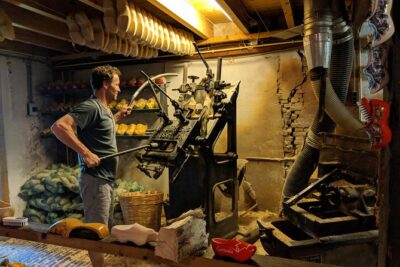
Countryside Bike Tour from Amsterdam: Cheese, Clogs & a Windmill
Read our review →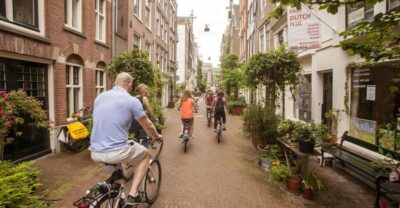
Windmill, Cheese, and Countryside E-Bike Tour
Read our review →
Browse the lists this tour appears in